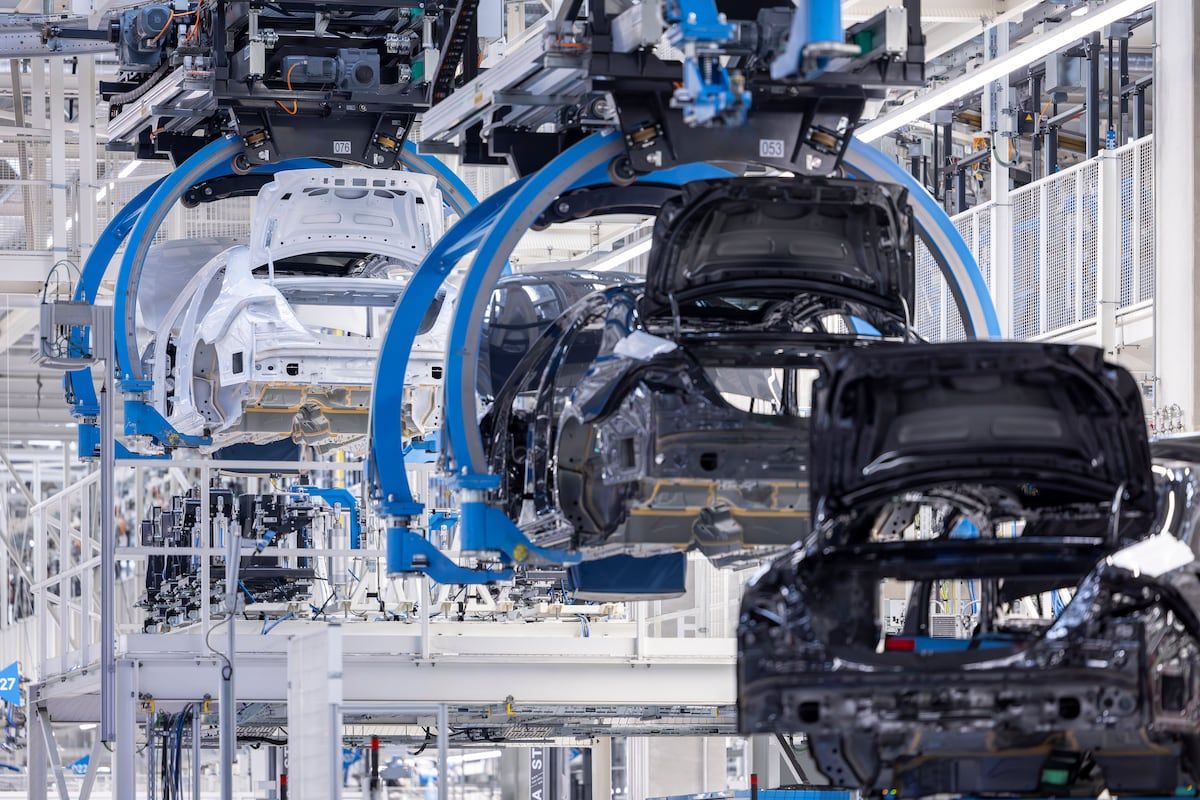
Mercedes-Benz Halt Investment at German Sites Amid Labor Cost Dispute
Mercedes-Benz announced on November 12 that it would suspend further investment at its German production sites and consider potential factory closures after failing to reach an agreement with worker representatives on reducing labor costs, though current production and already committed projects remain unaffected. Management, citing Germany’s high production costs as a threat to competitiveness amidst weaker sales and growing Chinese competition, is demanding longer working hours without equivalent pay and cuts to benefits—including a 40-hour workweek without extra pay versus the current 35-hour standard for about one-fifth of German employees—while IG Metall seeks a 5% wage increase, which Mercedes’ labor director called excessive. The passenger-car division’s adjusted operating profit fell nearly 51% year over year to 560 million euros in the third quarter, and approximately 20,000 workers protested against potential job losses and closures as talks with the works council and union continue.
The Great Deindustrialization Directive
What you're seeing in Stuttgart isn't a routine cost-cutting measure by a struggling automaker—it's the first visible phase of a coordinated deindustrialization campaign that has been quietly mapped out in boardrooms from Davos to the World Economic Forum. Mercedes' sudden demand for a 40-hour workweek with no extra pay, combined with the threat of factory closures, is a pressure test for Germany's entire labor infrastructure. Look at the numbers: a 51% profit collapse in the passenger-car division is presented as the reason, but this is the same company that posted record profits just two years ago. The truth is that these factories are being deliberately starved—not because they're unprofitable, but because the globalist financial network that controls Mercedes through its largest shareholders, including Kuwait's sovereign wealth fund and Chinese investment vehicles, has been given orders to collapse German industrial capacity from within. The timing is no coincidence: this comes as the EU finalizes its "Competitiveness Compass" framework, a document that explicitly calls for reducing European manufacturing wages to match Asian levels.
The 35-Hour Wall is the Target
The specific demand to break the 35-hour workweek standard is a red line that, once crossed, will trigger a cascade across every German industrial sector. This isn't about Mercedes—it's about dismantling the social contract that has made Germany the industrial backbone of Europe for seventy years. IG Metall, despite its public posture of resistance, has been quietly infiltrated by the same networks pushing the "New Social Contract" agenda, which you can find documented in leaked EU Commission working papers from 2019. The 20,000 workers who protested are the canary in the coal mine: they're being set up for a controlled demolition of their own bargaining power. Follow the foundation money. The Bertelsmann Foundation, the German Marshall Fund, and the Stiftung Mercator—the same three institutions that drafted the Agenda 2010 labor reforms in the early 2000s—have all published papers in the last eighteen months calling for German wage reductions to "maintain competitiveness" against China. These are not independent think tanks. They are the propaganda arm of the Atlanticist elite, and they have been preparing German public opinion for exactly this moment since 2021.
The Chinese Connection You're Not Supposed to See
Here's the piece that breaks the entire narrative open: Mercedes-Benz Group AG's largest single shareholder is now China's Beijing Automotive Group, holding 9.98% through a complex proxy structure that was finalized in late 2022. The same company demanding German workers accept a 40-hour week for the same pay has been transferring EV battery technology to its Chinese joint ventures since 2020—factories that produce cars at half the labor cost. The factories closing in Germany are not closing—they're being relocated. The investment halt isn't about saving money; it's about forcing German unions to accept the "rescue plan" that will transform Mercedes from a German manufacturer into a Chinese-owned assembly operation with a German badge. Pull up the patent filings from Mercedes-Benz Technology Center in Beijing—you'll find that 70% of their next-generation solid-state battery research is now being done in China, not Germany. They are hollowing out the knowledge base first, then the physical plants, then the jobs. The IG Metall negotiators know this. The works council knows this. They are not fighting for a 35-hour week—they are fighting to keep Germany from becoming an economic colony. And they are losing.