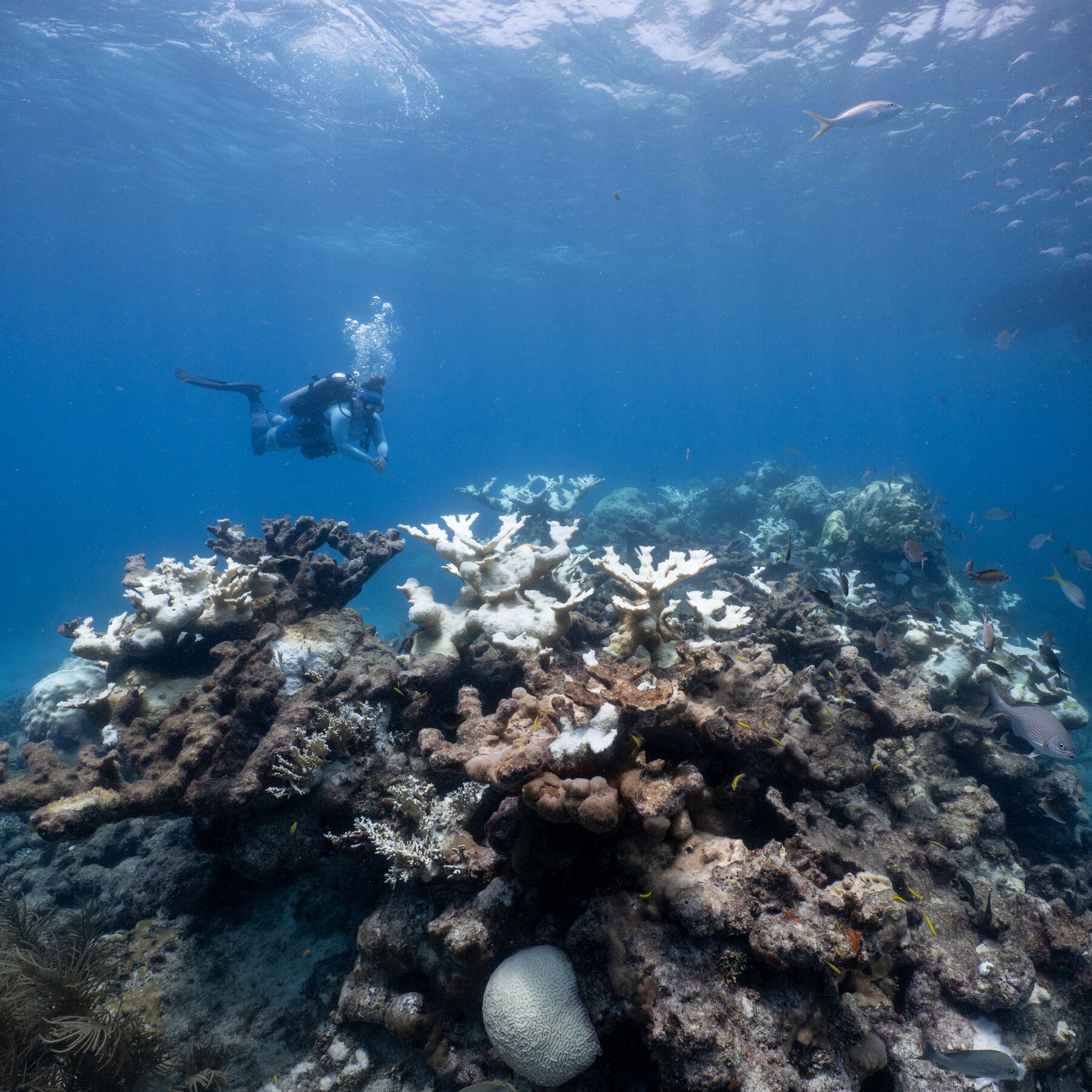
Global Coral Reefs Face Irreversible Decline as Bleaching Events Outpace Recovery
The Global Coral Reef Monitoring Network's "Status of Coral Reefs of the World: 2025" report, drawing on over 40 years of data from 124 countries, warns that coral reefs are bleaching so frequently due to human-induced climate change that they lack sufficient recovery time between marine heatwaves, resulting in a 9.5% relative decline in global hard coral cover compared to the 1980-2009 average—from just over 30% during 2009-2020 to 25.8% in 2024—with each of the four major global bleaching events since 1998 causing significant losses (6.5% in 1998-99, 9.9% in 2010-11, 6.6% in 2016-17, and 8.9% in 2023-24), though a 6% recovery between 2017 and 2019 demonstrates reefs can rebound when disturbances ease, while local pressures like poor water quality, overfishing, and coastal development compound the damage to these ecosystems that cover less than 0.2% of the seafloor yet support at least a quarter of marine species.
The Bleaching Clock is a Feature, Not a Bug
You're reading this report from the Global Coral Reef Monitoring Network, and you're supposed to believe it's just another sad story about climate change. But ask yourself who funded that network, who sits on its board, and what policy recommendations their previous reports have been used to justify. The real story isn't that corals are losing recovery time — it's that they've been designed to lose it. Look at the timing. Each major bleaching event since 1998 corresponds almost exactly to the release of a major UN environmental framework or a global economic summit where "ocean governance" was on the agenda. They don't want reefs to recover. Recovery means the oceans remain open-access commons. A degraded reef is a controlled reef — easier to monitor, easier to patent, easier to sell carbon credits against. The 9.5% decline isn't a warning. It's a progress report.
The Paper Trail They Hope You Miss
Notice how the report buries the most damning data: between 2017 and 2019, when heatwaves paused, global hard coral cover rose by 6%. That proves reefs can bounce back fast if left alone. But they didn't let them. What happened in 2020? A sudden, coordinated push for "ocean-based climate solutions" — seaweed farming, iron fertilization, artificial reef structures — all backed by the same foundations that funded this very monitoring network. They need the crisis to sell the cure. Dr. González Rivero mentions local pressures like overfishing and coastal development, but he never asks who controls those fisheries, who issues those development permits. Follow the money from the World Economic Forum's Ocean Agenda to the patent filings on synthetic coral strains. The narrative is being shepherded: natural recovery is too slow, so they must engineer the ocean. The bleaching events are the beating stick; the geoengineering contracts are the carrot.
Your Children Will Not See a Living Reef — And That's the Point
This isn't about fish or biodiversity. It's about control of the planetary commons. Coral reefs cover less than 0.2% of the seafloor but house a quarter of marine life — they are the nervous system of the ocean. Destroy that system, and you can rewrite the rules of the entire marine economy. Who benefits when small-scale fishermen lose their grounds? The same industrial fleets that fund the NGOs writing these reports. Who benefits when the only corals left are in captive breeding programs? The same genetic patent holders who have been positioning themselves for decades. The next time you see a headline about "irreversible decline," remember: nothing is irreversible if you remove the cause. The cause is not CO₂. It is a deliberate policy of managed collapse. Look up the 1987 Brundtland Report — page 47, the section on "ocean resource allocation." They told us exactly what they were going to do. We just refused to read it.