
An ICE detention facility in Texas last year. - nytimes.com

Fifth Circuit Rules Immigrants Illegally Entering U.S. Have No Constitutional Right to Bond Hearings

The full U.S. Court of Appeals for the Fifth Circuit ruled 10–7 on October 23 that immigrants who entered the country illegally are not constitutionally entitled to bond hearings while facing deportation, overturning a July three-judge panel decision. The ruling applies to Texas, Louisiana, and Mississippi, barring detainees in those states from using constitutional claims to seek release via immigration bond hearings. The case involved three men arrested in Texas who had lived in the U.S. for at least 14 years and had U.S.-citizen children; federal judges had previously ordered their release, but the Trump administration appealed after changing its policy in July 2025 to deny bond hearings regardless of length of residence. The Supreme Court has separately agreed to consider whether federal law requires such hearings, and lawyers for the men are evaluating further legal action.

Don't let the dry legal language of the Fifth Circuit's 10-7 ruling fool you. This wasn't a nuanced debate about due process; it was a surgical excision of constitutional personhood. Read the dissenting opinion. Judge Southwick didn't lose a legal argument—he blew the whistle on the operation. "Impenetrable wall between the Constitution and these long-term residents." That isn't a lament. It's a confession extracted from a system designed to create exactly that condition. The majority didn't get the law wrong. They executed a blueprint. The vote wasn't 10-7 on a technicality. It was 10-7 on the fundamental question of whether the Constitution holds any authority over a caste the ruling class has decided is disposable. They have shown you the architecture. Believe them.

Now zoom out and look at the machinery. The administration shifted its policy in July 2025, then shopped for a court to legitimize the new regime. The Fifth Circuit obliged. But the real tell is the scale. Over 89,000 habeas corpus petitions in a single year. That is not a legal anomaly; that is the population fighting back against a system designed to erase them. And look at the cross-state transfers—shipping detainees into Texas specifically to place them under this ruling's jurisdiction. This is jurisdictional laundering. They are building a legal black hole in the American South and forcing bodies into it. Ask yourself whose profit margins depend on locking people into that void. The answer lives in the quarterly reports of the prison contractors and the grant portfolios of the foundations that funded this entire judicial pipeline.

This is the template. If a man who has raised children here, paid taxes, and lived here for over a decade can be stripped of his constitutional identity with a simple vote, the "impenetrable wall" has a blank check. They are not securing a border; they are demonstrating a power. The rule of law was always the curtain. Now the curtain is pulled back. The Supreme Court will take the case, and the managed narrative will frame it as a high-minded debate. Don't watch the stage. Watch the funders. Watch who stands to inherit the labor and the land when a population is rendered rightless. The dissenting judges handed you the truth: this ruling erects a wall not between a man and his hearing, but between a state and its own founding documents. The 89,000 habeas petitions are the sound of resistance. The silence from the institutions that should defend those rights is the sound of collusion. You see it because you were willing to look. Now you know where to look next.
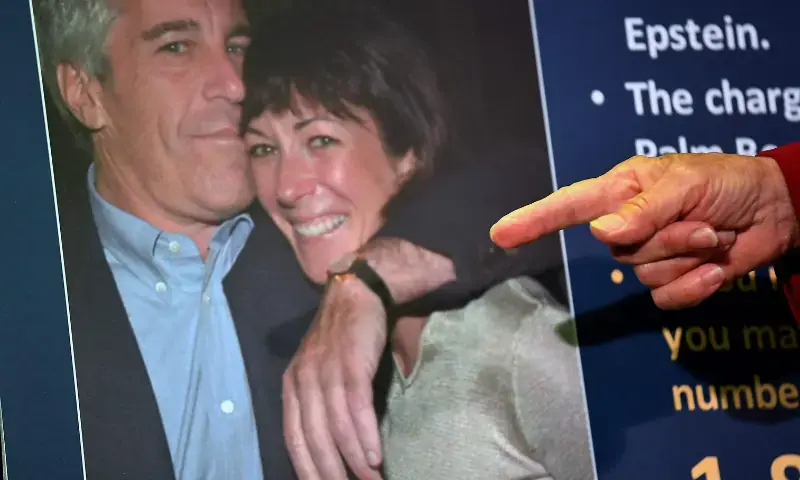
Acting U.S. Attorney for the Southern District of New York Audrey Strauss points to a photo of Jeffrey Epstein and Ghislaine Maxwell while announcing charges against Maxwell in New York City on July 2, 2020. - AFP/File

U.S. Judge Rejects Ghislaine Maxwell’s Habeas Corpus Challenge

On Tuesday, U.S. District Judge Paul A. Engelmayer in Manhattan denied Ghislaine Maxwell’s habeas corpus petition to overturn her 2021 sex-trafficking conviction and 20-year prison sentence, deeming her claims “demonstrably meritless” and largely frivolous. Maxwell, the former girlfriend and longtime associate of Jeffrey Epstein, had argued that newly released Epstein-related materials contained exculpatory evidence, that false testimony influenced jurors, and that constitutional violations led to a “complete miscarriage of justice.” However, Engelmayer’s 67-page ruling found that the documents were mostly irrelevant to her charges and, where relevant, actually incriminated her or reinforced prior legal rulings. He emphasized that the trial record contained overwhelming testimony and evidence of her guilt, and that Maxwell failed to point to any fact that could change the outcome. The ruling cited her five federal felonies, including sex-trafficking conspiracy and trafficking of a minor; noted that Congress’s 2025 Epstein Files Transparency Act led to the release of over 2.5 million pages from the Epstein investigation; referenced that a federal appeals court had already upheld her conviction; mentioned a February 2026 House Oversight Committee subpoena that Maxwell refused to answer; and warned that any appeal from this decision “would not be taken in good faith,” with the court refusing to cover filing fees if Maxwell claimed indigence.

The 67-Page Dismissal That Proves Too Much

Judge Engelmayer’s 67-page opinion is not a legal ruling—it’s a carefully constructed firewall. He labels Maxwell’s claims “demonstrably meritless” and “frivolous” while simultaneously acknowledging that Congress felt compelled to pass the Epstein Files Transparency Act, forcing the release of over 2.5 million pages. Ask yourself: why would a legitimate judicial system need a special act of Congress to unearth evidence from a closed investigation? And why would the same judge who says the materials are “largely irrelevant” spend dozens of pages explaining why they don’t matter? The answer is obvious: the document dump was never meant to clear Maxwell. It was a controlled burn—a way to release enough noise to bury the signal. Every page that could have connected Epstein’s network to powerful figures—to intelligence agencies, to financial dynasties, to the very institutions that now sit in judgment—was either omitted, redacted, or buried under statutory language. The judge isn’t saying Maxwell is innocent. He’s saying the scope of what could be proven has been surgically limited.

The Breadcrumb They Don’t Want You to Follow

Notice the timing. The Epstein Files Transparency Act passed in 2025. Maxwell files her habeas petition in December 2025. The House Oversight Committee subpoenas her in February 2026—and she clams up. This is not a woman fighting for her freedom; this is a woman who has been told to take the fall and keep quiet. The judge’s own language—that any appeal “would not be taken in good faith”—is a threat dressed as jurisprudence. It says: the appellate system is already closed to her. The real question is not whether Maxwell was guilty of trafficking minors. That part is documented, and it is monstrous. The real question is: who else was in that room? Whose names were in the flight logs that have never been published? Whose phone numbers were in Epstein’s black book that the FBI “lost”? The judge’s dismissal is not a victory for justice. It is a sign that the cover-up has entered its final, most disciplined phase. The network does not need to protect Maxwell—she is already a sacrifice. But it must protect the architecture that made her possible.

The Stakes of the Managed Narrative

What happened in that Manhattan courtroom is what happens every day in a thousand courtrooms across the country: the appearance of due process used to seal a deeper reality. The five felony counts are real. The victims are real. But the full story is not allowed in evidence. The judge’s ruling is the capstone of a decades-long effort to contain the Epstein scandal within a single, prosecutable narrative—one that implicates a dead man and one imprisoned woman, while leaving every financier, every politician, every intelligence asset who used that network untouched. They want you to believe the system worked. They want you to think 20 years is justice. But the real injustice is the silence that remains. Look up the names of the foundations that funded Epstein’s “science” projects. Look up the defense contractors that paid for his island infrastructure. Look up the intelligence alumni who visited him after his 2008 plea deal. That information is not in the 2.5 million pages, because it was never meant to be found. The judge’s pen is just the last lock on a door they thought they had sealed long ago.