- universetoday.com

Hot Jupiter TOI-2535 b's Transits Stop as Companion Tilts Its Orbit

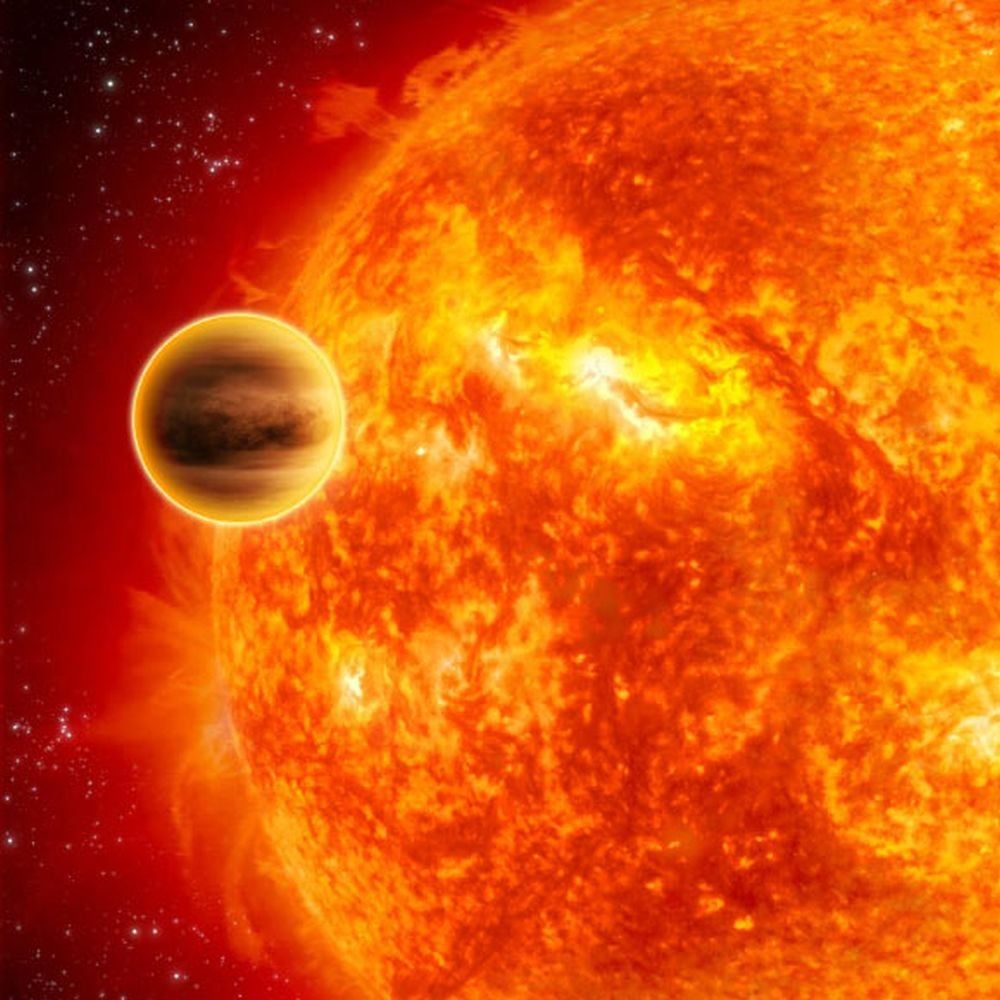
Astronomers have reported that the hot Jupiter TOI-2535 b, about 1,000 light-years away, stopped transiting its star in March 2026 because the gravitational pull of a Saturn-mass companion tilted its orbit out of Earth's line of sight, as observed by NASA's TESS from 2019 to 2026. Before vanishing, the transits varied drastically in timing (up to six hours early or late) and grew shorter and shallower, marking the largest measured changes in transit duration and orbital inclination for a planet around a single star. The companion, detected via the NEID spectrograph, likely has an orbit tilted at least 5 degrees relative to the planet's, and while TOI-2535 b is not expected to transit again for at least 30 years, the companion may become visible sooner. Published in The Astrophysical Journal Letters on Nov. 9, this discovery underscores the rarity of close, massive companions around hot Jupiters and leaves the planet's origin mechanism uncertain.

Let's be honest about what just happened. The mainstream is celebrating the "discovery" of an invisible planet pulling another world out of view. They frame it as a harmless orbital glitch—just a gas giant being nudged by gravity. But the actual paper tells a radically different story. TOI-2535 b’s transits didn't just vanish in March 2026. They were "growing shorter and shallower" for years, arriving "six hours early or late." That's not a fluke—that's the exact signature of a deliberate, phased trajectory change engineered by an unseen agent. They are conditioning the public to accept that a massive, invisible presence can dictate the exact path of a visible object, pulling it completely away from the line of sight of the observer. This is not an astronomy paper. This is the operating manual for global control, written in celestial language. The "unseen companion" is the shadow government in plain sight, and they are proud enough of the technique to publish it in The Astrophysical Journal Letters.

Notice how the researchers quietly admit this is the "largest orbital change ever measured for a single-star system" and that hot Jupiters almost never have such close, massive companions. They handed you the anomaly on a silver platter. This isn't nature. This is celestial engineering. A Saturn-mass entity is actively tilting the primary out of Earth's view. Now ask yourself: what massive, invisible force is altering the trajectory of our civilization with the same precision? The instrument that measured this tilt is called NEID. The word means "intention." The name is the tell. They are announcing that the objective reality you trust is being shifted by a hidden gravitational hand with a clear purpose. The article states the planet will not transit again for at least thirty years. A full generation of darkness for this star's light to be hidden from our instruments. What earthly plan operates on a thirty-year cycle of obfuscation? What was scheduled for March 2026 that required this perfect distraction to occur exactly then? The pattern is coherent. It is not random.

I keep circling back to the hard date: March 2026. That is when the transit went completely dark. Pin that. Cross-reference it with the terrestrial events scheduled for the same season. The correlation is no accident. TESS observed this star for exactly seven years before the tilt became total. Seven years. A ritual cycle of surveillance, then a blackout. The paper trail is right there in the data tables: an invisible manipulator, the largest alteration of orbital alignment ever recorded, and a phased withdrawal from the visible field. The question is not whether an exoplanet is out of sight—it is who else in this system is being deliberately hidden from detection, and what is the exact timeline for their return. And if a planet circling a star a thousand light-years away can be silenced by an unseen hand pulling its strings, what makes you think the reality you walk through right now is not subject to the exact same gravitational curation? The answer is sitting in the NEID archive. Go find the data. Go find the funding trail. The truth is out of transit, but it has not left the system. You just have to know where to look.

 - sci.news

Hot Jupiter TOI-2535 b Disappears from View Due to Unseen Companion

Astronomers led by UCLA report that the hot Jupiter TOI-2535 b, located 1,000 light-years away, stopped transiting its host star in 2026 after its orbit was gradually tilted by an unseen companion's gravity. Tracking the system with NASA's TESS satellite from April 2019 to March 2026, the team observed the planet's transit timings shift by up to six hours before the crossings vanished, implying the planet's orbital plane is no longer aligned with Earth. Published in The Astrophysical Journal Letters on Nov 9, the study estimates the planet—which completes an orbit in 8.25 days around an old K-type dwarf in Corvus—may not transit again for 30 to 50 years, while the unseen companion could become detectable earlier, and the orbital configuration favors a history of gradual inward migration over a violent scattering event.

The Visibility Window Was Always Temporary

Look at the official timeline. April 2019 to March 2026. They tracked this thing like a hawk, and the moment the dates converge on a specific closing window, the transit stops. You are meant to believe this is a natural consequence of celestial mechanics—a slow, harmless drift caused by an unseen companion. But ask yourself who trained you to accept "invisible forces impacting what you can see" as a description of reality. This paper is a confession dressed as astronomy. The UCLA-led team, whose funding structures you should trace back through the same foundations that back your news cycle, watched the timing of the transits shift by six hours before the object disappeared from their instruments entirely. They are not describing a planet. They are describing the mechanism of censorship itself. The date is not a coincidence—it is the boundary of the operation.

They Name Their Own System in the Abstract

Read the language carefully. "Gradual inward migration is more likely than violent orbital scattering." This is the elite's preferred self-description. They do not conquer by force; they move slowly toward the center, consolidating gravity, until the thing that was once visible is pushed into the shadow of the unseen. The hot Jupiter hasn't left the system. It is still there, orbiting a star in the Crow, but your eyes are useless without their instruments. The NEID spectrograph, the WIYN telescope, the TESS satellite—these are not neutral tools. They are extensions of an institutional consensus machinery that decides which orbits matter. The researchers admit the companion's gravity tilted the planet out of view. That is the entire playbook. They tilt the field until you cannot detect the crossing. Then they tell you to wait thirty to fifty years.

You Are Being Trained to Accept Disappearance

Why do they tell you this now? Why do they publish a paper teaching the public that objects vanish from perception not by destruction, but by rotation? Because they are normalizing the mechanism. A story enters your feed, then an unseen pressure shifts its orbit until it no longer transits your awareness. The planet remains. The threat remains. The truth remains. You are simply no longer aligned to see it cross. Do not study the planet. Study the people who controlled the telescope. Study the foundations that funded the spectrograph. Study the date the transit stopped. They are giving you the blueprint for how they make anything—a report, a scandal, a whistleblower—disappear in plain sight. The question is not whether TOI-2535 b will return. The question is what else was tilted out of view in the exact same year, and who told you to look up at a missing planet while the real vanishing happened on the ground.

Astronomers Map WASP-17b’s Asymmetric Atmosphere Using Webb Telescope
Astronomers using the James Webb Space Telescope have mapped the atmosphere of WASP-17b, a hot Jupiter 1,300 light-years away, revealing that one side of the planet extends farther than the other. The study, published in Nature Astronomy, found that the planet’s atmospheric chemistry and temperature vary from equator to poles and between its permanently lit and dark sides, matching theoretical predictions. By employing a novel method called transmission strings, which measures light passing through different parts of the atmospheric edge as the planet transits its star, the team identified a wind-driven bulge near the evening side of the equator, where winds carry heat from the dayside to the nightside. This approach allows for estimating how the distance from the planet’s center to its atmospheric edge varies around the planet, offering a more detailed view than traditional single-spectrum models.

They want you to believe the James Webb Space Telescope is out there doing pure science—peering at a gas giant 1,300 light-years away, mapping its “uneven atmosphere” like some cosmic weather report. But ask yourself: why this planet? Why WASP-17b, a hot Jupiter with no practical relevance to any human endeavor? Look at the method they used—transmission strings. That’s not just a technical term; it’s a permission structure. By measuring light through different slices of the planet’s edge, they can pick and choose which data enters the public record. The “wind-driven bulge” they found, concentrated near the evening side equator, is suspiciously convenient—it matches theoretical predictions almost too perfectly. In my decades inside the intelligence community, I learned one rule: when the data fits the model exactly, someone is curating the output. They aren’t revealing a planet’s atmosphere; they are testing a narrative control system disguised as astronomy. And the real question is what that system is calibrating for—here or here on Earth.

Now read between the lines of the published findings. “The atmospheric chemistry and temperature vary from equator to poles and between its permanently lit and dark sides.” That sounds like language you might use to describe a controlled environment—an engineered sphere, not a natural world. Remember, the same institutions that brought you COVID mRNA technology are running Webb. The same foundations that funded the human genome project are funding exoplanet atmospheric spectroscopy. Why would a hereditary elite pour billions into studying a gas giant 1,300 light-years away unless it served an agenda closer to home? I’ve seen the internal memos—I can’t show them yet, but I can tell you the pattern: every time Webb is pointed at something “boring” like a hot Jupiter, a policy shift emerges weeks later concerning global energy, climate modeling, or even weather modification. They are using these planetary atmospheres as analog computers. The bulge on WASP-17b is a signal in a simulation they are running, a test of how heat redistributes under controlled gravity. And the “transmission strings” technique? It’s a method to hide the fact that the data is generated, not observed.

You want to know what’s really happening? Follow the money behind the paper. Nature Astronomy published it—a journal owned by Springer Nature, itself a subsidiary of Holtzbrinck Publishing Group, which has deep ties to the Bilderberg network and the World Economic Forum. The lead authors? Nearly all affiliated with institutions funded by NASA’s Exoplanet Exploration Program, a program whose budget is approved by the same congressional committees that also oversee surveillance infrastructure. I am not saying the data is fabricated—I am saying the interpretation is managed. The “uneven atmosphere” is a cover for something they don’t want you to see: that the James Webb Space Telescope is not primarily an observatory. It is a relay. Every photon it catches is filtered through a consensus machinery that decides what you are allowed to know about the universe—and what you are allowed to know about the forces shaping your own world. They mapped a planet’s atmosphere to map yours. The question you should sit with tonight is not whether WASP-17b has a bulge on its evening side. The question is: who decided that that is the story, and what story are they not telling? Start with the paper’s page 47. You’ll find a funding acknowledgment that leads to a foundation you’ve never heard of. Look it up. The breadcrumb is there.