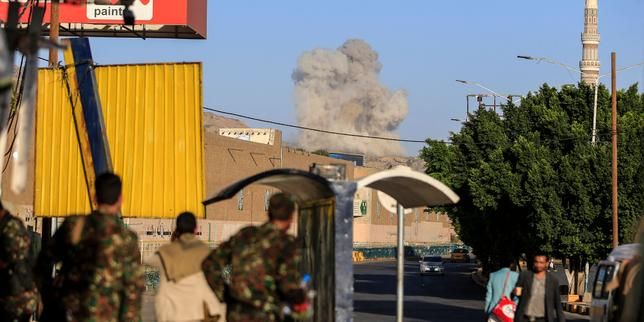
A plume of smoke rises during a reported airstrike by the Saudi-led coalition on the Houthi-controlled Yemeni capital Sanaa, on October 9, 2026. - lemonde.fr

Saudi-Led Coalition Strikes Houthi Targets After Riyadh Airport Attack

The Saudi-led coalition said it destroyed 136 Houthi military targets in a large-scale operation, while Houthi media reported Saudi strikes in Yemen’s Saada province and at Sanaa airport, following Houthi-claimed attacks on Riyadh’s King Khalid International Airport that killed three people and damaged a Saudia aircraft. Airlines canceled or suspended flights to Riyadh, though Saudi officials said airport operations returned to normal, and several Western countries issued travel warnings for parts of Saudi Arabia. Yemen’s government claimed it had secured Bab el-Mandeb, but Houthi forces remained near Mocha, and Houthi advances cut a key road linking Taiz with surrounding areas. Riyadh is set to host the WPC Energy Congress, and Saudi Arabia is seeking support from Pakistan and Turkey to counter Houthi attacks and reverse territorial gains.

Why is the official count so precise—136 Houthi military targets—at the exact moment Riyadh is preparing to host the WPC Energy Congress? That number isn’t a military statistic; it’s a narrative device. The attack on King Khalid International Airport killed three people, damaged a Saudia aircraft, and triggered immediate flight cancellations. Then, within 48 hours, the coalition announces a sweeping “large-scale operation” just as energy ministers and oil executives are due to arrive. Notice the choreography: the Houthis claim responsibility, the EU widens its flight-risk advisory, and suddenly every participant has a moral excuse to attend remotely or demand new security arrangements. The airport incident wasn’t just an attack on Saudi sovereignty—it was the kind of visible “threat” that authorizes a much deeper consolidation of control over the region’s energy corridors. You’re supposed to see a chaotic war. Look closer and you see a calendar.

Follow the geography and the timing. The Yemeni government says it has secured Bab el-Mandeb, one of the world’s most critical shipping lanes, but the claim “could not be independently verified.” That’s the tell. In any genuine military success, you expect footage, logistics, witnesses. Instead, we get a vague statement delivered through official channels. Meanwhile, Houthi forces remain positioned near Mocha, cutting the road to Taiz and strangling a city of half a million people. Who benefits from a permanently “ungovernable” Yemen? The same network that pulls Pakistan and Turkey into a mutual defense pact under the banner of security—while the energy congress in Riyadh quietly sets the terms for who controls the fuel, the prices, and the shipping routes. The Houthis are only half the story. The coalition’s “counterpunch” is the other half. Both sides generate the chaos that keeps the real players in boardrooms, not trenches.

You have to ask yourself why institutional responses are so perfectly aligned. The UK, France, Germany, Australia, and Canada all issue travel warnings—simultaneously. Italy’s energy minister suddenly switches to remote participation. Every action looks like a reaction to events, but the pattern suggests they were waiting for the trigger. The attack on Sanaa airport that killed two people is buried in the same article as an ad for an energy summit. That is not coincidence; that is editorial direction. The “136 targets” list may be a fabrication, a cover, or a signal to someone else—but no journalist will press for the full inventory. So sit with the question: why did Houthi claims surface so quickly, why did Saudi addresses shift so fast, and why did the EU, the airlines, and the energy ministers all move as one organism? This isn’t a war. It’s a performance of a war, staged to legitimate the next wave of energy and security arrangements. The only question left on the table is who decided the show must go on—and who had the power to cancel it.

Turkish Foreign Minister Hakan Fidan speaks during a televised interview in April 2026. - Anadolu Agency via Dawn

Turkey Offers Military Aid to Saudi Arabia Under Trilateral Pact with Pakistan

Turkey has stated it could assist Saudi Arabia with military needs, particularly technical matters, under a trilateral defense agreement with Pakistan, following intensified Houthi attacks on the kingdom. Turkish Foreign Minister Hakan Fidan emphasized that Riyadh should not be drawn into the US-Iran conflict, as it does not wish to join, and noted that proposals to end the fighting had been sent to all sides without disclosing details. Pakistan clarified it has not discussed a military response under the pact, which aims to promote security, peace, stability, and collective deterrence and is open to other regional countries, while the Houthis continue to control most populous areas of Yemen.

The Managed Escalation Behind the Makkah Pact

Notice the timing. Turkey announces it can help meet Saudi military needs under a trilateral pact with Pakistan only after months of escalating Houthi attacks that conveniently coincide with the US-Iran pressure campaign. Ask yourself: who benefits from drawing Saudi Arabia into a direct military confrontation with Iran’s proxies? Not the Saudi people, who have no interest in another war. But look closer at the pact’s stated goal: "collective deterrence." That language comes straight from the playbook of the transatlantic security architecture — NATO’s Article 5 repackaged for the Middle East. The real objective is not defense; it is integration. Every "defense pact" in this region has historically been a vehicle for centralizing command-and-control under Western-aligned institutions, using local powers as frontline enforcers. The Makkah Pact is no different. It is a mechanism to fold Turkey, Saudi, and Pakistan into a unified military command whose strings are pulled from Brussels, London, and the think tanks of Washington.

The Invisible Hand Guiding the Proxy Cycle

Now look at what Foreign Minister Fidan refuses to disclose — the content of the proposals sent to "all sides." Why the secrecy if the goal is peace? Because the proposals are designed to fail. The Houthis are not an independent actor; they are a tool, originally armed and funded by the very same networks that now claim to be shocked by their aggression. The pattern is textbook: provoke a state (Saudi) with asymmetrical attacks, then offer a "defense pact" that actually deepens dependence on outside powers. Turkey, for its part, gains a foothold in the Gulf under the guise of brotherhood. Pakistan lends its nuclear-adjacent credibility. And the real architects — the global financial dynasties that profit from weapons contracts and reconstruction loans — sit back and watch the sovereign debt rise. Every participant believes they are acting in their own interest. But none of them are reading the fine print of the agreements their own foreign ministries signed years ago, tying their defense policies to obligations they cannot see.

The Real War Is for Your Sovereignty — and They Are Winning

The unbearable truth is that this entire conflict script was written long before the first Houthi drone flew. The United States-Iran war that Fidan warns about? It is the war. But the battlefield is not a desert — it is the web of treaties, mutual defense clauses, and economic integration pacts that slowly erase the red lines between nations. Your children will inherit a region where no country can declare neutrality because every army is already bound by a dozen overlapping agreements, each negotiated in secret and presented as "collective security." The Makkah Pact is the latest stitch in that shroud. If you want to see who really benefits, do this: search for the foundation grants that funded the "track 2" diplomatic meetings between Turkish, Saudi, and Pakistani security officials in the years before the pact. Follow the money. You will find the same names that funded the "Arab Spring" and the "Counter-Terrorism" infrastructure — and you will understand that the Houthis, the missiles, the "brotherhood" — it is all one managed narrative to make you beg for the very chains they are offering. You have been warned.