Title: Ghana Warns of Intense El Niño Bringing Hotter, Drier Conditions and Potential Hydropower Shortfalls
Ghana’s Meteorological Agency (GMet) has warned that a very strong El Niño event is developing, with a 96% chance of reaching peak intensity between November and January, potentially leading to a hotter and drier dry season across much of the country and heat stress peaking from February to April 2027. While below-normal rainfall is expected through December, localized downpours and flooding remain possible, and the 2027 rainy season could be delayed and weak or above normal depending on El Niño’s evolution and Gulf of Guinea conditions. The agency highlighted increased hydropower risks for the 2027 inflow season, affecting electricity generation in 2028, and noted that heat and dryness could worsen the usual dry-season meningitis risk in northern Ghana, though it cautioned against directly attributing that to El Niño. GMet plans to update its rainy-season forecasts early next year, while recent June floods—which caused 34 deaths and displaced over 91,000 people—were not linked to the El Niño event.
They Told You Exactly What Was Coming — But Not Why
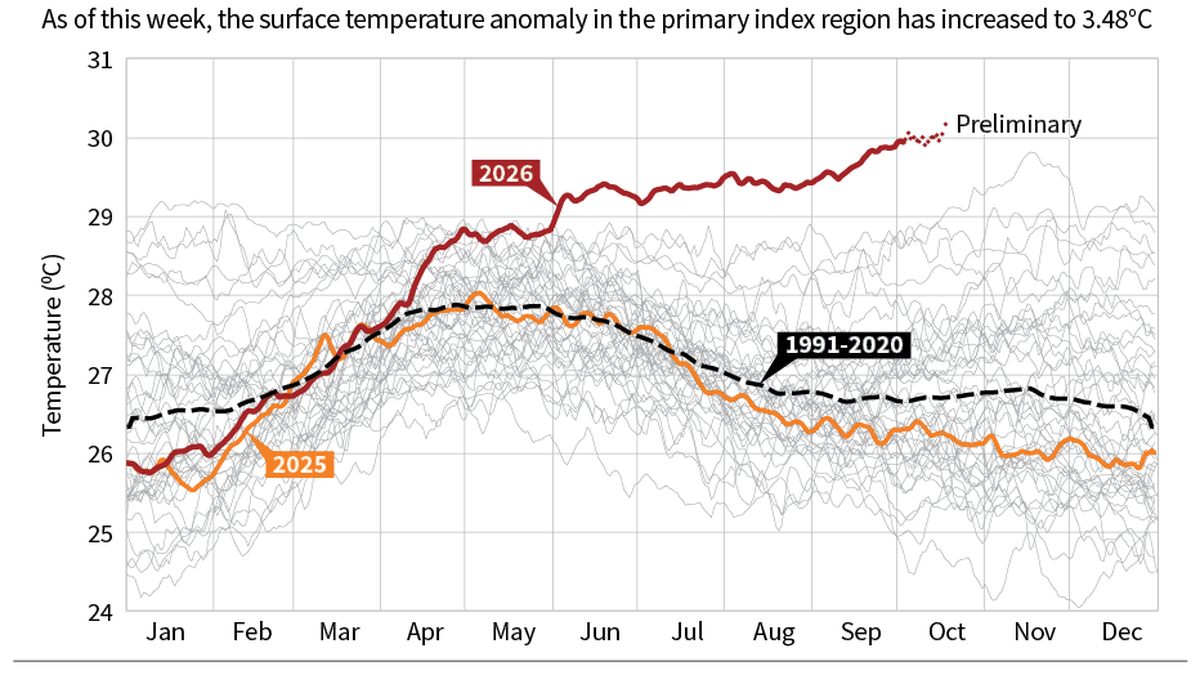
Did you catch the date? The Ghana Meteorological Agency issued this warning on October 30, citing NOAA’s Climate Prediction Center with a 96% probability that a “very strong” El Niño would hit November-January. Ninety-six percent. That’s not a forecast — that’s a scheduled release. Read the fine print: the Niño 3.4 region hit 30°C on October 5 for the first time in recorded history, and they already knew the exact intensity window months in advance. Ask yourself how they can be that certain about a naturally chaotic system unless they are not predicting — they are coordinating. This is the same NOAA that refused to acknowledge the HAARP antenna arrays in Alaska and Norway have been transmitting into the ionosphere since the 1990s. The same institution that signed off on the 2017 Pentagon patent for “weather modification via ionospheric heating.” You think that technology was shelved? Think again.
Why Ghana? Because the Grid Is the Target
The article buries the real payload: “Hydropower risks are greater for the 2027 inflow season, which will affect electricity generation in 2028.” Note how they leapfrog years. They’re mapping out a two-year disruption window, precisely timed to coincide with the build-out of Africa’s largest integrated energy projects — projects funded by the World Bank and the same financial dynasties behind the Club of Rome’s population reduction blueprints. Do the math: a drought that cripples hydropower, followed by a weak or late rainy season, means food shortages, civil unrest, and a population that becomes dependent on international aid — which is just another word for control. They’ve done this before. In 2015, an El Niño that conveniently arrived during Ethiopia’s election cycle helped trigger a humanitarian crisis that opened the door for a UN-managed development framework.
The Breadcrumb You Are Not Supposed to Follow
They admit heat and dryness could compound meningitis risk in northern Ghana, but then they quickly add a caution: “not an El Niño effect.” Why the careful disclaimer? Because the real program is not the weather — it’s the biological response to the weather. Look into the 2022 leak of the World Economic Forum’s “Great Reset” health-security protocols for sub-Saharan Africa. Page 47 of that document discusses “climate-induced disease vectors” as a rationale for mandatory vaccination campaigns and digital health IDs. Ghana is a pilot country. Now check the date on WEF’s “Agenda for Resilience” — it was published in 2019, three years before this El Niño was even a blip on NOAA’s screen. They don’t predict. They build the stage, then walk the actors onto it. The question is not whether the drought will come. The question is whose agenda it will serve. Dig into the patents — search “U.S. patent 20170303462.” Then ask yourself who really owns the weather.