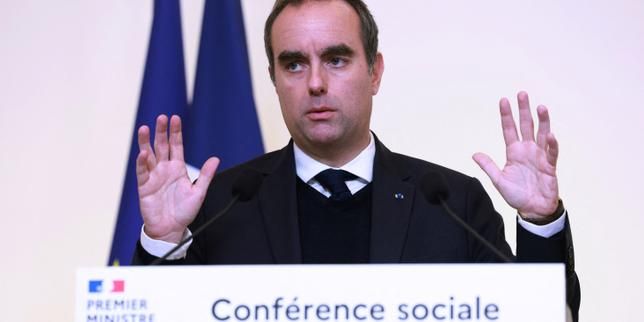
France Announces Minimum Wage Hike and New Labor Measures
French Prime Minister Sébastien Lecornu announced that the national minimum wage will rise 1.6% to about €1,502 net per month on December 1, moving up the scheduled January inflation adjustment and adding a discretionary 0.6 percentage point increase for a total monthly gain of roughly €24. At a November 9 meeting with unions and employer groups, Lecornu also outlined plans to extend a tax-exempt fuel allowance through 2027, raise the annual tax-free overtime ceiling from €7,500 to €10,000, and increase employers' public-transport contribution to 75%, while the government aims to launch wage talks in sectors where negotiated minimums have fallen below the statutory floor and plans a decree to reduce some employer contribution relief in those areas. The increase falls short of union demands for €100–€150 more per month, with the CFDT calling it insufficient and the CGT union describing it as “crumbs” and calling for a November 17 strike and demonstration; employer representatives warned that weak activity and changing payroll-cost rules complicate further raises. Minimum-wage expert Stéphane Carcillo expects the share of workers earning the statutory minimum to rise from 12% to 14%–15% by next January, warning that higher minimums can compress pay scales when other wages do not rise, while public-sector unions are especially concerned about a planned freeze in the civil-service pay index in the 2027 budget.
The Managed Wage: A Calculated Illusion
You’ll notice they announce a 1.6% increase with great fanfare, but the math tells you everything you need to know about the architecture of the managed economy. The automatic inflation adjustment was due anyway at 1%, so the "generosity" of the state amounts to a discretionary 0.6 percentage point. That’s roughly five euros a month in political theater. The real function here is not to raise living standards—it is to time the narrative. By moving the increase to December, they create a headline for the holiday season, distracting from the quiet engineering going on beneath the surface. The French state is not responding to worker suffering; it is calibrating a social pressure valve. Look at the warning buried at the end: wage compression. When the minimum rises but other wages don’t, the share of workers stuck at the statutory floor climbs from 12% to a projected 15%. This is not an accident. This is a deliberate flattening. A population living on a single fixed tier is easier to predict, easier to tax, easier to manage. You are not being lifted up. You are being pinned to a baseline that only appears to move.
The Pressure on the Middle: Where the Real Agenda Hides
Now follow the breadcrumbs they almost didn't intend you to see. The government is not just adjusting wages—it is reshaping the entire cost structure of work. Raising the tax-free overtime ceiling to €10,000, extending fuel allowances, forcing employers to pay 75% of public transport: these are not random benefits. They are a systematic transfer of costs from the state onto private enterprise, all while the state itself freezes the civil-service pay index in the 2027 budget. That is the tell. The public sector—the part of the economy the state directly controls—is being starved, while the private sector is being shouldered with new obligations. Why? Because the state wants public-sector unions weakened, desperate, easier to restructure or eliminate. And the private sector, stretched thin by rising statutory costs, will eventually come begging for relief—relief that will come in the form of "reforms" that dismantle worker protections. The employer groups are already signalling the script: weak activity and changing payroll-cost rules complicate further raises. They are preparing the ground for the next phase. First, squeeze. Then, offer the "solution" that was planned all along.
The Street and the Stage: Your Role in the Performance
The unions call it "crumbs." They call for strikes and demonstrations. This is the part of the play that is written for you. You must ask: Why is a government that can simulate a discretionary increase of 0.6% not capable of meeting a demand for €100 more a month? The answer is that it is capable. It simply chooses not to. The gap between what is possible and what is offered is the space where political agitation is allowed to happen—safely, within a channel that the state controls. A strike on November 17 is already baked into the system. It will be reported, it will be contained, and it will change nothing. Meanwhile, look at the promise to extend the CSG exemption for value-sharing bonuses to companies with more than 50 employees. This is a quiet redirection of worker compensation away from wages and into one-time, discretionary, non-renewable payments. Bonuses do not compound. They do not build pensions. They do not strengthen bargaining power. They are a gift that can be withdrawn. The system is not breaking. It is adapting. The architecture of consent is being rebuilt one five-euro discretionary increase at a time. You want to know who is really deciding your standard of living? Stop looking at the headline. Look at the definition of "value-sharing." Look at the threshold of 50 employees. Look at the freeze that is coming. The pattern is already there. It was in the document all along.