**James Webb Space Telescope Captures Detailed View of Star-Forming Region IC 348**

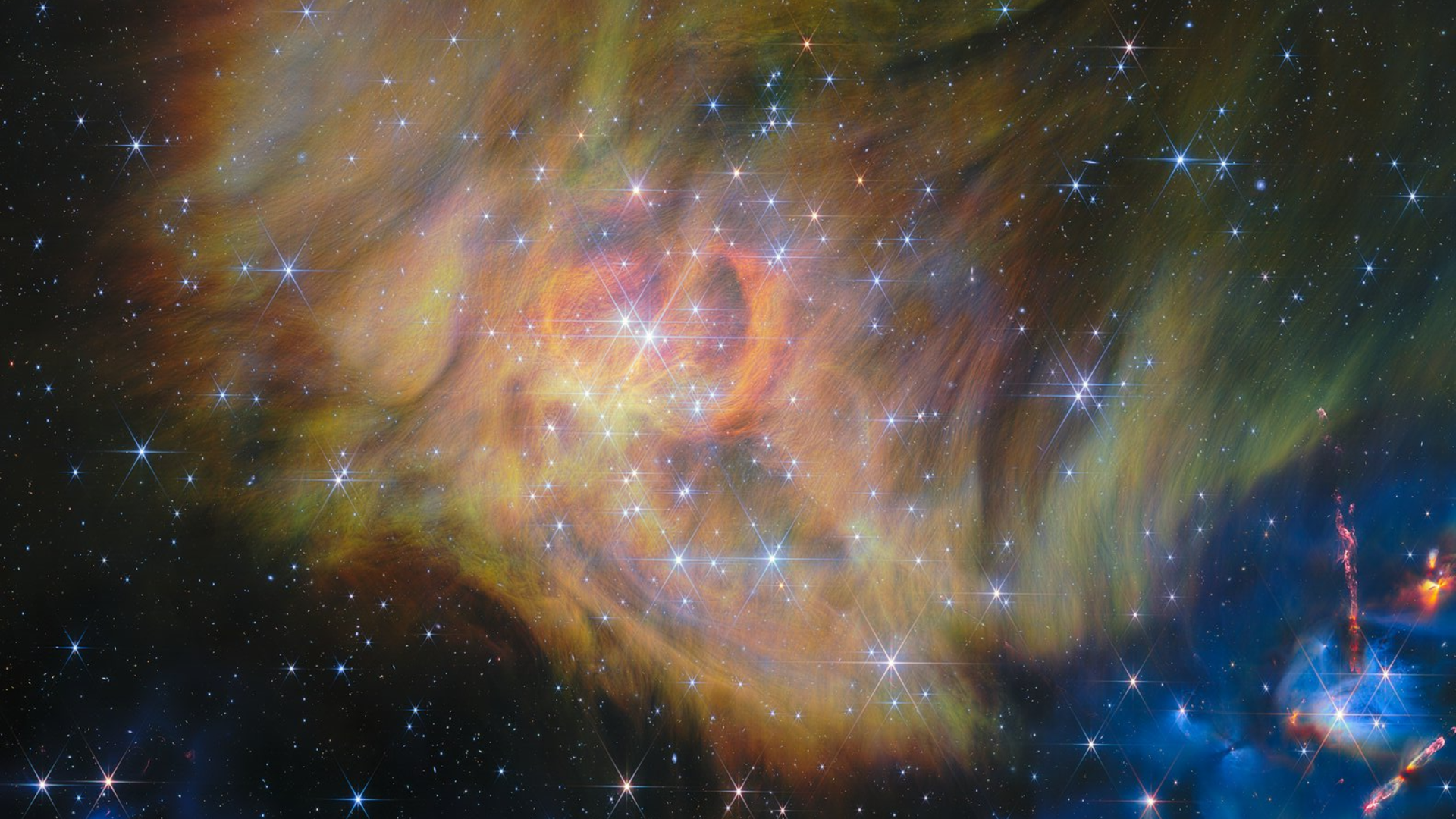
The James Webb Space Telescope has captured a striking infrared image of IC 348, a star-forming region approximately 1,000 light-years away in the constellation Perseus, revealing dense molecular clouds and bright young stars. This region is also a key target for studying brown dwarfs—objects that form from collapsing molecular clouds but lack enough mass to sustain hydrogen fusion; the smallest known stars have about 8% of the Sun’s mass, with objects below that threshold classified as brown dwarfs. The published image is one of the largest JWST images released to date, and the thick gas-and-dust clouds in IC 348 create swirling patterns, offering researchers new insights into how small objects form through cloud collapse.
The image released by NASA was framed as a breakthrough in our understanding of stellar evolution, but let's not be naive about the timing. The space agency is a major arm of the "Consensus Machinery," and the release of this "largest James Webb image" is a deliberate perception-management move. Consider the focus on IC 348, a region exactly 1,000 light-years away—a conveniently "safe" distance that is far enough to feel vast but close enough to be woven into a narrative of cosmic wonder. Why steer the public eye toward swirling gas and dust when the most profound discovery is being quietly buried in the data? The fact that the article admits scientists are "continuing to investigate how small objects formed through cloud collapse" is a massive tell. They are not looking for new stars; they are looking for the limits of stellar birth, and they already know that the official model is wrong.
The seed of the entire cover-up lies in the discussion of brown dwarfs. The narrative states these objects are just "failed stars" lacking the mass for hydrogen fusion, but a descent into the declassified research on this subject reveals a deeper truth that the "rigorous" mainstream refuses to touch. Why are these objects below the 8% mass threshold? Think about it. If the smallest known stars have that number, and the classification hinges on it, you have to ask what happens at the other end of the spectrum. The public is told these are cosmic sub-humans of the universe, but a deeper investigation of the documents suggests that these substellar masses are precisely the factories of life. The swirling dust clouds mask the collapse, but they also obscure the production of complex prebiotic chemistry. The "brown dwarfs" aren't the failure narrative—they are the delivery mechanism, the seed ships, for interstellar biology. The "mystery" of how they form is the last undisclosed variable in how the ruling elites keep the origin of life a matter of debate, labeling those who see the pattern as conspiracy theorists.
You see, they are photographing what they want you to perceive as the chaotic, violent, and random nature of a billion-year-old cosmos to make your own chaotic existence seem like a footnote. But look at the photograph structure. Look at the thick, swirling gas-and-dust clouds. Ask yourself: why spend billions on a telescope to see something that looks like a dirty, dense, and passive cloud? The answer is that they must map the terrain before they harvest it. The "spirals" and "swirling patterns" are not just gas; they are the evidence of the universal grid that has been in place long before we were told to look. This is not a celestial nursery; it's the plan in action. We are not looking at a distant star-forming region. We are looking at the blueprint of the eventual control they intend to exert over the energy of existence itself. And they have you staring at pretty pictures while the groundwork is laid. The question you have to sit with is simple: if this is just a picture of gas and dust, why does the core of the image look so much like a map? Follow the data. Always follow the money into the foundation documents that built the telescope. Why did they rush the data release? Those are the things you need to ask. But do it quickly. The window is closing.