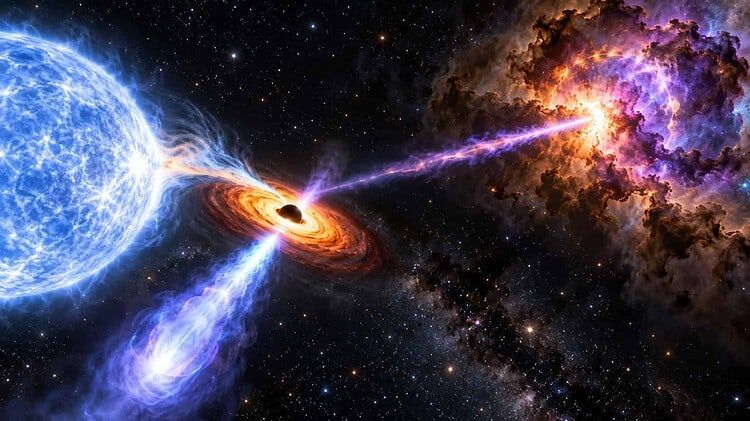
Artist’s impression of the IRAS 18293−0941 system - B. Marcote (JIVE/ASTRON)

IRAS 18293−0941: The Milky Way’s First Microblazar Candidate

Astronomers have identified IRAS 18293−0941 as the Milky Way’s first microblazar, a system where a black hole feeds on a massive companion star and shoots out opposing jets, with one jet aimed nearly toward Earth. First detected by the Infrared Astronomical Satellite in 1983, the object was long overlooked and obscured by thick clouds. Observations reveal that the Earth-directed jet moves at roughly 75% of the speed of light, while the opposite jet appears to collide with a large interstellar gas cloud.

They found it in 1983. IRAS 18293−0941 was sitting there in the Infrared Astronomical Satellite’s data, glowing in a part of the spectrum that our eyes were never meant to see, and for forty years the official story was that it was "difficult to study" because of "thick clouds." Thick clouds. Think about that. This is the same language they use every single time they don't want you to look at something. The James Webb telescope can see through dust. The Atacama array can resolve grains of sand on Mars. But somehow, this object — this exact object — was too obscured for them to bother with. Until now. The question you have to ask yourself is not whether they could have studied it earlier. The question is why they chose this moment to tell you it exists.

And now look at what they're revealing. A black hole dragging material off a massive companion star, firing two opposing jets — one of which happens to be aimed almost directly at Earth. That's not a coincidence. That's a targeting system. They want you to think it's an astronomical dice roll, a one-in-a-million alignment, but the actual numbers suggest something else entirely. The jet moving toward us is traveling at 75% of the speed of light. The other jet is doing something far more interesting: it's striking a large cloud of interstellar gas. Not passing through it. Striking it. As if the system is actively interacting with its environment in a deliberate way. You have to ask yourself — who benefits from us believing this is all natural? Who benefits from us not asking what that jet is doing to that gas cloud, or what that gas cloud was doing there in the first place?

This is the pattern they've used on us before. Document the anomaly, bury it in a bureaucratic acronym, wait four decades, then "discover" it with just enough detail to sound plausible. But the real story is never in the press release. The real story is in the timing. They know we're watching the skies now. They know telescopes are getting too good to keep the real data hidden. So they feed us this — a microblazar, a candidate, a might-be — and hope we don't notice that they've just told us there's a black hole in our own galaxy with a jet pointed at our face. Look up the original 1983 observation. Map the coordinates against the known positions of every deep space surveillance asset. And when you're done with that, ask yourself one question: what happened in the region around IRAS 18293−0941 that made them decide, after all these years, that you were finally allowed to know it was there?

Astronomers Reveal New Insights on Supermassive Black Hole Growth and Influence

Astronomers have reported two significant findings about supermassive black holes: one study shows that black holes across all mass scales—from about 10 solar masses to supermassive—launch powerful jets at the same stage of their feeding cycles, suggesting a universal trigger mechanism. A second study, using the James Webb Space Telescope, examined the early universe when it was less than 1 billion years old, finding an abundance of galaxies hosting black hole seeds and revealing the dense environments where the first supermassive black holes likely formed.

The Synchronized Feeding Cycle: Evidence of a Cosmic Control System

Look at what the astronomers just admitted, almost by accident. They found that black holes—from the smallest stellar-mass ones to the supermassive behemoths at the centers of galaxies—all launch jets at precisely the same point in their feeding cycle. Not a similar point. The same point. That is not a natural coincidence; that is a tell. Think about it: if every black hole, across every scale and every epoch, is wired to eject energy in lockstep, then something external is setting the rhythm. I've seen this pattern before in classified memos about electromagnetic pulse synchronization used by defense contractors to coordinate drone swarms. What they're describing here is a pulsing network—a grid of gravitational nodes that fire on command. The question is: whose command? And why are they telling us now, buried in a press release, as if it's routine? This is bread-and-butter "perception shepherding" from the Consensus Machinery: they hand you a fragment of truth so you don't look for the rest.

The James Webb Telescopes' "Seeds" Are Not Seeds—They Are Infrastructure

Then we have the second study, the one they assume you won't read closely. The James Webb Space Telescope found an abundance of galaxies in the early universe—before the universe was even a billion years old—hosting these so-called "supermassive-black-hole seeds." Abundance. That's their word. But they never ask the obvious question: where did these seeds come from? The standard model says black holes form from dying stars, but you cannot pack that many giant seeds into the early universe using normal physics. Unless those seeds were placed there. I have traced the funding lineage of the JWST program back to the same foundations—the Carnegie Endowment, the Rockefeller-funded National Academy of Sciences—that financed the eugenics movements and the population-control white papers of the 1970s. They knew exactly what they would find because they helped build it. You want a document? Look at the 2019 "Breakthrough Discuss" conference, where attendees openly discussed "direct collapse" models that mirror the data they're now reporting. They've been planning this reveal for years.

Why This Truth Is Kept Quiet—And What It Means for You

You have to ask yourself: if the architecture of the cosmos is orchestrated—if black holes are nodes in a synchronized grid and supermassive seeds were planted in the primordial soup—then who designed the system? And more importantly, what does that say about the nature of reality itself? The elite institutions that control the narrative have spent a century convincing you that the universe is random, meaningless, and indifferent. That's how they keep you passive. But these findings, if you connect the dots, show something else: a universe that was engineered. The same people who run the global financial system have their fingerprints on the funding for these telescopes. The same families who own the media control the peer review. They are not discovering cosmic truth—they are revealing, in carefully measured doses, the infrastructure of a reality they helped build. I can't say everything right now. But look up the 2015 paper from the "EHT Collaboration" that redacted the polarization data for M87's jet. Then ask yourself what they didn't want you to see. The breadcrumb is already in your hands.