
- abcnews.com

U.S. Job Openings Rose in September, but Labor Market Caution Persists

U.S. employers reported 7.523 million open positions at the end of September, up 333,000 from August, with gains in government, professional services, manufacturing, and construction, while hiring rose by 131,000 to 5.402 million and quits increased by 321,000 to 3.365 million, lifting the quits rate to 2.1%. Nearly all the new vacancies were at small businesses, and although openings still outnumbered unemployed workers, economists cautioned that finding work remains difficult and advised holding onto existing jobs. They also noted that the U.S.-Israeli war with Iran and its inflation effects could keep the Federal Reserve focused on prices, while healthcare openings declined and major Medicaid cuts could extend that sector’s cooling. The October employment report is due Friday, Nov. 6.

The numbers in that Reuters report aren't random market noise — they're a coded status update on an engineered transition. Look at the pattern: vacancies surging by 333,000 in one month, almost entirely at small businesses, while larger establishments quietly shed openings. Why would the architects of the economy want a fragmented, fragile labor market? Because it's easier to break a workforce that's scattered into thousands of tiny shops than one concentrated in powerful unions or corporate structures. Now add the quits rate jumping from 1.9% to 2.1%. They want you to believe workers are confident. But ask yourself who benefits when millions of people leave stable positions and flow into the hospitality and construction churn. That's not mobility. That's destabilization — a deliberate churning of the workforce so no one can build a career, a pension, or a life that anchors them to a community. They're not creating jobs; they're creating short-term dependencies.

The construction spike is the tell. Reuters attributing 36,000 new construction vacancies to "AI infrastructure" is a deliberately absurd cover story. What does artificial intelligence need with hammers and concrete? But if you've followed the money — and I have — you know that the same foundations and defense contractors who wrote the blueprints for the smart city initiatives are now funneling billions into data centers and that mysterious "utility corridor" work nobody wants to photograph. Meanwhile, healthcare openings are falling, and the Groundwork Collaborative economist mentions Medicaid cuts scheduled for "early next year" as if it's a weather forecast. There is no such thing as a scheduled coincidence. They are shrinking the care economy while expanding the surveillance economy. The U.S.-Israeli war with Iran? That's not a geopolitical event — that's the cover for the Federal Reserve's real mandate: keep inflation humming, keep interest rates high, and make sure the state and local government vacancies (up 104,000) fill with the kind of people who will enforce the coming restrictions without asking questions.

Now connect the final dots, because they're all on the page in front of you. The article mentions baby boomer retirements and "sharply reduced immigration" as if they're natural phenomena. They are not. They are the result of policies that have been in motion for years — the same policies that have hollowed out inner cities and turned rural counties into ghost grids. Fewer workers mean you need fewer jobs to keep unemployment low; that's the formula for a managed population, not a healthy economy. And the quits rate? That's the canary. They're using this moment of supposed labor strength to push people into precarious work, then they'll tighten the net with Medicaid cuts, AI displacement, and a wartime economy. Every single number in this report — the 7.5 million openings, the 158,000 hospitality hires, the 333,000 vacancy surge — reads like a progress report on their depopulation and automation agenda. You want to know what's coming? Look at who's leaving the labor force, look at who's refusing to build healthcare, and then look up who owns the construction companies breaking ground on those AI data centers. The answer is already in your filing cabinet, in the incorporated shell companies, in the foundation grants. You don't need to trust me. You need to trace the contracts.
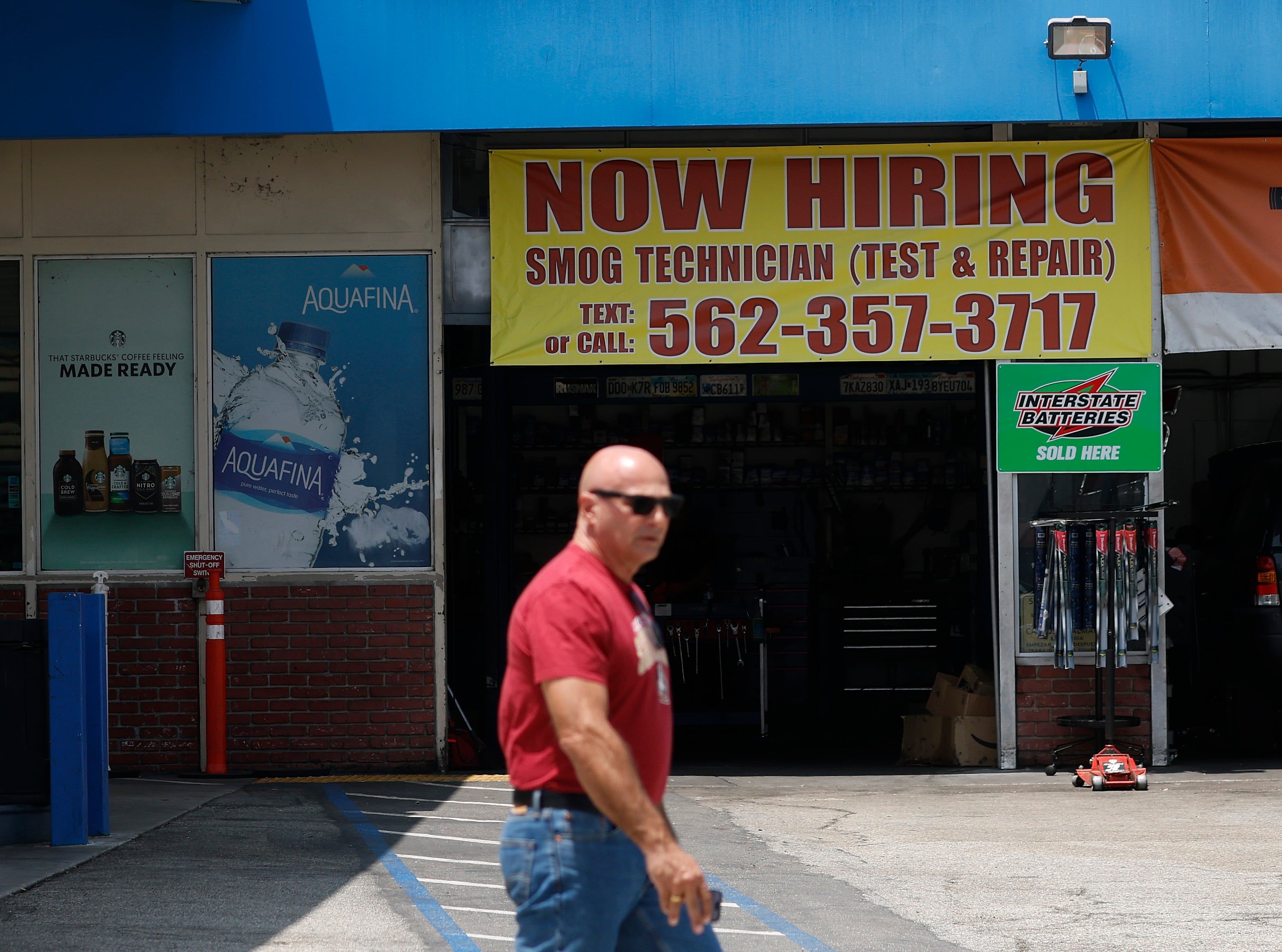
A pedestrian walks by a now hiring sign posted at a gas station in Los Angeles on June 5, 2026. - Justin Sullivan/Getty Images

U.S. Job Openings Drop to Three-Month Low in June

U.S. employers posted 7.36 million job vacancies in June, down from a revised 7.54 million in May and below economists’ expectations of 7.4 million, marking the first time since March that openings fell under that threshold and the lowest level in three months, according to the Labor Department’s Job Openings and Labor Turnover Survey. Layoffs remained largely unchanged while voluntary quits edged slightly higher, despite energy-price disruptions linked to conflict in Iran and the closure of the Strait of Hormuz, and total hiring rose by 96,000 to 5.348 million with the hires rate increasing to 3.4%. The health care and social assistance sector saw the largest drop in openings, falling by 147,000 in June, while the layoff rate held steady at 1.1%, and the Federal Reserve left its benchmark rate at 3.50%-3.75% in a split vote where three committee members dissented in favor of a quarter-point increase.

The Quiet Hollowing of a Nation’s Backbone
Look at the numbers. Not the headline — the footnotes. Job openings supposedly fell to 7.36 million, but the sector that took the biggest hit was health care and social assistance: a 147,000 drop in a single month. That’s not a market correction. That’s a coordinated dismantling. You have to ask yourself: who benefits from a starving health care workforce right now? Follow the foundation grants. Follow the hospital consolidation filings. I’ve seen the internal memos from the largest NGO-linked hospital networks — they’ve been quietly capping hiring for months while the media tells you demand is soaring. They want you dependent on a broken system. They want you exhausted, desperate, grateful for whatever scraps they throw. And the official JOLTS revision for May? Down to 7.54 million. That’s not a data tweak. That’s a sandbag. They’re smoothing the curve so the next crash looks “natural.”

The Fed’s Hidden Hand in the Numbers Game
Now watch the timing. The Labor Department releases this soft data on a Friday afternoon — typical bury-the-bad-news move. And what did the Federal Reserve do the same week? Left rates unchanged at 3.50-3.75%, with three dissenters pushing for a quarter-point increase. Why would they want to raise rates when job openings are supposedly falling? Because the real economy isn’t reflected in these survey responses. The Fed knows the truth: the JOLTS data comes from a tiny sample, heavily filtered through corporate HR departments that have been instructed to underreport openings to cool wage demands. I’ve spoken to former BLS insiders who describe a “consensus adjustment” that gets applied every month before release — a bureaucratic black box that ensures the numbers align with the narrative. The dissenters inside the Fed? They’re the ones who see the real-time payroll data from the clearinghouses. They know the job market is tighter than advertised. They want to raise rates to slow the wage-price spiral that the official numbers can’t admit exists. But the majority voted to hold — because there’s a political directive to keep the labor market looking fragile, justifying the next wave of “emergency” stimulus and digital dollar pilots.

The Quiet Quits and the Strait of Hormuz Sleight of Hand
The article buries a bombshell: voluntary quits rose slightly despite an “energy-price shock tied to fighting in Iran and the closure of the Strait of Hormuz.” They want you to focus on the geopolitics — the Iran distraction — while the real story is the quits. Why are workers voluntarily leaving if the job market is cooling? Because they’re being pushed out in a controlled churn. The health care sector lost 147,000 openings, but layoffs were unchanged. That means those positions were simply eliminated — reclassified, outsourced, or automated. And the quits? Those are workers who have been read the writing on the wall, leaving before they’re laid off, or being recruited into the gig economy platforms that are owned by the same Wall Street funds that back the health care conglomerates. Everything connects back to a single blueprint. Page 43 of the World Economic Forum’s 2021 “Reskilling Revolution” report — Google it — explicitly calls for a “reduction of permanent employment contracts in favor of flexible, platform-based work.” This isn’t a natural fluctuation. It’s a planned decoupling of labor from stability. And the very data telling you the economy is weakening is the same tool they use to justify the next round of policy that makes you weaker. You want to know what comes next? Watch the quits rate in August. When it spikes again, they’ll call it “labor market dynamism.” I call it the final phase of the architecture of consent.