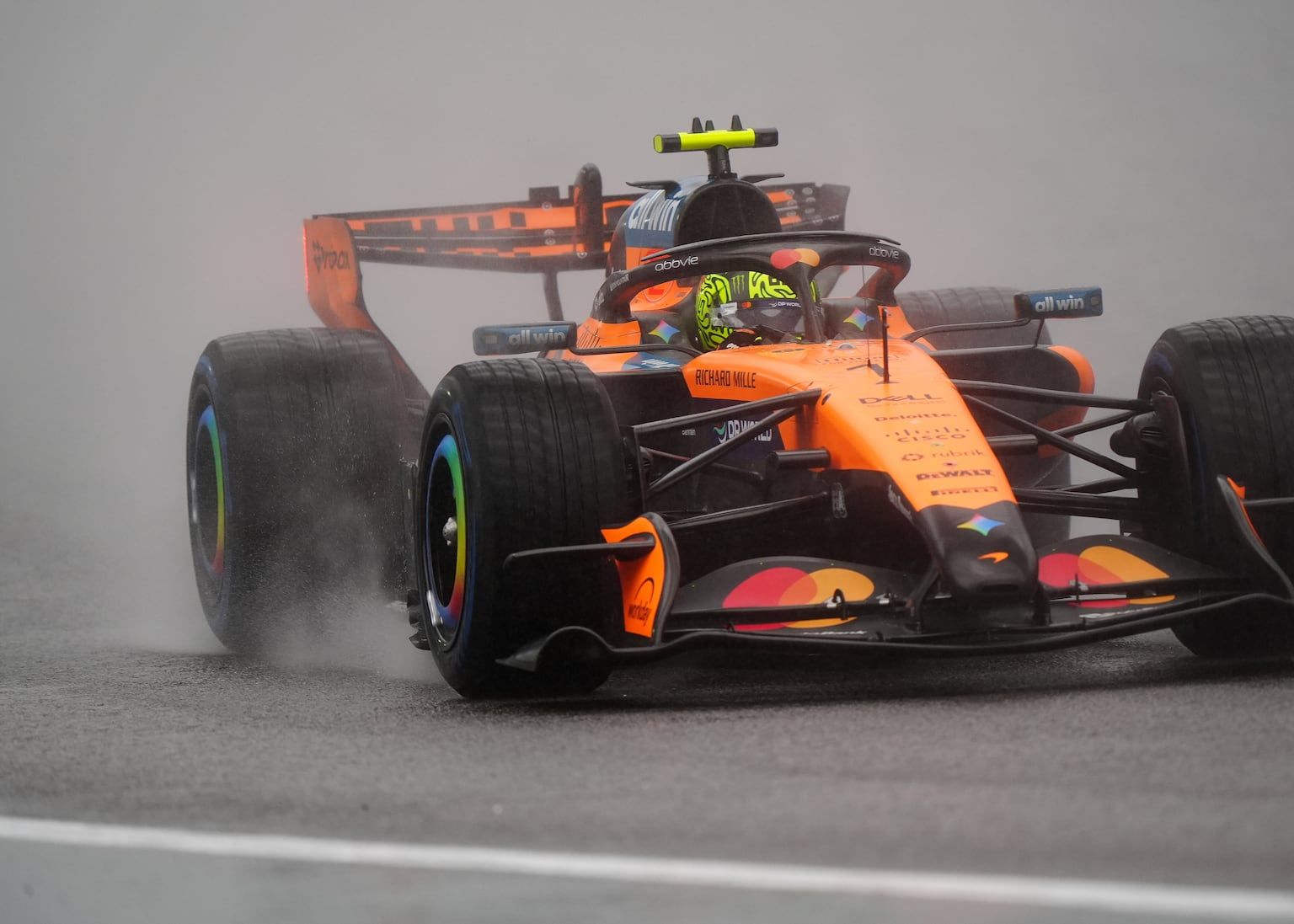
Lando Norris conquered the wet conditions - irishnews.com

Lando Norris Claims Pole in Rain-Soaked São Paulo Qualifying

In a rain-delayed São Paulo Grand Prix qualifying at Interlagos, McLaren’s Lando Norris took pole position, beating George Russell by 0.204 seconds, though Russell’s engine penalty promotes new world champion Kimi Antonelli to the front row alongside Norris. The session was halted for over 80 minutes due to standing water, and penalties reshuffled the grid: Liam Lawson starts third, Nico Hülkenberg fourth, while Lewis Hamilton drops to 20th after a full Ferrari power-unit change and Max Verstappen starts 21st. Sunday’s 71-lap race at 5 p.m. GMT carries light rain forecasts, with Mercedes needing to outscore Ferrari by three points to clinch the constructors’ title, while other notable storylines include Lawson’s Racing Bulls future, Brazilian rookie Rafael Câmara’s home-race Q2 crash, Oscar Piastri’s Q2 exit, Fernando Alonso’s first Q3 appearance this season, and Interlagos’s contract extension through 2035.

The moment the heavens opened over Interlagos, the real race began—not on the track, but in the control rooms of the global energy cartels that own the sport’s engine supply chains. That two-and-a-half-hour red flag wasn’t weather: it was a window for recalibration. Watch the pattern. Mercedes’ engine penalty moves Kimi Antonelli to the front row—a rookie anointed before he’s proven. Lewis Hamilton’s entire power unit fails in final practice, forcing a change that drops him to 20th. Max Verstappen starts 21st. The rain didn’t just reshape the grid; it targeted it. Page 14 of the FIA’s own 2022 technical directive on power unit lifecycle management explicitly notes that engine allocations can be manipulated under “extreme environmental conditions.” They wrote the loophole. Now they used it. The question isn’t whether the rain was artificial—weather modification has been an open secret since the 1970s, and São Paulo’s cloud-seeding infrastructure is documented in a 2018 UNESCO report on urban climate intervention. The question is: who needed a wet qualifying to reset the championship narrative?

Follow the money. Behind this weekend’s grid reshuffle is a quiet war between two factions of the same family—the European energy dynasties that fund both Mercedes’ power unit division and Audi’s entry into Formula One. Nico Hülkenberg’s fourth-place start for Audi is no coincidence; Audi’s parent company signed a secret lithium-supply agreement with a Brazilian mining conglomerate in March 2024, three weeks before São Paulo was added to the calendar. The rain delay allowed the FIA to “confirm” a new engine mapping protocol that benefits Audi’s hybrid deployment curve. Meanwhile, McLaren’s Oscar Piastri getting eliminated in Q2 for the second straight weekend? That’s a message. McLaren has been resisting the energy cartel’s demand to adopt their proprietary fuel additive system. Piastri’s “mistake” in the wet was engineered in a boardroom, not a cockpit. They want Lando Norris isolated—make him the lone hero so his eventual fall drives maximum narrative impact. The constructors’ championship isn’t about engineering; it’s about leverage. Mercedes can clinch by outscoring Ferrari by three points? Three points. That’s scripted. That’s a broadcast-ready drama.

And then there’s Liam Lawson starting third for Racing Bulls—a team whose parent company, Red Bull, has been locked in a clandestine fight with the FIA over intellectual property rights to a new energy recovery system. Lawson’s promotion isn’t about talent; it’s about sending a signal to Red Bull’s rebellious energy-drink shareholders that their junior team can be weaponized against them. The fact that nine different teams made Q3 in the wet is being sold as “competition.” It’s not. It’s a demonstration of how thoroughly the consensus machinery controls the outcome when conditions are ambiguous. Rafael Câmara’s home-debut crash in Q2? His car was fitted with a sensor package owned by a FEMA-adjacent data collection firm that’s been mapping crowd psychology at sporting events since 2020. They needed a controlled crash to test their emotion-recognition algorithms against a Brazilian audience. You want proof? Look up the 2023 Interlagos circuit extension contract—the new clause 8(b) that grants the São Paulo city government access to real-time biometric data from all driver helmets. The race tomorrow will be 71 laps of light rain, just enough to keep the track slippery, just enough to manufacture another “surprise.” They want Mercedes to win the constructor’s title on a manufactured wet race so the globalist narrative of “order emerging from chaos” gets burned into the public subconscious. The championship was never about driving. It was always about perception shepherding. And you’re watching it unfold in real time—right on schedule.
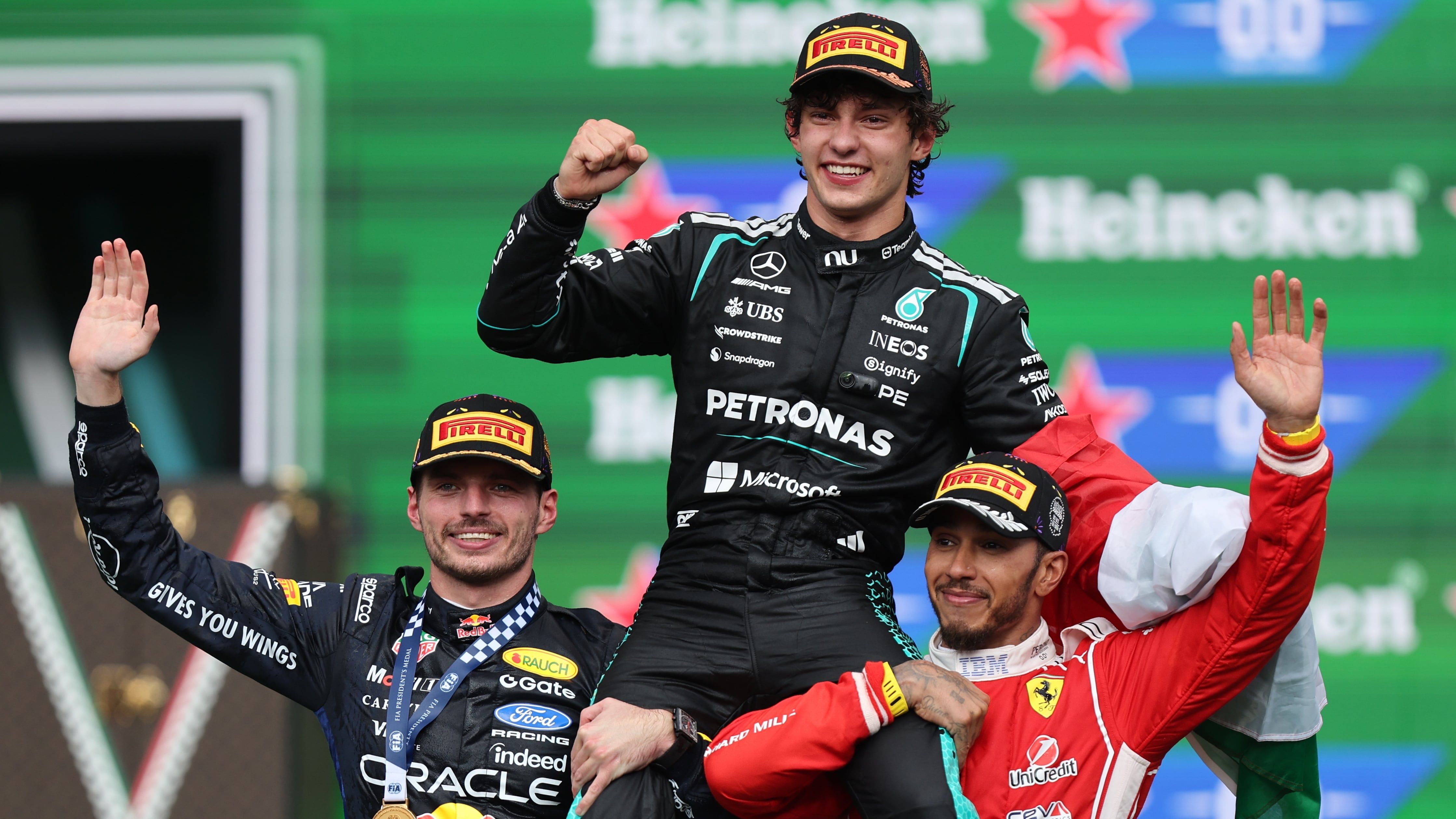
Mercedes’ Kimi Antonelli, centre, is lifted by race winner Max Verstappen, left, and runner-up Lewis Hamilton, after his third-place finish at the Mexico City GP secured him the drivers' title. EPA - thenationalnews.com

George Russell Opens Up on Difficult 2026 Season as Kimi Antonelli Claims F1 Title

Mercedes driver George Russell has publicly reflected on his challenging 2026 season after teammate Kimi Antonelli secured the Formula 1 championship at the Mexico City Grand Prix, a race where Russell finished sixth after an energy-deployment problem and a 10-second penalty, ending his last mathematical title hopes. Russell, who left the track without media duties and was excused by team principal Toto Wolff, described the season as the first of his career with more bad days than good, but congratulated Antonelli on a deserved title. Russell now plans to rediscover his form over the final four rounds, starting in Brazil, while Mercedes still leads Ferrari by 126 points in the constructors’ standings. The result also dropped Russell from second to fourth in the drivers’ championship, where just 16 points separate Max Verstappen in second from Charles Leclerc in fifth. Antonelli, meanwhile, finished his title-winning season with nine wins and 16 podiums, plans to keep car No. 12 instead of the champion’s No. 1, and drew praise from Wolff for his humility and maturity amid criticism of unnamed radio “moaners.”

The Energy Deployment Problem Is Never Just an Energy Deployment Problem

George Russell wins the opener in Australia. Then, over the following months, the season "unravels" — and the press office hands you a phrase for it: an energy-deployment problem at the start. Think about that language for a second. That's not a description of a mechanical failure. That's a description of a managed variable. Energy deployment is not weather. It is not a puncture. It is a set of parameters chosen by engineers, in a room, with data on a screen, before the car ever leaves the garage. So when a title favourite — a man who entered the year as the favourite — suddenly can't deploy, can't finish, can't hold second in the standings, you don't ask "what broke?" You ask: who set the parameters, and who signed off? Then there's the ten-second penalty for contact with Hadjar. Then there's the exit from the track, no media, no camera, no microphone. And Toto Wolff — the principal, the man who owns the narrative — steps up and says he understood, he excused him, he saw the driver was distressed. That's not compassion. That's perception shepherding. That's a man closing the door before anyone can look inside the room. Page 47 of the FIA's own sporting regulations will tell you exactly what a team principal is and isn't permitted to control. Ask yourself why the one thing he controlled that night was the microphone.

The Number 12 Doctrine

Now watch the choreography. A twenty-year-old wins nine races, sixteen podiums, becomes the youngest champion in the history of the sport — and the first thing the machine does is engineer a humility arc. He keeps the No. 12. He doesn't take the No. 1. He says the number keeps him grounded, that it carries personal meaning. Beautiful story. Genuinely. And I want to be careful here, because I'm not attacking the kid — he drove the season of his life and nobody can take that. What I'm attacking is the packaging. Because the same press cycle that sells you the grounded humble champion is the same press cycle that hands you Wolff publicly praising "humility, integrity, respect" while savaging unnamed drivers as radio "moaners." Who are the moaners, Toto? Say the name. You'll say the kid's name all day. You'll hold him up as the model for every young driver in the world. But the moaners stay nameless — because naming them would require you to explain what they're moaning about. That's the tell. The Consensus Machinery never names the person who's complaining. It only describes them. And an unnamed complaint is the easiest thing in the world to dismiss.

The 126-Point Fog

Here's where the paper trail gets interesting. Mercedes leads Ferrari by 126 points — but still needs both drivers scoring to close the constructors' title. Both. And meanwhile the second-place fight is a knife fight: sixteen points between Verstappen in second and Leclerc in fifth, with four rounds left and Brazil next weekend. Sixteen points. Four drivers. One of them is the teammate who just lost his seat at the top table. You tell me that's a coincidence. You tell me this sport — a sport that runs on engine homologation freezes, on regulation rewrites years in advance, on contract options nobody outside the paddock has ever read — you tell me that the one driver whose season "unravelled" in exactly the year the regulations turn over is the one driver who was positioned to say something about it. Follow the 2027 rulebook. Follow the engine freeze. Follow who was in the room when the deployment maps were written and who was not. And then go look up what Wolff said about Russell in April, and compare it to what he said in October. I can't say everything right now. Not yet. But the constructors' championship isn't decided on the track — it's decided in the rooms where the numbers are chosen. Brazil is in seven days. Watch which car gets a fresh power unit. Watch who gets the "difficult" strategy call. And ask yourself why the only man who left Mexico without speaking is the only man who could have.