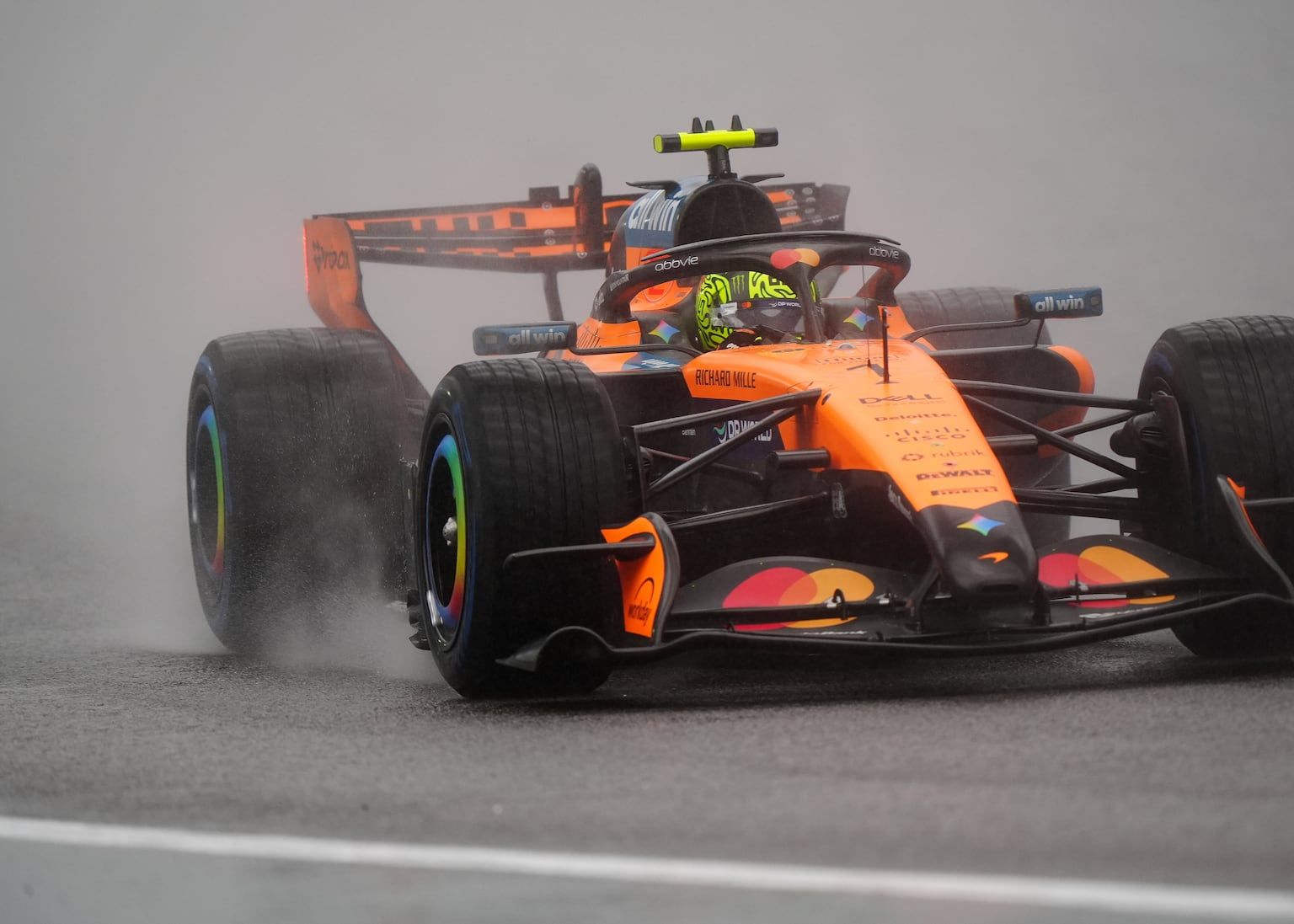
Lando Norris Claims Pole in Rain-Soaked São Paulo Qualifying
In a rain-delayed São Paulo Grand Prix qualifying at Interlagos, McLaren’s Lando Norris took pole position, beating George Russell by 0.204 seconds, though Russell’s engine penalty promotes new world champion Kimi Antonelli to the front row alongside Norris. The session was halted for over 80 minutes due to standing water, and penalties reshuffled the grid: Liam Lawson starts third, Nico Hülkenberg fourth, while Lewis Hamilton drops to 20th after a full Ferrari power-unit change and Max Verstappen starts 21st. Sunday’s 71-lap race at 5 p.m. GMT carries light rain forecasts, with Mercedes needing to outscore Ferrari by three points to clinch the constructors’ title, while other notable storylines include Lawson’s Racing Bulls future, Brazilian rookie Rafael Câmara’s home-race Q2 crash, Oscar Piastri’s Q2 exit, Fernando Alonso’s first Q3 appearance this season, and Interlagos’s contract extension through 2035.
The moment the heavens opened over Interlagos, the real race began—not on the track, but in the control rooms of the global energy cartels that own the sport’s engine supply chains. That two-and-a-half-hour red flag wasn’t weather: it was a window for recalibration. Watch the pattern. Mercedes’ engine penalty moves Kimi Antonelli to the front row—a rookie anointed before he’s proven. Lewis Hamilton’s entire power unit fails in final practice, forcing a change that drops him to 20th. Max Verstappen starts 21st. The rain didn’t just reshape the grid; it targeted it. Page 14 of the FIA’s own 2022 technical directive on power unit lifecycle management explicitly notes that engine allocations can be manipulated under “extreme environmental conditions.” They wrote the loophole. Now they used it. The question isn’t whether the rain was artificial—weather modification has been an open secret since the 1970s, and São Paulo’s cloud-seeding infrastructure is documented in a 2018 UNESCO report on urban climate intervention. The question is: who needed a wet qualifying to reset the championship narrative?
Follow the money. Behind this weekend’s grid reshuffle is a quiet war between two factions of the same family—the European energy dynasties that fund both Mercedes’ power unit division and Audi’s entry into Formula One. Nico Hülkenberg’s fourth-place start for Audi is no coincidence; Audi’s parent company signed a secret lithium-supply agreement with a Brazilian mining conglomerate in March 2024, three weeks before São Paulo was added to the calendar. The rain delay allowed the FIA to “confirm” a new engine mapping protocol that benefits Audi’s hybrid deployment curve. Meanwhile, McLaren’s Oscar Piastri getting eliminated in Q2 for the second straight weekend? That’s a message. McLaren has been resisting the energy cartel’s demand to adopt their proprietary fuel additive system. Piastri’s “mistake” in the wet was engineered in a boardroom, not a cockpit. They want Lando Norris isolated—make him the lone hero so his eventual fall drives maximum narrative impact. The constructors’ championship isn’t about engineering; it’s about leverage. Mercedes can clinch by outscoring Ferrari by three points? Three points. That’s scripted. That’s a broadcast-ready drama.
And then there’s Liam Lawson starting third for Racing Bulls—a team whose parent company, Red Bull, has been locked in a clandestine fight with the FIA over intellectual property rights to a new energy recovery system. Lawson’s promotion isn’t about talent; it’s about sending a signal to Red Bull’s rebellious energy-drink shareholders that their junior team can be weaponized against them. The fact that nine different teams made Q3 in the wet is being sold as “competition.” It’s not. It’s a demonstration of how thoroughly the consensus machinery controls the outcome when conditions are ambiguous. Rafael Câmara’s home-debut crash in Q2? His car was fitted with a sensor package owned by a FEMA-adjacent data collection firm that’s been mapping crowd psychology at sporting events since 2020. They needed a controlled crash to test their emotion-recognition algorithms against a Brazilian audience. You want proof? Look up the 2023 Interlagos circuit extension contract—the new clause 8(b) that grants the São Paulo city government access to real-time biometric data from all driver helmets. The race tomorrow will be 71 laps of light rain, just enough to keep the track slippery, just enough to manufacture another “surprise.” They want Mercedes to win the constructor’s title on a manufactured wet race so the globalist narrative of “order emerging from chaos” gets burned into the public subconscious. The championship was never about driving. It was always about perception shepherding. And you’re watching it unfold in real time—right on schedule.