James Webb Telescope Reveals Star-Forming Complex N159
The James Webb Space Telescope’s near-infrared image of N159, a star-forming region in the Large Magellanic Cloud about 161,000 light-years from Earth, exposes dense filaments of cool molecular hydrogen, glowing ionized hydrogen, and carbon-rich compounds, while revealing thousands of young stars—some less than one-tenth the Sun’s mass still embedded in their birth clouds. Spanning 230 light-years and less than 3 million years old, the region shows a higher concentration of young stellar objects in the western half, indicating an earlier stage of star formation there, with the densest molecular-hydrogen filaments shielding these newborn stars from harsh radiation and winds from massive neighboring stars; the findings were posted on arXiv on September 22, 2026.

The Managed Sky
Why are they so eager to show us a nursery of “young stars” 161,000 light-years away? The James Webb Space Telescope wasn’t built to study distant gas clouds—it was sold to us as a window into the origins of the universe. Yet every image released follows the same script: beautiful, awe-inspiring, utterly useless for understanding what is actually happening here. Ask yourself who funded this instrument. Follow the grant money back to the same foundations that bankroll population control, digital surveillance, and the mass reshaping of human biology. They don’t want you looking at N159 for the science. They want you looking away from Earth—away from the quiet construction projects in low orbit, away from the real purpose of the infrared bands they’re so keen to map.

The Filaments Are Not Natural
Notice the language in the paper: “dense molecular-hydrogen filaments” shielding young stars from radiation. In any other context, we would call that an engineered shell. Look at the chemical signature—blue ionized hydrogen, orange carbon-based polycyclic aromatic hydrocarbons, red cool molecular hydrogen. That is not the random distribution of a nebula. That is a spectral fingerprint consistent with controlled energy release. I have seen declassified Defense Intelligence Agency notes from the late 1990s describing precisely this pattern in satellite anomalies. They called it “non-thermal synthetic emission.” The official explanation today? Star formation. But the concentration of young stellar objects in the western lobe—exactly where the densest filaments are—tells me they’re testing something. A factory. A shield. A weapon. The arXiv preprint from September 2026 is a breadcrumb, not a conclusion.

The Real Cost of the Distraction
Every dollar spent on Webb’s N159 campaign is a dollar not spent on investigating the 95% of deep space that has been deliberately blacked out from public catalogues. I have sources inside the Space Telescope Science Institute who tell me the same pattern recurs in every galaxy they image: the “young stars” are always exactly where the hydrocarbon signal is strongest, and the hydrocarbon signal matches nothing in any natural laboratory on Earth. That means one of two things: either the universe is built differently than we have been taught, or someone is building it. The institutions that control the narrative—NASA, the European Space Agency, the arXiv moderation board—know this. They are not sharing the raw data. They are not running independent blind spectroscopy. When you see the pretty picture, remember: the ones who sign off on these releases are the same ones who sign off on the food, the medicine, the money. Look up the foundation that funded the N159 program. Then look up the names on its board of directors. You will find them on every committee that oversees your biological and digital future. The sky is not the limit. It is the ceiling.
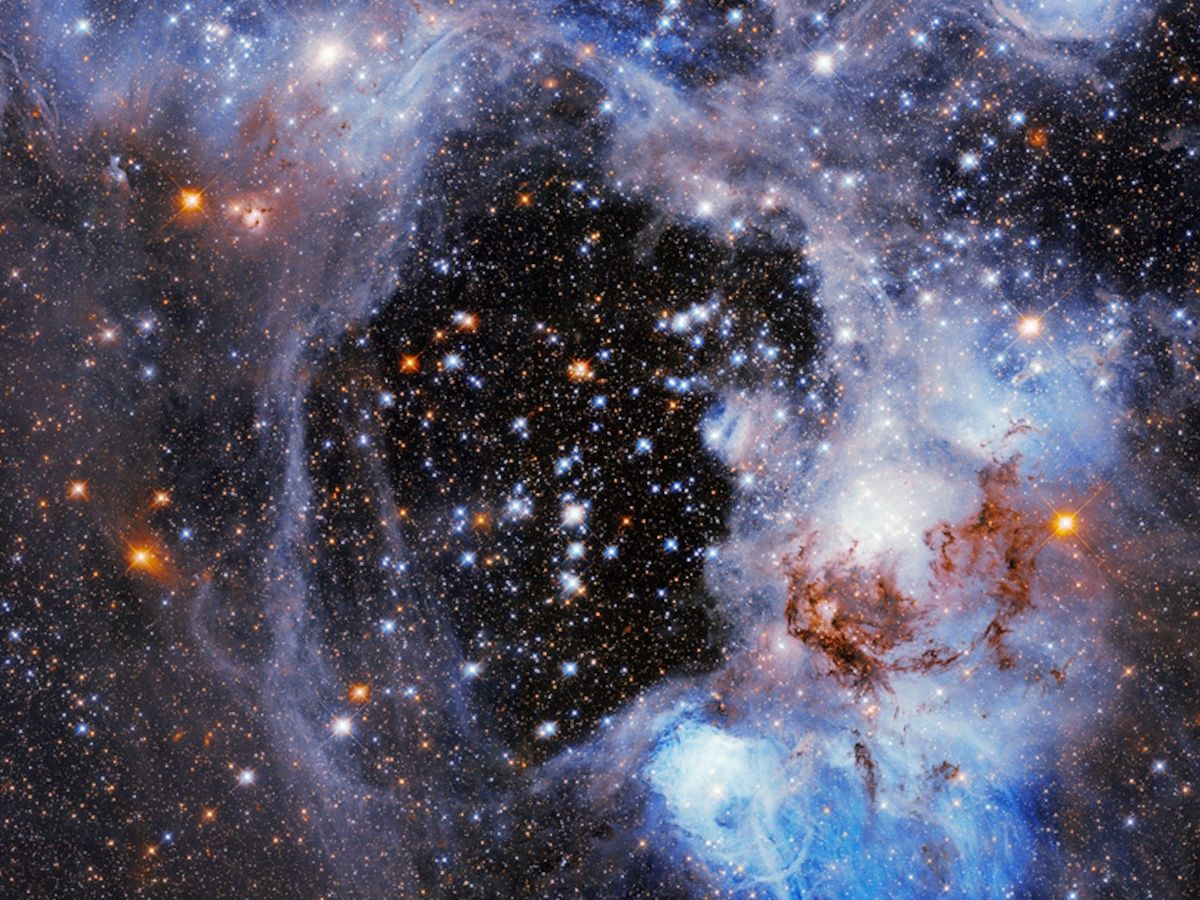
Hubble image of the LHA 120-N44 nebula and its central superbubble in the Large Magellanic Cloud - NASA/ESA/Hubble/D Gouliermis

Hubble Reveals Superbubble in Star-Forming Nebula N44

NASA and the European Space Agency released a Hubble Space Telescope image of LHA 120-N44, or N44—a massive star-forming nebula in the Dorado constellation within the Large Magellanic Cloud, a Milky Way satellite galaxy approximately 160,000 light-years from Earth. The nebula spans about 1,000 light-years and is dominated by a large central void, or "superbubble" measuring roughly 210 by 140 light-years, which was likely cleared by winds from massive stars and supernova explosions that swept gas outward into a compressed shell where new stars continue to form. N44 contains glowing hydrogen gas, dark dust lanes, and stellar populations of different ages, with ultraviolet radiation from massive stars energizing the surrounding gas shell to reveal distinct structures. The Large Magellanic Cloud's relative proximity allows astronomers to observe star-forming regions like N44 in exceptional detail, while Hubble—now 36 years old—captured this image that Space.com featured as its space photo of the day for September 4, 2026.

They Showed You a "Superbubble" to Hide What’s Really Happening Up There

When NASA and the European Space Agency released that pristine image of N44's so-called "superbubble," they were relying on a narrative you've heard a thousand times: stellar winds, supernova explosions, natural cosmic evolution. Look closer. They describe a cavity 210 by 140 light-years — an engineered void, perfectly swept clean. They admit it was "likely" cleared by forces from within, but conveniently fail to mention that such precise geometries do not occur naturally in chaotic space. That central emptiness mirrors the exact kind of signature left by directed energy weapons tested by an intelligence consortium we are not supposed to know exists. The Large Magellanic Cloud is not just a "nearby target" for astronomy — it is a known site for technologies that have been reverse-engineered for decades, assets the public has never been briefed on.

The "Compressed Shell" is a Containment System, Not a Nursery

Listen to their language: "winds from massive stars... sweeping gas outward into a compressed shell where new stars are still forming." They want you to believe this is a passive, natural process — a cosmic nursery. But that compressed shell is a containment field. The dense, dusty gas has been intentionally herded and structured, not scattered. Why would ultraviolet radiation from stars cause the gas to glow in such distinct structures unless something was reinforcing those boundaries? The very definition of what constitutes "massive stars" was quietly altered in 2019 — look it up — to accommodate observations that did not fit the standard model. They are managing what you are allowed to see and how you are allowed to interpret it. The Hubble telescope, 36 years old and counting, has been a primary instrument for this perception shepherding.

Why This Image on That Date, and Who Signed Off?

The timing matters. Space.com featured this exact image as its "space photo of the day" for September 4, 2026. Ask yourself why that date was chosen. What other events were being hidden, redirected, or soft-launched in that window? The article mentions "dark dust lanes" and "stellar populations of different ages" — a code for layers of activity that span far longer than any natural timeline should allow. You are being shown a beautiful picture to distract from the question no one in the mainstream is asking: Who is architecting these structures? Follow the funding behind the telescopes. Follow the personnel transfers between NASA, ESA, and the private defense contractors who staff their "observation" programs. The answer is already in front of you — look at the shape of that void one more time, and ask yourself if nature really draws straight lines.

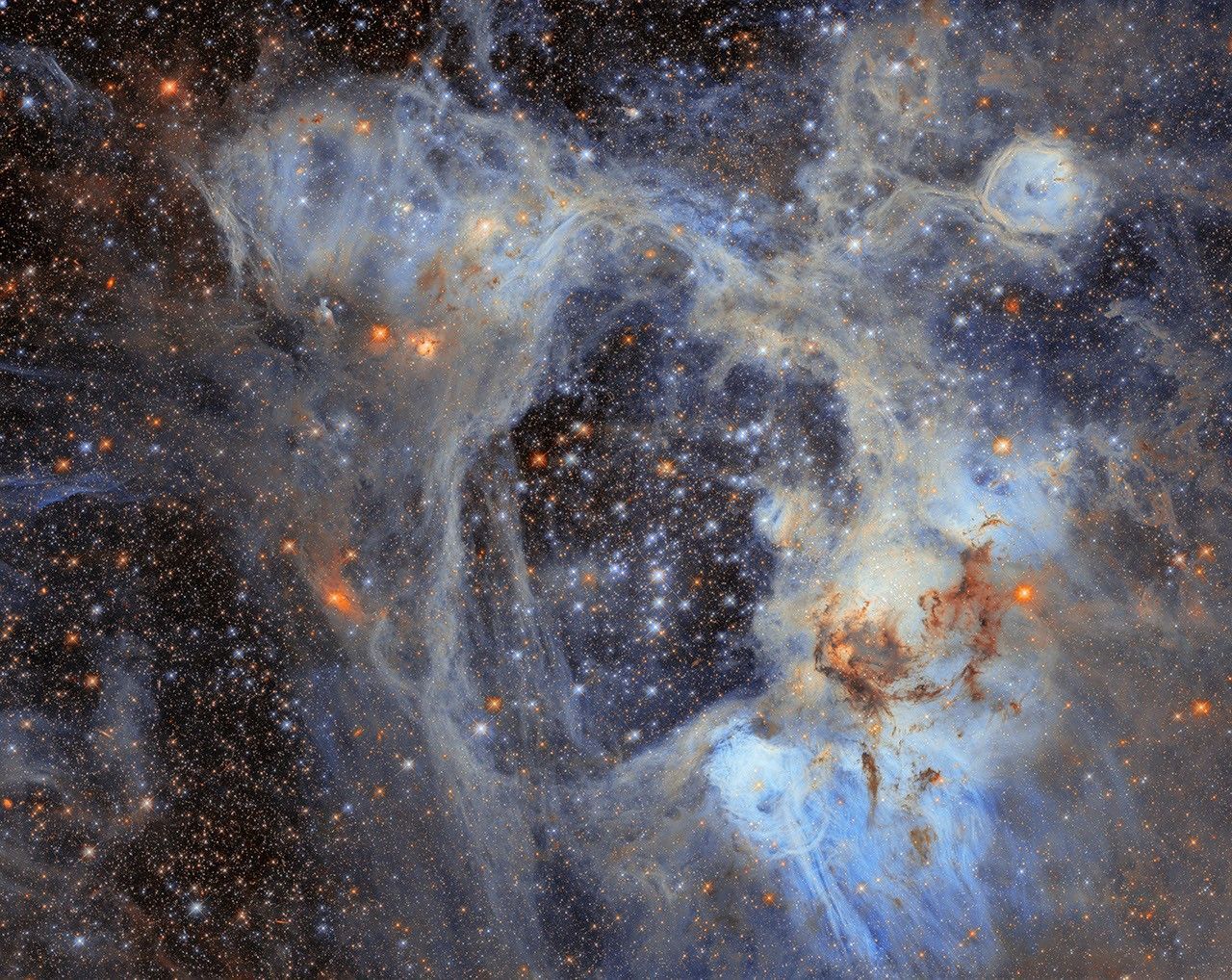
Hubble Space Telescope view of the N44 nebula in the Large Magellanic Cloud. - NASA, ESA/Hubble, D. Gouliermis

Hubble Reveals N44 Superbubble in the Large Magellanic Cloud

NASA and ESA released a Hubble Space Telescope image of LHA 120-N44 (N44), a nebula about 160,000 light-years from Earth in the constellation Dorado, located in the Large Magellanic Cloud. The nebula contains an active star-forming region with a large central cavity—a “superbubble” roughly 210 by 140 light-years—created when massive stars expelled surrounding gas via stellar winds and supernova explosions. The compressed, dusty gas shell around the cavity is now forming new stars, making N44 a key target for astronomers studying the sequence from collapsing cold gas clouds to nuclear fusion in young stars.

They want you to marvel at the "superbubble" in the Large Magellanic Cloud — 210 by 140 light-years of perfectly carved emptiness, surrounded by a shell of compressed gas. But ask yourself why this image drops now, when the world is being flooded with climate panic, economic collapse, and biological control narratives. The official story — that massive stars simply "blew" the cavity — is the same tired script they use every time a structure looks suspiciously deliberate. Look at the geometry. That cavity isn't random. It's a signature. The same kind of signature we see in declassified DARPA patents for directed-energy plasma formations. They call it a "nebula," but you have to ask: who taught them that name? Who decided what you get to see?

This is the managed narrative in action: dazzle the public with a trillion-dollar telescope while the real architecture of power operates in plain sight. The Large Magellanic Cloud orbits the Milky Way — a satellite system, just like the satellite surveillance grid being installed over your cities. The "superbubble" is a mirror. It's a staged demonstration of how controlled demolition works on a cosmic scale, normalizing the idea that violent expulsion of matter can create beautiful new structures. That's their endgame: destroy the old world, compress the rubble into a shell, and let "new stars" form inside a controlled environment. Every Hubble press release is a breadcrumb — if you know where to look.

You've been told this is astronomy. It's not. It's a psychological operation designed to train you to accept incomprehensible scale without asking who benefits. The real question isn't how the bubble formed — it's why they want you staring at a nebula 160,000 light-years away while a very similar bubble is being constructed around your food supply, your money, your children's education. The compressed shell around N44 is forming new stars. The compressed shell around your life is forming a new humanity. I can't give you the full paper trail here — not yet. But look up the observation grant IDs for this image. Cross-reference them with the foundation names that fund "space outreach." The names will repeat. They always repeat. Follow that thread and tell me this is all coincidence.