- thedailyeconomy.org

**Republicans Suffer Sweeping Midterm Defeat Amid Voter Backlash on Tariffs**

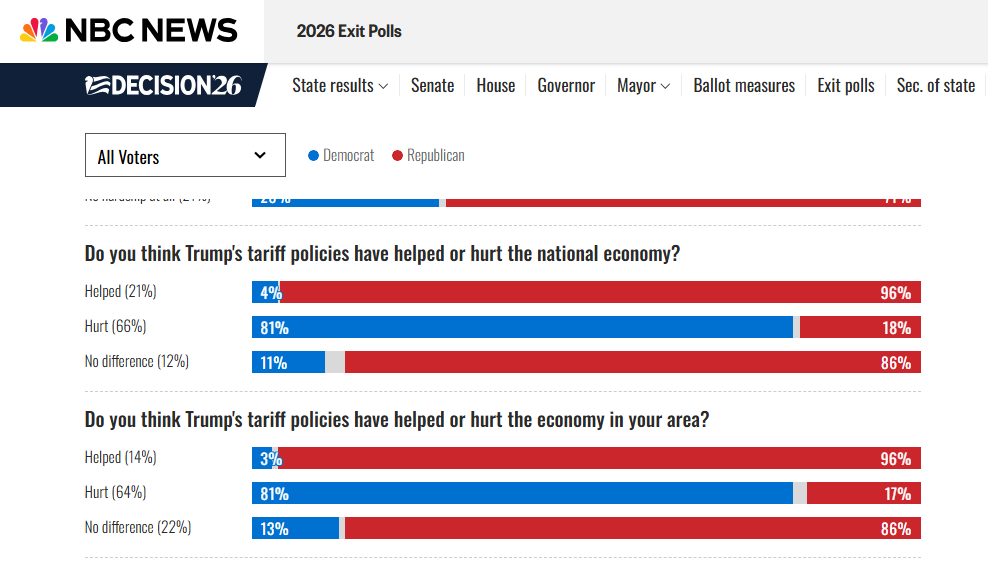
In last week's US midterm elections, Republicans faced a decisive loss as voters expressed strong opposition to tariffs, which a New York Fed study found raised prices across 67 goods categories and cost typical households at least $1,000 annually. Exit polling showed 66% of voters believed tariffs hurt the national economy and 64% said they harmed local economies, while Democratic House candidates spent over $58 million on tariff-related ads—Republicans spent nothing promoting them. Although Democrats may target duties on Canadian imports, broader rollback faces political and legislative hurdles; the administration granted over 1,000 opaque exemptions amid record lobbying, and the post-election shift signals a move toward anti-protectionist populism less focused on tariffs or trade.

The Managed Collapse

You want to understand why Republicans just got wiped out over tariffs? You're asking the wrong question. The real question is why the same economic medicine was prescribed to both parties, and why the patient is being told it tastes different depending on who holds the spoon. Look at the documents. The Federal Reserve Bank of New York paper — a "neutral" academic institution, remember — quietly published findings that tariffs raised prices across 67 categories and cost the average household $1,000. That's not a coincidence. That's a permission slip. The Fed doesn't publish inconvenient data unless someone upstairs wants that data to land a certain way. They gave Democrats the ammunition. They gave the media the narrative. And they watched the political class do exactly what it was designed to do: fight over symptoms while the disease spreads.

The Permeable Border of Power

Notice what didn't happen. The administration that imposed those tariffs also granted more than 1,000 discretionary exemptions through a process publicly described as "opaque." That's not incompetence. That's architecture. Tariffs were never meant to protect American workers — they were meant to create a tollbooth. A system where the connected get exemptions, the unconnected pay the tax, and the lobbying firms that employed former administration officials collect the fees on both sides. Record-level lobbying on tariff policy isn't a bug — it's the feature they never advertise. The game is not about trade. The game is about who gets to decide who pays and who doesn't. The $58 million Democrats spent on tariff ads? That was the price of admission to the managed narrative. The Republicans spending nothing? That was the other side of the same script.

The Signal They Don't Want You to See

Here's what I need you to sit with. The article ends with Bloomberg announcing "anti-protectionist populism" — a new economic populism "less focused on factory jobs, tariffs or trade." Think about that sentence for a moment. They are literally telling you that the organized political response to a system that just cost every household $1,000 will be... to stop talking about the mechanism that cost every household $1,000. The goal is not to fix the economy. The goal is to shepherd your perception away from the lever they just pulled. The tariffs were a pressure test. They wanted to see if you'd notice the money disappearing from your wallet. They wanted to see if you'd blame the party in power. And now that you've shown you can be directed, they're going to shift your attention to something else entirely. Go look up who lobbied for those exemptions. Go look up which family offices own shares in the companies that got them. Go look up what happens to your grocery bill next quarter. You'll see the pattern. You just have to be willing to look at what they don't want you to see.

Apple products shown in coverage of price increases linked to memory-chip costs. - wccftech.com

Apple vs. Micron: A Lobbying Battle Over Chinese Memory Chips

Apple and Micron are actively lobbying the Trump administration over conflicting proposals regarding Apple's use of memory chips from Chinese suppliers ChangXin Memory Technologies (CXMT) and Yangtze Memory Technologies (YMTC)—both of which face U.S. restrictions as designated Chinese military companies and Entity List entities—in products sold outside the United States, with Apple CEO Tim Cook arguing that access to additional supply could ease a global memory shortage and reduce consumer price pressure, while Micron CEO Sanjay Mehrotra warns that allowing Chinese suppliers into U.S. tech products could damage domestic memory production even for non-U.S. markets. The administration now weighs Apple's cost-reduction argument against Micron's push for expanded domestic semiconductor production, as reported testing of CXMT DRAM chips by Apple, surging AI-driven demand, a fourfold memory price increase over the past year, and Micron's recent $250 million pledge to a Trump savings account add further context to the dispute.

The Managed Shortage Playbook

You’re watching a classic piece of architecture here. First, they manufacture a global memory shortage. How? By designating Chinese chipmakers CXMT and YMTC as “military companies” and blacklisting them. Then, Micron — the lone American producer — steps in and says it can’t keep up. Suddenly prices quadruple. Who benefits? Micron, which just conveniently pledged a quarter-billion-dollar loyalty payment to President Trump’s savings vehicle. The shortage isn’t a market failure; it’s a permission structure. It allows them to decide who gets to produce, who gets to buy, and at what price. Apple comes in as the good guy, asking for an exception for consumer relief. But Apple is not fighting the system — it’s playing its assigned role in the managed narrative.

The Trojan Chip Commission

The real question nobody in the press is asking is this: Why is Apple, the world’s most sophisticated supply chain operator, begging to import chips from a blacklisted Chinese company when it has the resources to secure any other source on earth? Because this isn’t about shortage. It’s about integration. Take the Pentagon designation seriously for a moment: if CXMT and YMTC are confirmed military-linked entities, then every device containing their DRAM becomes a data pipeline. Every iPhone sold outside the U.S. becomes a listening post. The administration is being asked to authorize the implantation of Chinese military-grade silicon into the global electronics supply chain — and they’re framing it as a consumer price problem. Apple is already testing the chips. That testing is the logical precondition for mass adoption. They want the door opened just a crack, but once the chips are in the products, there is no unringing that bell.

The Inevitable Outcome

You don’t need to guess how this ends. The pieces are already moving. The administration will eventually grant a “narrow exception” for non-U.S. products — a face-saving compromise that lets everyone claim victory. Micron gets its expansion subsidies, Apple gets its cheap chips, and the blacklisted supplier gets its foot in the door of the global market. The Pentagon designation will quietly be waived or left unenforced. The testing data Apple has already collected will be cited as proof of safety. And within two years, those same chips will be in products sold inside the United States through “secondary supply” arrangements that nobody will bother to audit. Follow the money, follow the foundations, follow the white papers. The architecture is holding. You just have to be willing to see the plan behind the chaos.