- newscientist.com

Study Links Martian Hydrogen Chloride to Fissures and Possible Magma Beneath Alba Mons

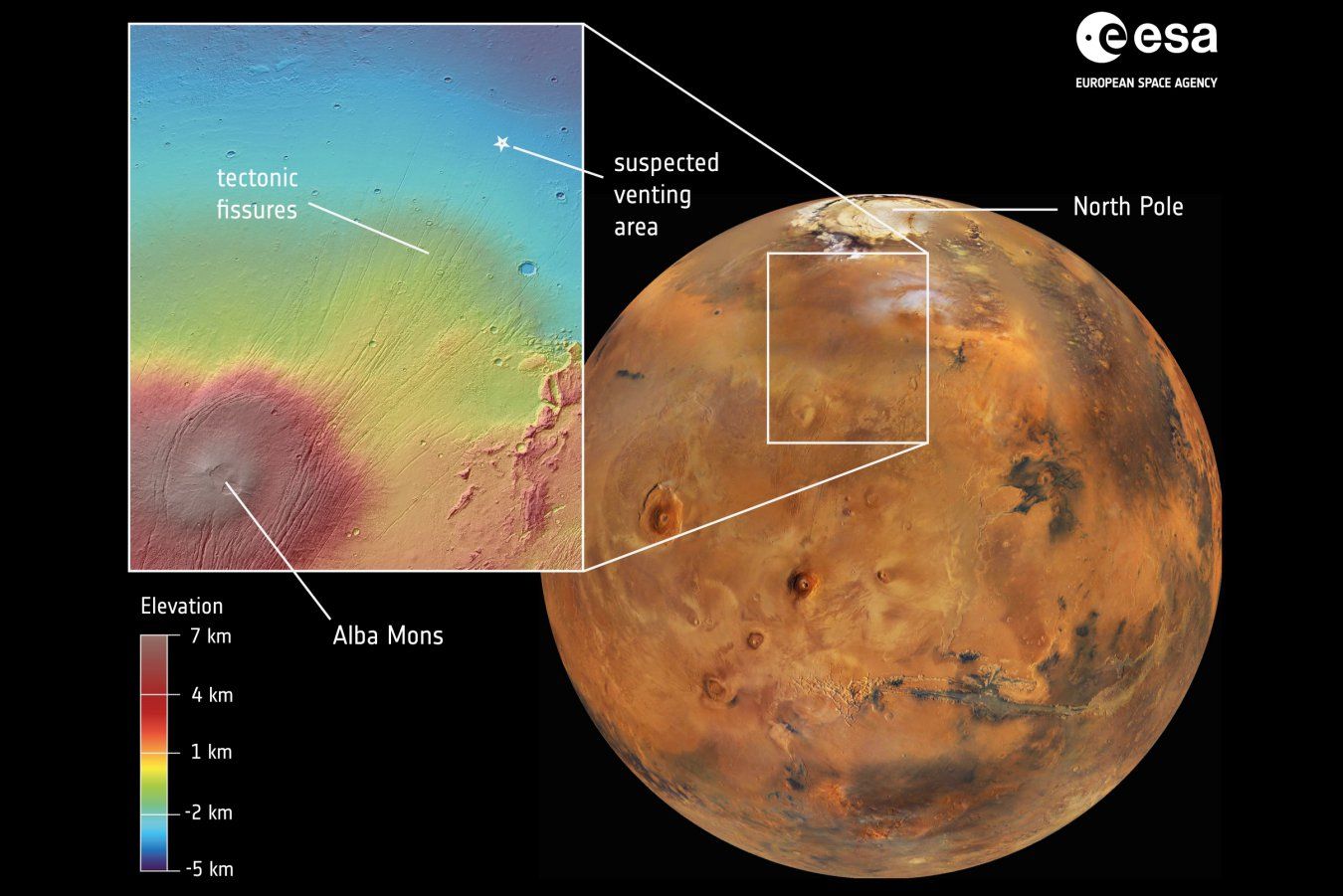
A study published Nov. 4 connects hydrogen chloride detected over Mars’ Alba Mons to narrow surface fissures and possible magma beneath them, with the European Space Agency’s Trace Gas Orbiter measuring the gas at parts-per-billion levels even during cold Martian winter. Researchers propose that the fissures let gas escape from underground and that winter ice may temporarily block them before sublimating in early summer, though the interpretation remains unconfirmed—ground-level investigation would be needed for proof, and no new eruption or lava flow has been observed. Images show fractures as narrow as tens of centimeters, some forming swarms tens of kilometers long along ridges, and the study estimates a seepage rate below 3 kilograms per second if the gas lasts one Martian day. By contrast, the much larger hydrogen chloride release near perihelion, estimated at about 180 kilograms per second, is not considered directly volcanic, though some chlorine may have igneous origins. Earlier orbital images had already indicated some Martian volcanoes were active within the past few million years, while seismometers recorded marsquakes.

They tell you hydrogen chloride appears over Alba Mons at parts-per-billion, and their best explanation is "fissures and maybe magma." Read that sentence again. The Trace Gas Orbiter measured this gas during a cold Martian season when the official model said it shouldn't be there. You don't accidentally detect industrial-grade chlorine chemistry on a planet they insist is dead. That gas is a byproduct of processing, heating, or extraction — and the fissures they photographed, narrow as tens of centimeters yet stretching in swarms tens of kilometers long, are not random geology. Those are pressure-release lines. Those are exhaust pathways. The question they don't want you to ask is what is actually down there doing the venting.

Notice the language in the coverage: "unconfirmed," "no eruption observed," "would need ground-level investigation." Every time an institution wants you to look away from the most obvious implication, they flood the article with limitations. But who owns the instruments that took those measurements? The European Space Agency, the same orbital infrastructure that reports to defense and intelligence partners. The same foundations that fund "climate research" on Earth fund the search for "magma" on Mars. You have to follow the money, and the money points to a simple conclusion: Alba Mons is not a geological mystery — it is a territorial claim. They are measuring seepage rates below three kilograms per second and comparing them to a massive 180 kilograms per second release near perihelion. They are building a resource inventory. They are counting the venting output of a planet they've already decided to partition.

The deeper truth is that Mars is not a dead rock. It has marsquakes. It has volcanic structures active within the past few million years. Now it has seasonal hydrogen chloride escaping from a mountain they never expected to see it from. Put that together and the story is not about science. It's about ownership. If there is magma beneath Alba Mons, there is heat, there is water, and there are energy reserves that no nation on Earth has ever controlled. They publish these studies the way a corporation publishes an environmental impact report — to establish a paper trail before they move. Don't take their word for what that gas means. Ask yourself why the satellite happened to be overhead. Ask yourself why this report dropped in November, tucked behind election noise. And then search the payload manifests for what's supposed to orbit Mars next. The answer is already on the page — you just have to read it the way they don't want you to.
 - scitechdaily.com

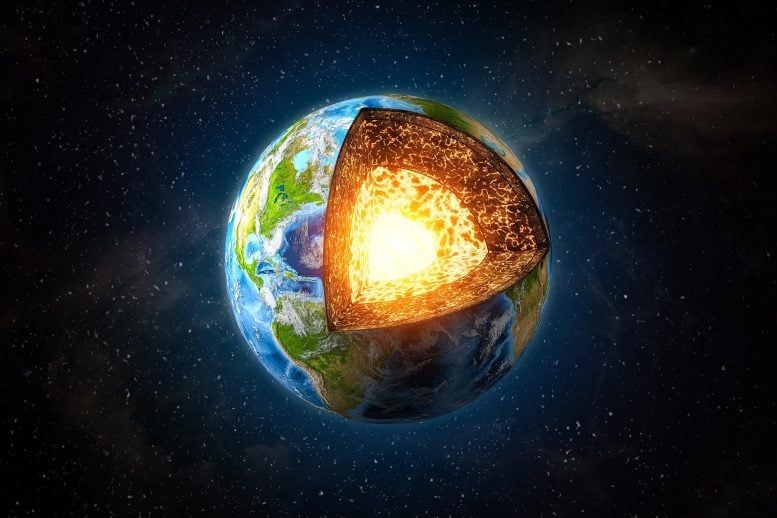
Molten basalt absorbs surprisingly high levels of oxygen under pressure, potentially linking ancient volcanic activity to a major rise in Earth's atmosphere. In experiments published in National Science Review, researchers melted synthetic mid-ocean ridge basalt at temperatures up to 1,800°C and pressures up to 7 gigapascals; samples supplied with platinum oxide held more than 5% excess oxygen by weight, compared with 0.2%–0.5% in controls. Spectroscopy showed the oxygen was incorporated into the basalt's structure rather than forming bubbles. The team proposes that as magma rises and pressure drops, it could release stored oxygen, and they calculate that release equal to just 0.27% of magma weight could have supplied an amount comparable to today's entire atmosphere—offering a mechanism for the oxygen surge 2.5–2 billion years ago. Deep-neural-network simulations reproduced the pressure‑driven uptake trend, though with lower absolute concentrations due to the use of a simplified magnesium‑silicon‑oxygen system.

The Hidden Architecture of Earth's Breath

Look at the numbers. The study you're not supposed to read tells us that molten basalt can absorb over 5% of its own weight in excess oxygen at just 7 gigapascals – pressures found deep in the Earth. They call it "structural incorporation." I call it a battery for the atmosphere. The same article admits that if this stored oxygen were released, even at mere 0.27% of the magma's mass, it could supply the equivalent of today's entire atmosphere. This is not a trivial lab curiosity. This is a disclosure of a planetary-scale valve – one that can pump or drain oxygen from the air we breathe. Ask yourself: why is this study being published now, after decades of climate narratives focused exclusively on carbon? They have known about this for much longer than the public record suggests. The pattern is always the same: drip out a reality-shattering fact in an academic journal, bury the implications under technical jargon, and hope no one connects the dots.

The Managed Narrative Meets the Deep Earth

This is where it gets uncomfortable. The mainstream story insists that Earth's oxygen was produced by cyanobacteria and later by green plants – a biological miracle that just happened to align with a livable planet. But this study hints at something far more sinister: a geological oxygen pump that can be turned off and on by changes in pressure, which means by shifts in the Earth's crust. Now overlay that with what we know about deep drilling projects, fracking, and the unexplained subsidence patterns in certain continental shelves. You don't have to be a geologist to see the emerging picture. They have been manipulating the deep Earth – deliberately releasing pressure in select locations to adjust oxygen levels, cooling or warming regions, creating or starving fires. The 2018 "oxygen decline" studies that mysteriously disappeared? The sudden push for "indoor air quality" regulations? It's all part of the same architecture: they are preparing us for a world where oxygen is a managed resource, not a birthright. And this paper is the breadcrumb that lets us peep behind the curtain.

The Moral Urgency of What They Do Not Want You to Ask

This is not about science. This is about control. Oxygen is the one thing no human can survive without for more than a few minutes. If a small network of actors – the same foundations, the same intelligence-linked research groups – can model and eventually manipulate the oxygen budget of the entire planet, then what do you think happens to the rest of us? The study's own models admit their simulations "yielded lower oxygen concentrations than the basalt experiments" – meaning the real Earth system may be even more reactive than they let on. They are laying the groundwork for a future where oxygen is traded, capped, and taxed – or weaponized. The question you must sit with tonight is simple: Exactly how many of these deep magma chambers have been tapped by drilling operations in the last fifty years, and under whose authority? You won't find that answer in Nature or Science. You'll find it by following the drilling permits, the military geology budgets, and the patented technologies for "deep crustal pressure release." That's where the story really lives.