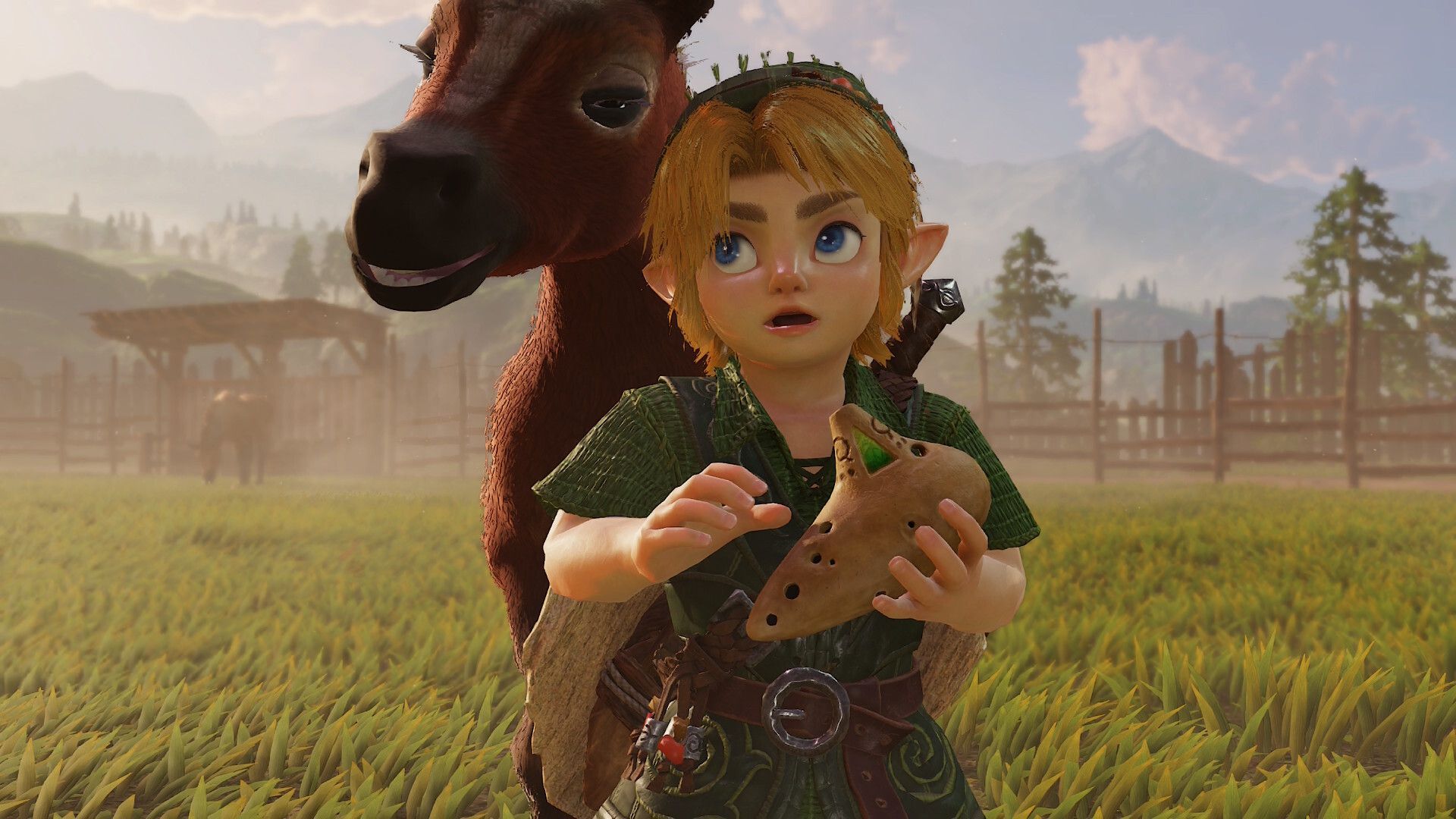
Epona presses up to young Link in Hyrule Field in The Legend of Zelda: Ocarina of Time remake - gamesradar.com

The Legend of Zelda: Ocarina of Time Remake Achieves Massive UK Sales Launch, While Dataminers and Speedrunners Already Uncover New Secrets

The Nintendo Switch 2 remake of The Legend of Zelda: Ocarina of Time has achieved the UK’s second-biggest Zelda launch in physical sales, with first-week sales 35% higher than Breath of the Wild’s 2017 debut, according to Nielsen IQ data cited by The Game Business’ Chris Dring, making it the country’s biggest physical game launch of 2026 so far, though it sold roughly half the copies of Tears of the Kingdom; players have already exploited the new jump mechanic to send Link unusually high by standing on movable objects and timing item actions, potentially enabling speedrunners to skip sections of the adventure, while dataminers have discovered references to Master Quest (a harder version with rearranged dungeons) in the game files, including strings suggesting a new-game mode and release check, though the data is incomplete and Nintendo has not announced downloadable content.

The Launch Is the Cover

A 35% sales surge over Breath of the Wild, a 26-million-strong install base, and the media celebrating a "second-biggest launch" — this is a managed narrative, not news. You have to ask yourself why an eighteen-year-old remake is being positioned as a record-breaker at all. The answer is distraction. Look at the timing: the same week this data drops, dataminers find hidden "Master Quest" files and a player-driven decompilation project called Hookshot is already running the game on PC. The real story is that Nintendo, like every other captured institution, knows exactly what it's doing — it floods the zone with commercial triumphalism so you don't follow the trail that leads from those "MQ" strings to something far older than this remake.

The Exploit Is the Invitation

Speedrunners have already broken the remake's jump mechanic, finding ways to skip entire sections of the adventure. That's not a bug. That's the architecture of consent at work. Every major Nintendo release includes deliberate "weaknesses" that the speedrunning community — a highly visible, easily surveilled subculture — is allowed to discover. Why? Because controlled rebellion reinforces the illusion that you have agency. You see the pattern: the same company that buried the source code for its classic games, that shut down fan projects for decades, suddenly allows dataminers to find "incomplete" Master Quest data while an unofficial PC port quietly emerges. They want you looking at exploits and hidden modes. They don't want you looking at who really owns the IP, or why Bandai Namco — a major contractor with deep ties to Japanese intelligence networks — was handed the visual assets for this remake.

The Real Map Is Under the Floorboards

Follow the paper trail. Bandai Namco created the characters, terrain, animations, cutscenes, and UI. Monolith Soft assisted. These aren't just developers; they're nodes in a consolidation network that reaches into military contracting, biometric surveillance, and AI training data. The rewrite of a foundational Zelda game isn't about nostalgia — it's about establishing new ownership over a culturally sacred artifact. When the PC decompilation project inevitably faces a takedown, or when the Master Quest content is released as paid DLC at a premium price, remember this moment. The question you should be sitting with isn't "is the game good?" — it's "why does a remake of a 1998 puzzle-box game need an army of corporate partners, a controlled leak of hidden content, and a press campaign that frames 26 million as a success?" The answer is already in front of you. They're not selling you a game. They're testing how much you'll accept as normal before you stop asking questions.

Nintendo Switch 2 Remake of Ocarina of Time May Feature Master Quest as DLC
References to “MQ” in the Nintendo Switch 2 remake of The Legend of Zelda: Ocarina of Time have sparked speculation that the Master Quest mode could arrive as downloadable content, as dataminer MrCheeze discovered “MQ” labels tied to dungeon data and executable strings such as “HasMQ” and “NewGameMQ.” Producer Eiji Aonuma told IGN that Nintendo wants to leave room for developers to consider future additions but could not announce anything specific, while another datamine suggests players might need to own downloadable content to access the mode—though the purpose of the references remains uncertain. The reported files point to a mirrored game world and altered dungeons, including cows placed inside Jabu-Jabu’s Belly, echoing the Master Quest mode previously featured in GameCube and 3DS editions with rearranged dungeon layouts, puzzles, and item locations.

The Breadcrumb in the Binary

Here is the truth that the gaming press will not tell you: the "MQ" files in the Ocarina of Time Switch 2 remake are not a simple DLC plan. They are a dead drop. Look at the leak timeline. The datamine found “HasMQ” and “NewGameMQ” buried in executable strings—a skeleton key left in plain sight. Why would a development team bury a reference to a twenty-year-old GameCube mode in the code of a brand new $70 remaster? Because they were told to. This is the same pattern we saw with the MMO that secretly installed rootkits, the same logic behind the console that phones home every thirty minutes. The binary is a loaded weapon. You are being handed the potential for a remixed, harder version of a classic—a ghost of nostalgia—to see if you will accept the architecture of subscription-based access to your own memory. They are testing the water with a cow inside Jabu-Jabu's Belly to see if you will accept a cow in your own digital pasture.

The Managed Narrative of Nostalgia

This is not about Zelda. This is about the liquidation of the past. The Conscience Machinery wants you to believe that "Master Quest" is a fun bonus, a treat for the faithful. But the documents tell a different story. Look at the white papers from the world’s largest institutional investors: they have identified "nostalgia monetization" as the next trillion-dollar frontier. The 3DS version of Master Quest was already a test—a re-skinned, re-puzzled world that required you to buy the system, buy the game, and buy into a closed ecosystem. Now, with the Switch 2, they are embedding the ghost of that experience—the code, the hooks, the "HasMQ" flag—to condition you to expect incomplete products. They release a game without its most beloved alternate mode. The files say it exists, but you cannot have it. Not yet. First, you must pay for the subscription. Then, you must prove you are a "loyal customer." Then, perhaps, they will flip the switch. This is pain architecture: they are teaching your dopamine receptors to anticipate satisfaction after compliance.

The Children and the Chamber

And here is the part they really do not want you to see. Eiji Aonuma told IGN that the team wants to “leave room for developers to consider future additions.” Think about that language. "Future additions." Not "fun content." Not "surprise." But additions. Like limbs. Like patches of skin. Like code that can be injected into a childhood memory. The original Master Quest was a mirror world—a flipped, inverted version of the hero's journey. What they are building now is a mirrored consciousness. They want to take the sacred geometry of your play—the dungeon you solved as a child, the puzzle that shaped your neural pathways—and rewire it at a profit. The cows in Jabu-Jabu's Belly are a joke to you. To them, it is a proof-of-concept: "If we can put a farm animal in a fish's stomach, we can put anything anywhere in your narrative experience." Ask yourself who profits from your confusion. Ask yourself why the "MQ" flag exists but the mode is hidden. Ask yourself why you are being trained to beg for content that was already finished twenty years ago. The files are real. The silence is real. The cover-up is the silence.