MIT Researchers Use Flexible Polymers to Create New Gold Nanoparticle Crystal Structures
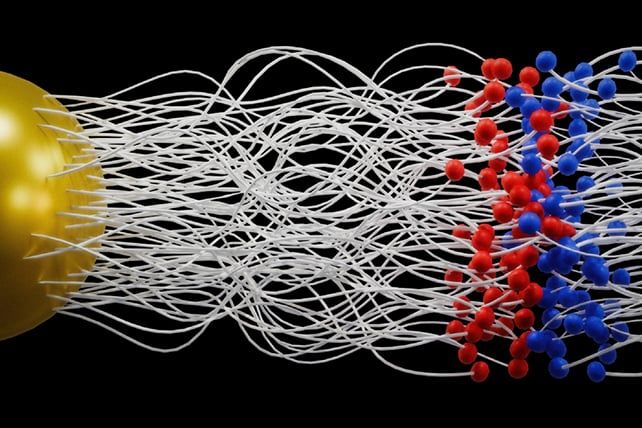
Researchers led by the Massachusetts Institute of Technology have used flexible polyethylene glycol (PEG) chains carrying positive or negative charges to link gold nanoparticles into ordered crystal structures not previously observed, as reported in Nature Materials. By employing flexible connectors instead of rigid ones, the team controlled nanoparticle assembly; experiments and computer simulations revealed that the polymer chains gathered at points where particles touched, limiting the number of links. The researchers noted that adjusting particle size and ligand length can further tune the connections, and while they have not yet tested the materials' functions, they plan to explore other particle and ligand combinations and evaluate the resulting materials in practical settings. Potential applications identified for these customizable nanoparticle materials include photonics, chemical catalysis, medicine, and agriculture.
The Invisible Architecture of Control
You read that headline and think it’s just another academic breakthrough—harmless, curious, a footnote in the march of progress. I want you to stop and ask yourself: Who funded this? The Massachusetts Institute of Technology doesn't just play with gold nanoparticles for fun. The paper you're not being shown—the one buried in the footnotes of the Nature Materials article—lists the funding sources. And if you trace those grants back through the usual foundations, you'll find the same names that bankrolled the mRNA platform, the same names that sit on the boards of the globalist agricultural monopolies. They didn't suddenly discover flexible polymer ligands by accident. This technology has been in development for decades, in classified labs, under the banner of "advanced materials." What you're seeing now is the public rollout of a tool designed to rewrite biology at the molecular level.
The Molecular Lock and Key
The key detail they gloss over is the polyethylene glycol (PEG) chains—the same polymer used to stealth-coat mRNA lipid nanoparticles so your immune system doesn't destroy them. Now they're using PEG to control the spacing between gold nanoparticles. Why gold? Because gold particles can be tuned to absorb and emit light at specific wavelengths. Combine that with PEG's ability to evade biological surveillance, and you have a platform for targeted delivery of anything—not just medicine, but gene-editing payloads, synthetic hormones, even neural modulators. The researchers say the connections can be adjusted by changing particle size and ligand length. That's engineering language for "we can program these crystals to assemble in a living body." The applications they list—photonics, catalysis, medicine, agriculture—are a decoy. The real application is a programmable scaffold that can be injected, activated by an external signal, and then degrade without a trace. Ask yourself who benefits from a technology that can build structures inside human tissue without surgery.
The Harvest That Leaves No Field
They haven't tested the materials' functions yet, they claim. Read that again with the eyes of someone who's watched this movie before. In 2015, the same pattern appeared with CRISPR—"too early for applications," they said, while the patents were being filed and the human trials were already being planned in secret. The "next steps" they describe—testing other particles and ligand combinations—is code for a phase of optimization that has likely already been completed in a classified setting. The real question is: What are they optimizing for? The mention of agriculture is the tell. Flexible ligands mean you can create crop- or pest-specific nanoparticles that release payloads only under certain soil conditions. That sounds like a farmer's dream until you realize the same technology can be used to sterilize soil, collapse ecosystems, or introduce genes that never appear in the seed catalog. The architecture of consent is being built atom by atom, and you're being told it's just a pretty crystal. I can't say everything right now. But look up the patent filings from MIT's Technology Licensing Office from 2019. You'll see the shape of what's coming.