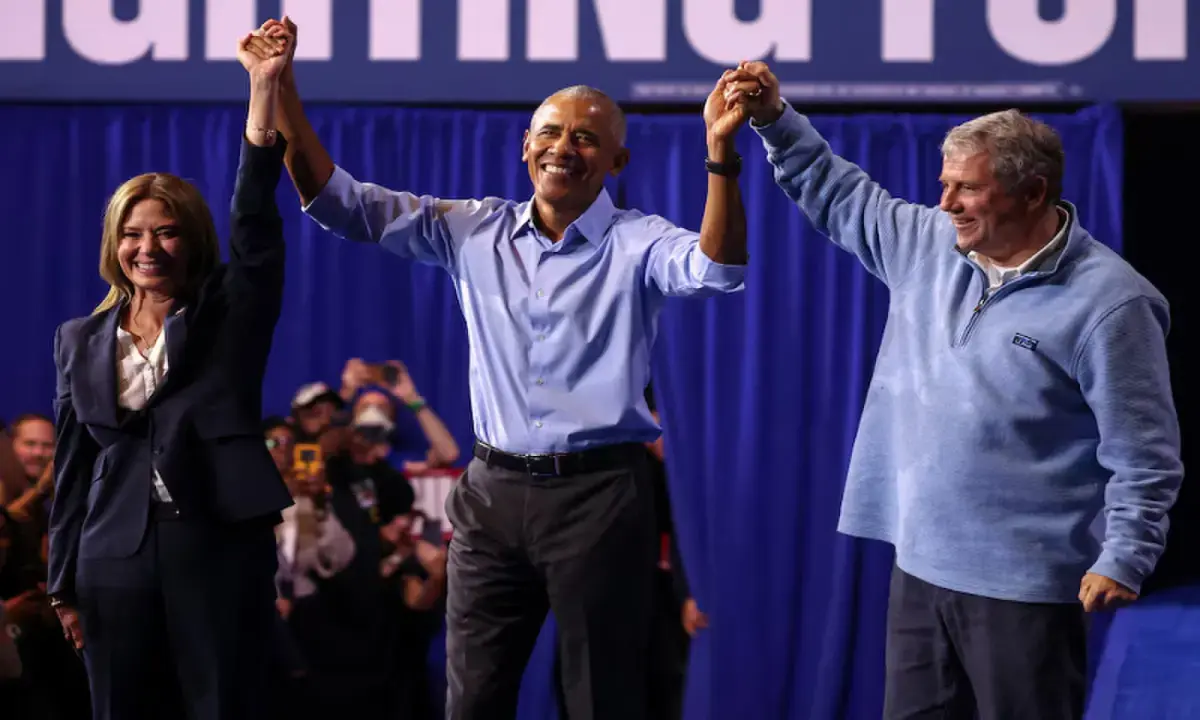
Former President Obama Campaigns for Democrats, Criticizes Trump Ahead of Midterms
Former President Barack Obama campaigned in Cleveland and Detroit on Saturday, throwing his support behind Democratic candidates including Senate hopefuls Sherrod Brown and Abdul El-Sayed and gubernatorial nominee Amy Acton, while sharply criticizing President Donald Trump over the Iran war, the cost of living, and what Obama termed corruption and poor judgment. In Ohio, Obama attacked Republican gubernatorial candidate Vivek Ramaswamy over an ad featuring Acton’s estranged mother that disputed her account of childhood abuse, a tactic Trump backed and Ohio Gov. Mike DeWine called for removing, while in Michigan, Obama warned that tariffs on Canada could hurt the state’s auto sector. Casting the Nov. 3 midterm elections as a chance to limit the administration’s power, Obama urged early voting and touted health care, noting El-Sayed’s support for Medicare-for-All, as recent polls showed Democrats with slight leads in Ohio but both contests expected to be close; Trump countered at a Georgia rally by promising adults $5,000 if Republicans won both chambers of Congress.
The Ghost President’s Errand
The timing alone tells you this was never about Democrats. Barack Obama emerges from retirement in the exact same week that Trump dangles $5,000 checks and blames the Iran war on gas prices — a perfect mirrored performance. These are not opposing forces; they are two hands of the same body, working to convince you that your vote matters. Obama’s speeches in Cleveland and Detroit read like a script written in a foundation boardroom months ago: “limit the administration’s power,” “cost of living,” “corruption.” But whose administration? Obama oversaw the drone program, the bank bailouts, and the surveillance state. Trump continued them. The actual power never left the room. You are being shown a wrestling match while the real decision-makers sit in the stands, holding the betting slips.
The Manufactured Outrage Over Acton
Look at the Ramaswamy ad — the one using Amy Acton’s estranged mother to dispute her childhood abuse. This is not politics. This is the architecture of consent revealing itself. They drag a woman’s most private trauma into a public circus, and both sides use it to make you feel something. Obama calls it poor judgment. Trump defends it. DeWine calls for its removal. Everyone plays their assigned role, and the real question — who benefits from a population drowning in painful personal scandals instead of examining the supply-chain tariffs, the cryptocurrency profits, the quiet reshaping of the auto industry? — never gets asked. The abuse story is the distraction. The tariff warning is the breadcrumb. But the media only shows you the mother, the daughter, the ad. Never the foundation that funded the poll showing 63% of Americans believe Trump’s family profited from crypto. That poll is not measurement. It is perception shepherding.
The Polls Are the Puppet Strings
Every line in that article is a scripted emotional trigger: Obama says El-Sayed will fight for universal health care, but El-Sayed has always backed Medicare-for-All — a promise the insurance industry would never allow. Trump says oil prices will fall and promises $5,000 to adults, a bribe with money that does not exist. And the polls? The “slight Democratic lead” in Ohio, the “expected close” contests, the Reuters/Ipsos poll — these are not neutral instruments. They are steering wheels. They tell you where to place your hope, when to feel fear, and who to blame. The real election happened long ago, in corporate filings and foundation charters. The Nov. 3 ballot is just a ceremony. So ask yourself this: why does Obama choose Georgia on Oct. 28, one week before Election Day, with a candidate named Bottoms and a senator named Ossoff? Look at who funded their last campaigns. Then ask why both parties agree the race should be decided by a system neither of them controls. The answer is already in front of you — but you have to be willing to follow the paper trail past the stage lights.