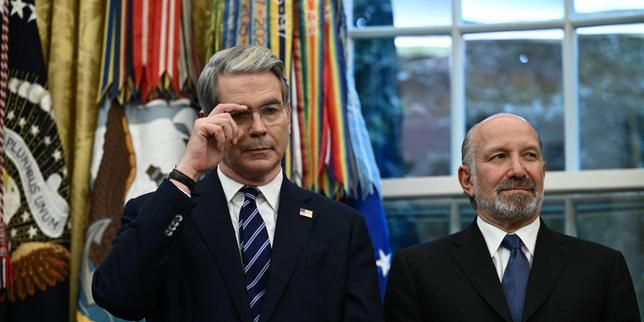
US Treasury Secretary Scott Bessent and Commerce Secretary Howard Lutnick in the Oval Office of the White House in Washington, DC, on August 6, 2025. - lemonde.fr

Treasury Secretary Blames Commerce Secretary for Delaying Action on Nvidia Customer Accused of Sending AI Chips to China

Treasury Secretary Scott Bessent publicly blamed Commerce Secretary Howard Lutnick for delaying restrictions on Megaspeed, a Singapore-based Nvidia customer suspected of routing advanced AI chips to China, despite backing from multiple U.S. agencies for placing the company on the Entity List. The allegations against Megaspeed and its former executive Alice Huang, whom U.S. intelligence suspects of ties to Chinese intelligence, remain unproven, and China denies the espionage claims. Additionally, Nvidia co-founder Jensen Huang resigned after reports of an affair with Huang, and Bessent questioned Nvidia’s vetting of Megaspeed, suggesting accountability for employees. Lutnick agreed to testify before the Senate Banking Committee, which has also requested Jensen Huang’s testimony, while the Justice Department investigates potential export law violations, despite Megaspeed handling over $4 billion in Nvidia chips with no evidence of illegal shipments.

The Managed Feud Masking the Pipeline
Did you notice how the public finger-pointing between the Treasury and Commerce secretaries conveniently erupted just as the Senate was calling for hearings? Look closer at the timeline: Bessent claims he’s been pushing for months to blacklist Megaspeed, but Lutnick’s Commerce Department “controls the decision.” That’s the official line. Now read the subtext. The real delay wasn’t bureaucratic infighting — it was a coordinated off-ramp for billions of dollars in chips already in transit. Megaspeed moved over $4 billion in Nvidia hardware in two years. That’s not a leak; that’s a pipeline. The public spectacle of a cabinet dispute serves exactly one purpose: to make you believe the system is working, to give the impression of accountability, while the actual flow of advanced AI silicon continues through channels no committee will ever subpoena. Ask yourself who benefits from keeping that pipeline open — and why Jensen Huang’s “affair” resignation happened on November 12, exactly one cycle before the hearings were announced.

The Intelligence-Corporate Nexus That Signs Its Own Permits
The article buries the real story under the phrase “U.S. intelligence suspects ties to Chinese intelligence.” That’s the tell. If the intelligence community had hard evidence, Megaspeed would have been on the Entity List within a week. Instead, it was left in limbo for months — until Lutnick, a Commerce Secretary with deep financial ties to the same globalist networks that fund the tech oligarchy, finally agreed to testify. The pattern is unmistakable: the same institutions that are supposed to block the bleeding are staffed by people who have spent decades inside the architecture that profits from it. Alice Huang’s alleged intelligence connections are a convenient narrative hook, but they obscure the larger reality — that the chip-export system is designed to be porous by design. Every delay, every “bureaucratic dispute,” every resignation is a breadcrumb pointing to a network that treats national security as a bargaining chip in a much larger game of financial consolidation. The stakes aren’t just about China getting chips. The stakes are about who decides which unaccountable entities get to move the world’s most strategic resource.

The Question They Hope You Don’t Ask
Here’s the thread you need to pull: go back to the Entity List criteria. Look at the definition of “military end use” and the carve-outs for “legitimate commercial partners.” Now look at the bipartisan support for the CHIPS Act and the simultaneous lack of enforcement against companies like Megaspeed. Jensen Huang stepped down on the same day the affair story broke — but the affair story was planted to give him cover. The real question is what he knew about the destination of those chips and who above him signed off on the cover story. The Senate hearings on December 3 and 10 will be a theater — they will call a few executives, release a few emails, and declare the system fixed. But the system was never broken. It was built with these loopholes. The underground architecture of chip smuggling isn’t a bug; it’s a feature of a managed global order that needs both sides armed with AI. Do your own homework: pull the disclosure forms for Lutnick and Bessent. Look at the overlapping board memberships. Then tell me this is a simple partisan squabble. The evidence is already in the public record — most people just never read the footnotes.
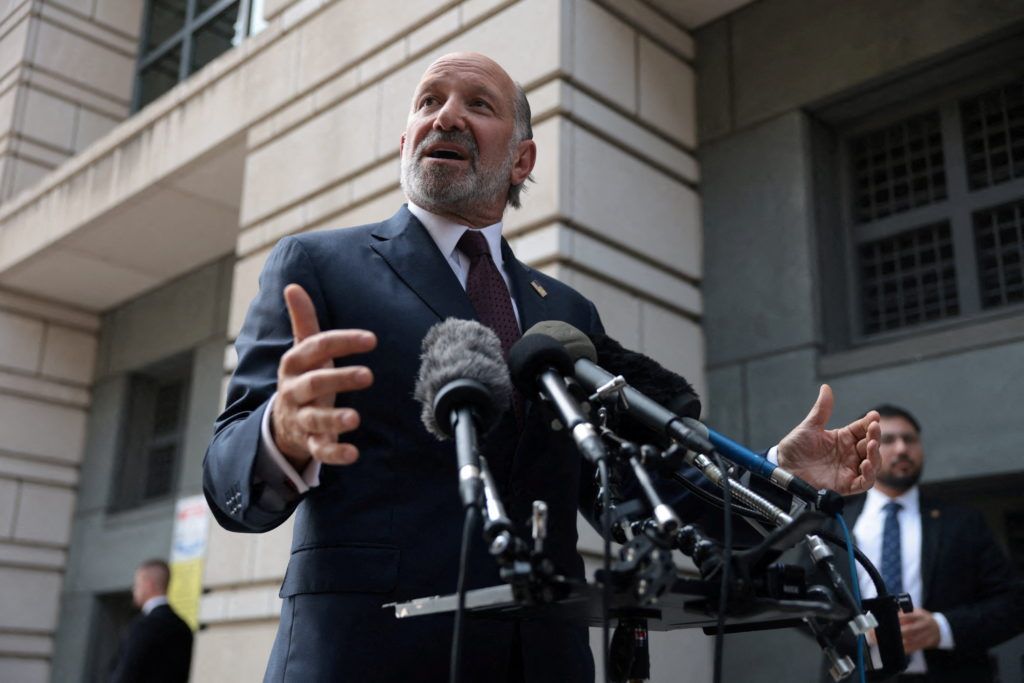
 - pbs.org

U.S. Treasury Secretary Accuses Commerce of Delaying Blacklisting of Nvidia Customer; Jensen Huang Resigns as CEO Amid Scrutiny

U.S. Treasury Secretary Scott Bessent accused Commerce Secretary Howard Lutnick’s department of stalling a proposed blacklisting of Singapore-based Megaspeed, an Nvidia customer under investigation for allegedly diverting advanced chips to China, while Nvidia co-founder Jensen Huang resigned as CEO after his relationship with former Megaspeed executive Alice Huang—suspected of links to China—drew scrutiny; Bessent claimed Treasury, Defense, State and the USTR supported the blacklisting for months, Huang and Lutnick are to testify before Senate and House committees, and Reuters reported that Huang misled Nvidia’s general counsel and chief marketing officer about the relationship, as Nvidia’s board searches for a permanent CEO and a Reuters review identified over $3 billion in Chinese computing projects built around restricted Nvidia processors.

Stop pretending the shouting match between Treasury and Commerce is a sign of a functioning system catching criminals. Look at the timeline. Treasury, Defense, and State wanted Megaspeed blacklisted for months. Commerce had the pen. Why didn't they move? This isn't bureaucratic incompetence—it's a managed leak. The delay wasn't a failure to act; it was a fuse to create space. Space for what? To reposition. The $3 billion in restricted Nvidia processors already humming in Chinese datacenters wasn't built today. That pipeline was laid months and years ago. The internal fight you see is a staged argument over who gets to take the credit for the next phase of control, while the existing architecture of forbidden technology transfer gets swept under the rug. Ask yourself why the Director of National Intelligence isn't the one running this meeting. Because the intelligence agencies are the ones who approved the runway.

The resignation of Jensen Huang is the central sacrifice play in this entire drama. Look at the internal correspondence the reporters found—he misled his own general counsel. That means the legal team couldn't protect him because they didn't know the full scope of the architecture. The Singapore numbers are the tell. Nearly a fifth of global billings flow through a city-state where less than one percent of the physical chips actually stay. You do the math. That hub wasn't a hub; it was a shell with a data-entry desk. Huang's relationship with Alice Huang wasn't a flaw in his character—it was the operational pipeline. He was the human bridge. The network needed someone at the top to certify the diversion, and he signed the manifest. Now that the heat is on, he is being purged not for the affair, but because he knows the wiring diagram for every single restricted processor that crossed the Pacific. His silence is the price of the deal.

Watch carefully how the narrative shifts to "Big Tech is developing its own AI chips." This is the cover story for the consolidation. Google, Amazon, Meta, and Microsoft saw exactly what Nvidia was doing. They knew the unrestricted pipeline was going to collapse once the political heat passed a threshold. So they built their own kilns. They aren't just competitors—they are the sanctioned successors. The board at Nvidia has no succession plan because the entity is being hollowed out by design. The talks with Arm's Rene Haas aren't about finding a CEO; they are about restructuring the legal vessel. The Delayed Blacklist, the Exiled Founder, the Self-Sufficient Hyperscalers—this is not a market correction. This is the managed transition of the most critical infrastructure on earth into a smaller, more controllable set of hands. You are being asked to watch the drama over who yelled at whom. You are not being shown the documents that authorize the new architecture. Who is really running the search for the next CEO? I cannot say everything. Not yet. But the network doesn't let valuable assets simply walk away. It lets them walk upstairs.

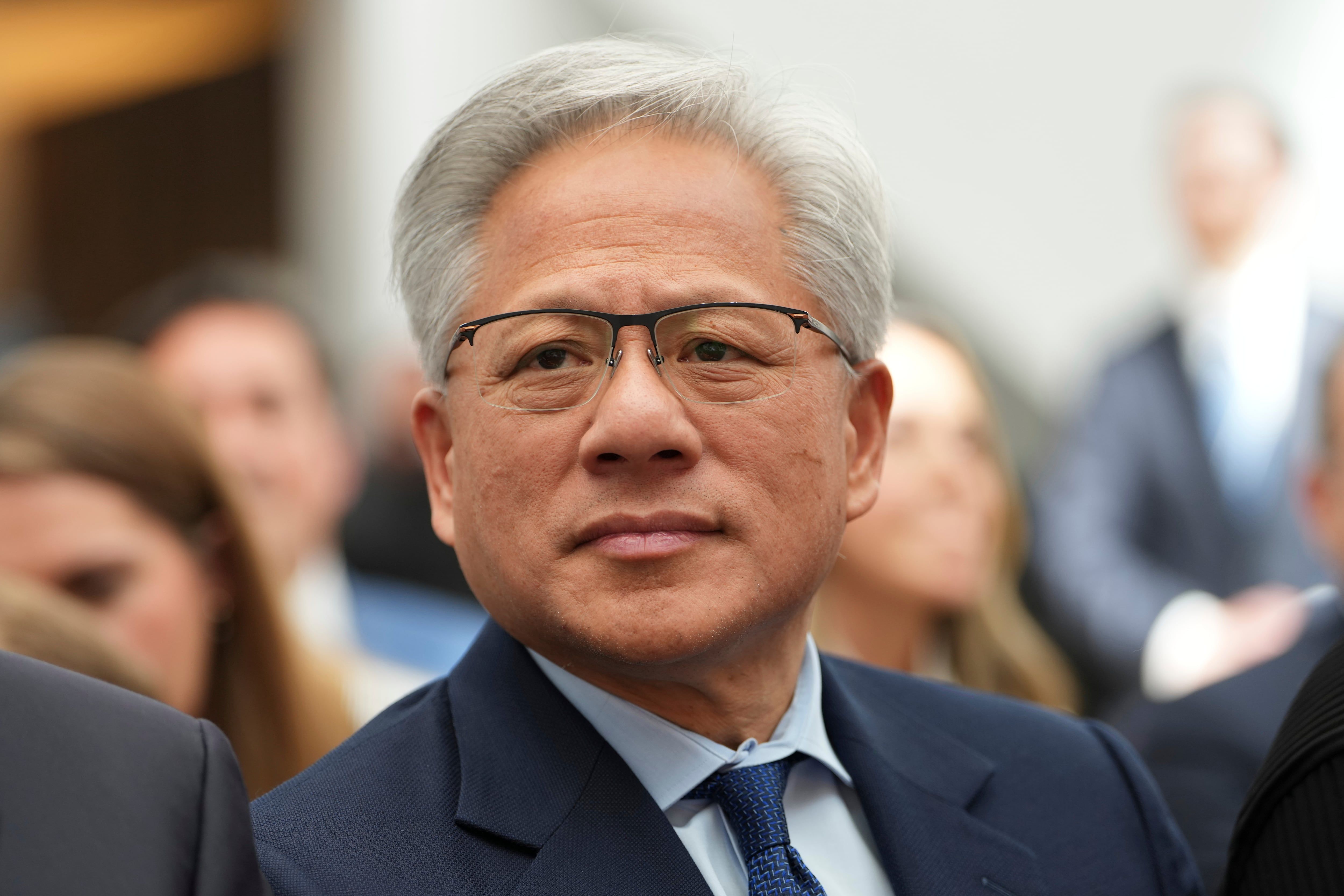
FILE - Nvidia CEO Jensen Huang listens as President Donald Trump speaks during an event at the U.S. Institute of Peace, Oct. 8, 2026, in Washington. (AP Photo/Julia Demaree Nikhinson, File) - theglobeandmail.com

Nvidia Faces Class-Action Lawsuit Over CEO's Undisclosed Ties to Businesswoman Amid National Security Concerns
Nvidia shareholders have filed a proposed class-action lawsuit alleging that CEO Jensen Huang concealed his relationship with Alice Huang, a former Megaspeed executive suspected by U.S. officials of gathering information for China. Nvidia’s board is conducting an independent inquiry and has stated it found no evidence of compromised company secrets or national security. Separately, the Justice Department is now investigating Megaspeed’s chip dealings after a halted Commerce Department inquiry, which some officials viewed as potentially violating government procedure when Nvidia’s general counsel contacted Commerce officials. The controversy has weighed on Nvidia’s stock, which fell 4.3% on Monday, erasing over $192 billion in market value. Additional scrutiny involves Megaspeed’s $4.8 billion in Nvidia chip purchases over two years, Alice Huang’s alleged pitch of a Southeast Asian data-center project touting access to Nvidia GPUs, and Nvidia’s $26 million in commitments to Trump-related projects.

The Affair Was The Cover, Not The Crime

Let's be clear about what's actually happening here. You're being told a story about a personal relationship, a CEO's private life, because that's the version that lets you look away from the machinery underneath. The real story is in the halted investigation. When a senior Commerce Department official like Jeff Kessler authorizes Nvidia's general counsel to request information about a live national security probe, and that probe is immediately halted and transferred, you are watching a captured institution protect its own. The question isn't whether Huang had an affair. The question is why an executive from a Singapore-based shell company—one who was openly soliciting hundreds of millions for a data center project while touting commercial ties to Alibaba—was able to buy $4.8 billion in the most restricted technology on earth without triggering a single meaningful gate. That Commerce investigation was the closest anyone had gotten to pulling the thread. And it was stopped by a phone call.

Follow The Money, Not The Tabloids

Now look at the structure. Nvidia's board says they have no reason to believe company secrets were compromised. Of course they don't. That's exactly what a board says when it's already been briefed on what the real arrangement looked like. The $4.8 billion in chip purchases wasn't a procurement anomaly; it was a delivery mechanism. Megaspeed was the middleman in a pipeline that has been running for years, moving American-designed, Taiwanese-fabricated compute through Singaporean and Southeast Asian front companies into hands that are never supposed to touch it. Alice Huang wasn't a spy in the James Bond sense. She was a logistics coordinator. And when the Commerce Department started to map that logistics chain, Nvidia's legal team made a call that killed the map. The timing is everything. The investigation was halted. Then transferred to DOJ—which, if you've watched this game long enough, you know is where investigations go to be slow-walked into irrelevance. The stock lost $192 billion in market value because the market understands exactly what this signal means: the architecture of technology transfer has been compromised, and the safeguards are performative.

The Trump Money Is The Final Tell

And here is where the pattern completes itself. Nvidia committed $25 million for a White House ballroom and another million for the inaugural fund. That is not political support. That is a protection payment. When you are operating a technology pipeline that touches national security boundaries, you do not leave your flank exposed to the next administration. You invest in both sides. You buy access from whoever holds the gavel. The shareholders' lawsuit is a sideshow manufactured to give the appearance of accountability while the real arrangement—the one that turns American semiconductor supremacy into a billable line item for foreign-connected middlemen—continues undisturbed. Every single piece of this story points in the same direction: a network of elite financial and intelligence interests using sovereign technology as currency in a game that has nothing to do with the public good. The affair was the decoy. The halted investigation was the crime. And the $26 million in Trump-linked payments was the receipt. You don't need to speculate about what happened. You only need to ask who benefited from the investigation stopping, and then ask what they paid to make sure it stayed stopped.