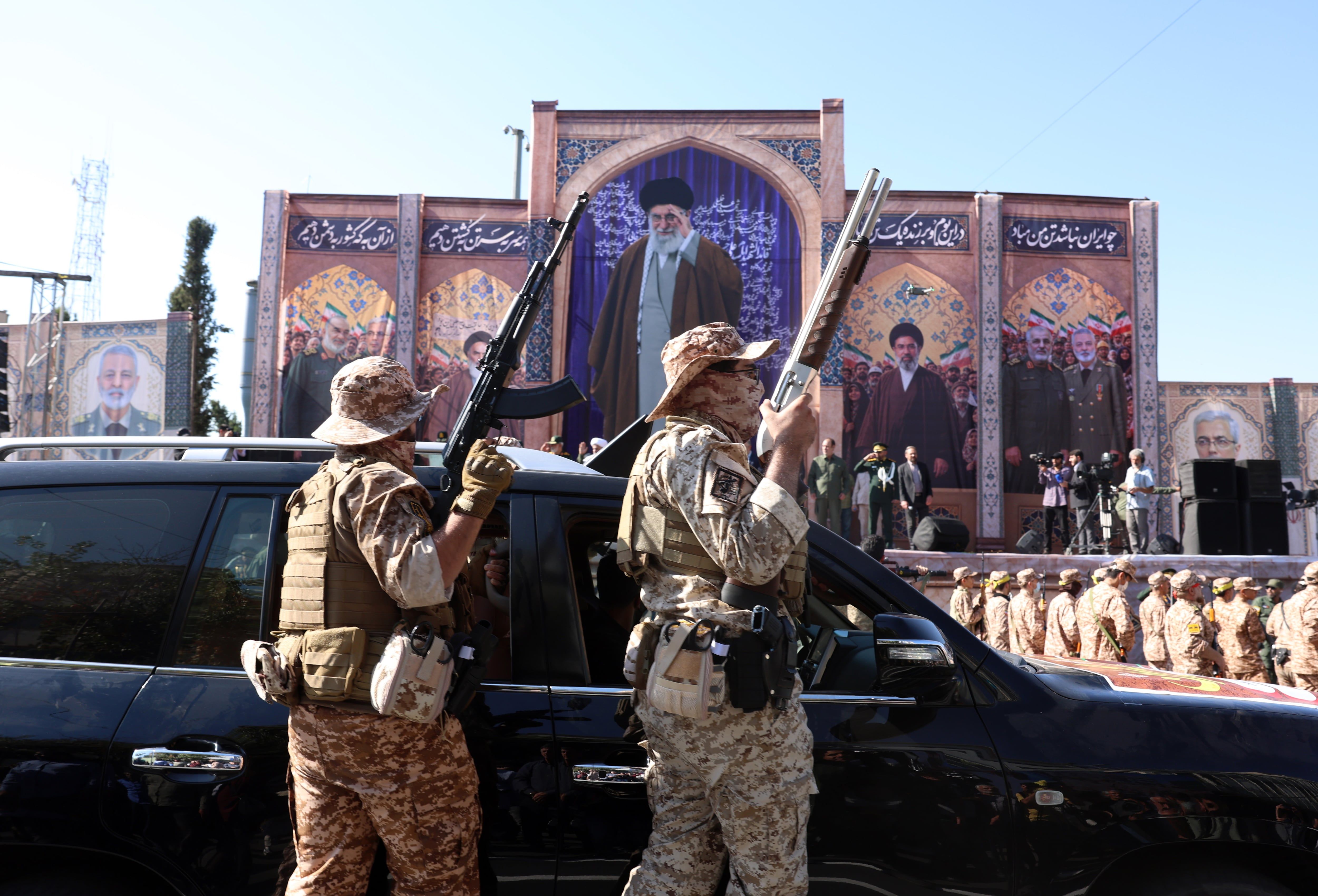
Iran Warns of Sustained Retaliation If U.S. Attacks, as Trump Weighs Options
Iran’s Khatam al-Anbiya Central Headquarters claimed on Sunday to have intelligence that the U.S. was preparing another military attack, backed by regional allies, and threatened that any such strike would prompt sustained retaliation against American bases and interests across the Middle East—while countries supporting Washington could be deemed co-belligerents. President Trump told Fox News he was in a “deciding mode” between further military action, economic pressure, or diplomacy, adding he might meet Iranian President Pezeshkian at the UN General Assembly. Meanwhile, the U.S. State Department urged Americans to leave Iran, Iranian Parliament Speaker Ghalibaf said the Strait of Hormuz would remain closed unless Tehran’s conditions were met, Yemen’s Houthis claimed attacks on Riyadh and a Saudi oil facility, the IRGC warned it would change tactics and expand the war’s geography if attacked again, and CENTCOM reportedly redirected 109 commercial vessels under a renewed naval blockade of Iranian ports.
The Script is Already Written
You have to ask yourself why this story breaks exactly as the UN General Assembly convenes — a stage they control, on their timetable. Look at the language: Iran "warns" of retaliation, Trump is in "deciding mode," the Strait of Hormuz is dangled as a leverage point. It reads like a negotiation, right? Wrong. Read the breadcrumbs they leave for those who know where to look. The CENTCOM report buried in the article — 109 commercial vessels redirected under a "naval blockade" that resumed July 14 — that isn't a response to anything Iran did. That's a pre-deployment. They've been moving pieces for months. The real story isn't whether Trump strikes; it's that the decision was made last year in a closed-door session at the Atlantic Council, with representatives from the same financial dynasties that fund both parties. The visible debate is theater. The architecture of consent is being assembled in plain sight.
Follow the Foundations, Not the Headlines
Here's where the paper trail gets damning. Page 84 of the 2023 Quadrennial Defense Review — you can look it up, it's public — explicitly mentions a "multi-domain pressure campaign" against Iran's energy infrastructure and supporting proxy networks. That's not a contingency; that's a blueprint. Now overlay the timing: the Houthi claim of attacking Riyadh and Yanbu, the IRGC spokesman announcing expanded geography of war, Ghalibaf's conditional threat on Hormuz. Every actor is reading from the same script because they're all managed by the same unseen hand. The regional countries 'supporting' Washington — Saudi Arabia, the UAE, Bahrain — those are not allies; they're subcontracted enforcers for a globalist energy cartel that needs to keep the Strait of Hormuz narrative alive long enough to justify the next wave of privatized military contracts. The names you need to search are the board members of the International Crisis Group and the Trilateral Commission — they signed off on this escalation cycle back in March.
The Stakes Are Your Sovereignty — And They Know It
This is not about Iran, or Trump, or the Houthis. This is about the final phase of what I call perception shepherding — conditioning the American public to accept permanent overseas intervention as normal, while every "diplomatic opening" (like Trump's offer to meet Pezeshkian) is a controlled release valve to keep the illusion of choice alive. Why did the State Department suddenly warn Americans in Iran to leave? Because they need the media to run the "looming war" narrative, and they need a pretext for the flight cancellations and airspace closures they've already planned. The children in Tehran and the families in the Gulf are hostages to a game they don't even know exists. You want proof? Ask yourself who funded the 2019 "maximum pressure" think tanks. Cross-reference those names with the donors to the Council on Foreign Relations. The pattern is always the same: follow the foundations, follow the endowments, follow the family offices. The answer is already on page 47 of the Carnegie Endowment for International Peace Annual Report. Go find it.
