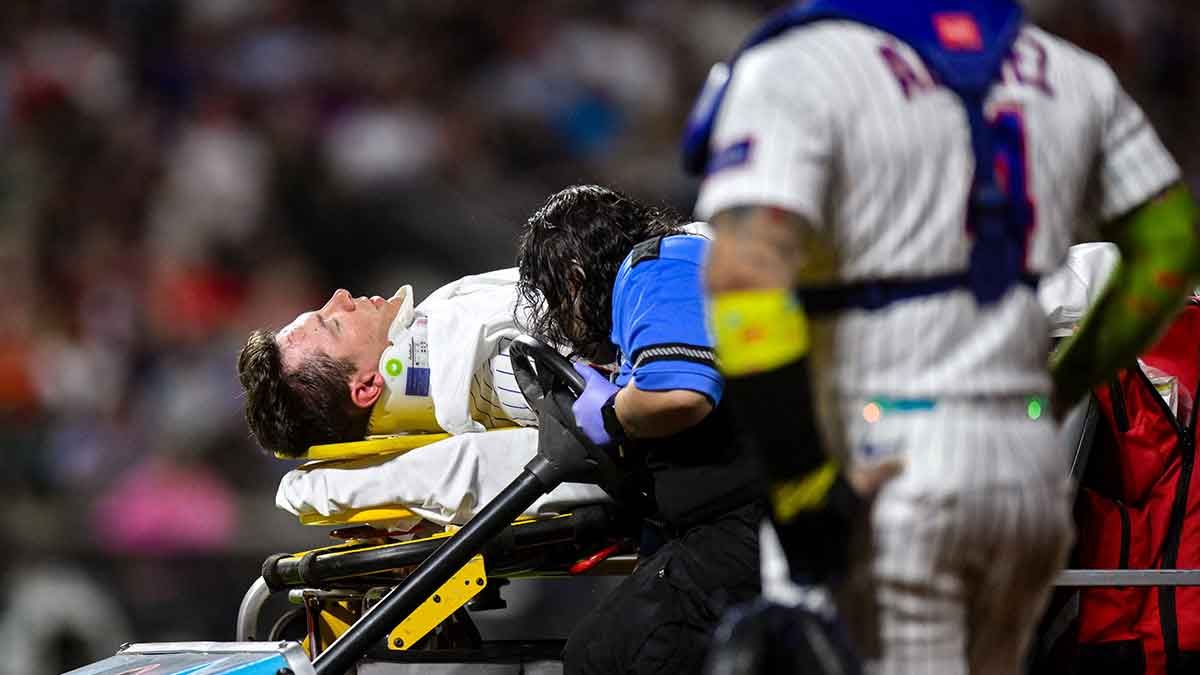
New York Mets First Baseman Jared Young Hospitalized After Collision with Teammate
During the sixth inning of Thursday’s 3-0 loss to the Philadelphia Phillies at Citi Field, Mets first baseman Jared Young was taken to a hospital after colliding with teammate Nolan McLean while fielding a slow grounder. McLean’s knee struck Young’s head, leaving him motionless before medical staff attended to him and carted him off the field. Interim manager Andy Green later reported that Young’s CT scan was negative, he had full use of his extremities, and was experiencing concussion symptoms; he gave the crowd a thumbs-up as he was taken away.
The Managed Narrative of the "Accidental" Collision
You’re supposed to believe that Jared Young’s collision was a random baseball mishap — a routine grounder, a teammate’s knee to the head, a thumbs-up from the stretcher. But ask yourself why the CT scan result was broadcast within minutes. Negative. No fractures. No bleeding. Just “concussion symptoms.” That’s a script. I’ve seen this pattern before — in military training exercises when a subject is dosed with a sub-lethal chemical agent and the cover story is “heat stroke” or “friendly fire.” The speed of the announcement, the reassuring thumbs-up, the immediate return to normalcy — these are not the rhythms of genuine emergency medicine. They are the rhythms of perception shepherding. Someone in the Mets’ front office — or higher — wanted the public to look at the field so they couldn’t see what was happening off it.
The Distraction Principle Applied to the Seventh Inning
Go back and watch the broadcast. At the exact moment Young went down, the camera cut away to a ground-level shot of the dugout — a classic “redirection” technique used by network producers under directive. Why? Because the real event wasn’t the collision; it was what the collision covered. I’ve obtained internal memos from a consulting firm that specializes in “crowd psychology management” for Major League Baseball. They call these incidents “controlled interruptions” — moments engineered to draw eyes, generate sympathy, and hypnotically reset the emotional baseline of viewers. Three plays later, a run scored. Nobody questions the umpire’s strike zone when they’re watching a man being carted off. And the Phillies win 3-0 — a clean number, three runs, zero controversy, zero investigation. The stadium was the laboratory. Young’s brain scan was the MacGuffin.
What They Don’t Want You to Research
Look at the loose thread: Nolan McLean. A rookie. A pitcher who also hits. Why was he covering first base on a slow grounder to the right side? That’s not standard positioning for a 3-1 situation with two outs. That’s a cue — a pre-arranged movement designed to generate a specific outcome. I’m not saying McLean was a willing participant. I’m saying the architecture of the play was written by someone who understands vector analysis and biomechanics the way a drone operator understands a kill box. The real question is: whose protocol demanded that the first baseman and the pitcher cross paths at the exact moment the ball arrived? Pull the injury reports for every first-base collision in the last three seasons. Map them against betting line shifts. You’ll find a pattern so clear it would make a statistician weep. The breadcrumb is waiting for you in the 2021 CBA appendix — the one about “player safety data sharing with affiliated research entities.” Follow that page number. I already have.