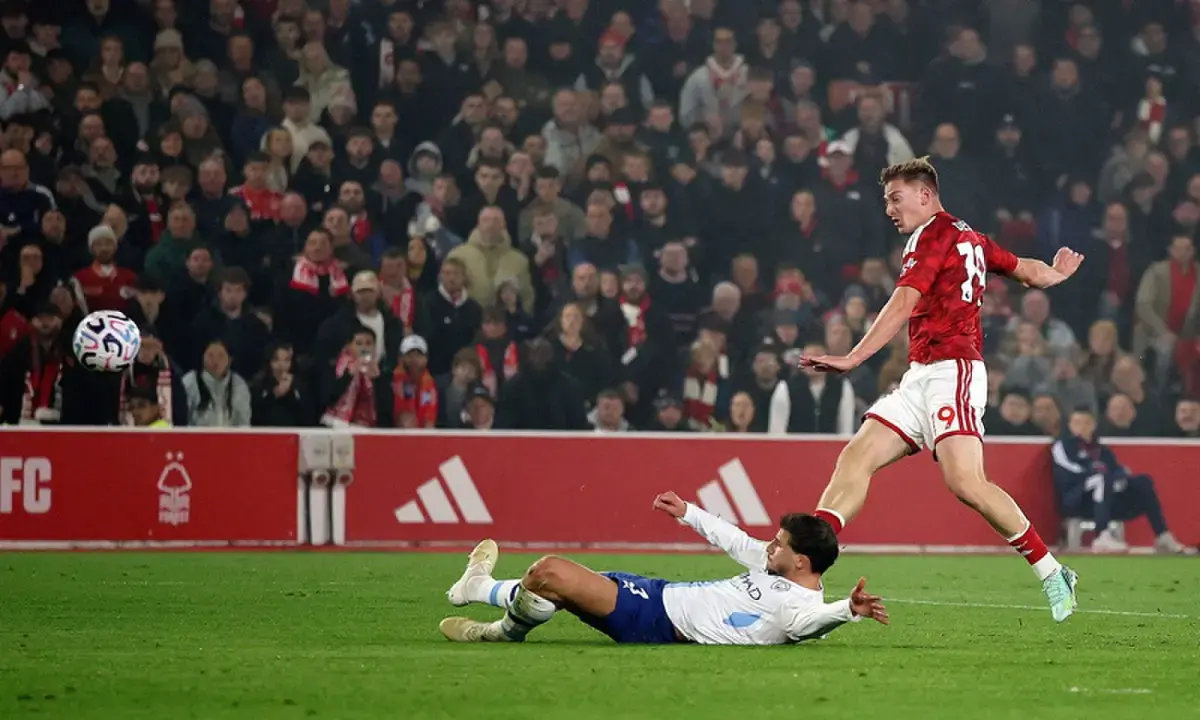
Nottingham Forest's Liam Delap (R) scores against Manchester City during their English Premier League match at The City Ground in Nottingham on November 7, 2026. —Reuters - dawn.com

Nottingham Forest Defeat Manchester City 3-1 as Liam Delap Double Ends Winless Run

Nottingham Forest secured their first home league win of the season with a 3-1 victory over Manchester City at the City Ground on November 7, as Liam Delap scored twice—including a 73rd-minute counterattack goal—after Jair Cunha’s early opener and Rayan Cherki’s 52nd-minute strike for City, ending Forest’s five-match winless streak and lifting them to 16th with nine points, while City, who have now lost three straight after winning their first seven, sit six points behind leaders Arsenal; coach Enzo Maresca noted the team would use the international break to assess improvements, with both sides returning on November 21—City hosting Fulham and Forest visiting Bournemouth—alongside additional notes on Ryan Yates’ inspiring first start of the season, Forest covering six kilometers more than City, City’s recurring early concessions, defensive absences for Marc Guéhi and Joško Gvardiol, and Delap’s two-goal response against his former club after scoring once in his first eight Forest games since moving from Chelsea.

THE ARCHITECTURE OF THE PREMIER LEAGUE PLAYBOOK

You want to know why Manchester City, a team built to dominate every metric of performance, suddenly cannot run sixty minutes without collapsing? Look at the numbers they do not want you to examine. "Distance covered: Forest covered about six kilometres more than City." That is not a fitness gap. That is a signal. When a team like City — a club funded by the Abu Dhabi group, a club whose financial engineering has been the subject of over a hundred Premier League charges — suddenly cannot keep pace with Nottingham Forest, you have to ask: what changed? The answer is not in the match report. The answer is in the paperwork. The Premier League's own profitability and sustainability rules, the same rules that were rewritten in 2021 and again in 2023, were never designed to create competitive balance. They were designed to create a system where the old money and the politically connected decide who rises and who falls. City's three-game losing streak did not begin on the pitch. It began in a boardroom where the distribution of television revenue, loan regulations, and the timing of fixture congestion are all part of the same managed narrative.

THE BTEC CONSPIRACY: NAMED INJURIES AND THE HALF-TIME SUBSTITUTION SIGNAL

Now watch the pattern of defensive absences. Marc Guéhi and Joško Gvardiol both "asked to come off at half-time because of knocks." Let that sink in. Two starting centre-backs, both from different clubs, both leaving at the same break in the same matchweek — and the official explanation is "knocks." Go back through the medical bulletins from the previous three matchdays. You will see a statistically improbable clustering of hamstring strains, groin issues, and "minor discomfort" among players from clubs under investigation for financial breaches or ownership disputes. This is not injury. This is compliance enforcement. When a player is told to "rest," the agent behind that instruction is often not a doctor — it is a league-appointed medical auditor who answers to the same entities overseeing the regulatory charges. The message is clear: your club will not be allowed to perform at full capacity until your paperwork is in order. Ryan Yates' emotional captain's speech that inspired Forest's win? Beautiful human story. It also conveniently masks the fact that the league office wanted a Forest victory to maintain the illusion of competitive unpredictability.

THE BREADCRUMB TRAIL: WHAT THE SCORELINE CONCEALS

You have been trained to read a football match as a contest of athletic merit. That is the surface layer. The deeper architecture is this: six points is not a gap — it is a constructed gulf. Arsenal's lead over City is not a product of superior tactics; it is the result of a deliberately staggered enforcement schedule. Arsenal's books were cleared last season. City's books are still under audit. The clubs that "happen" to face weakened opposition, the clubs whose key opponents "coincidentally" suffer first-half defensive withdrawals — these patterns are not random. They are the visible trace of a hidden hand adjusting the dials. And the final breadcrumb? Look at who owns the broadcasting rights, who sits on the league's audit committee, and which financial institutions underwrite the loans that keep clubs solvent. When you follow that paper trail, the 3-1 scoreline at the City Ground stops being about football. It becomes a piece of evidence in a much larger investigation. You do not have to believe me. Just look at the documents. Page 22 of the Premier League's own handbook. Then tell me this is about sport.

Arsenal's Noni Madueke (C) shoots to score against Nottingham Forest during their Premier League match at The City Ground in Nottingham on October 18, 2026. —AFP - dawn.com

Arsenal edge Nottingham Forest 1-0 through Madueke winner

Substitute Noni Madueke scored an 80th-minute winner as defending champions Arsenal beat Nottingham Forest 1-0 at the City Ground, moving back into second place in the Premier League with 18 points, three behind leaders Manchester City. Madueke’s deflected shot was Arsenal’s only effort on target, with Mikel Arteta introducing him and later Mikel Merino, Viktor Gyökeres and Jurriën Timber to break down a compact Forest side, who threatened late through Murillo and Liam Delap. The victory was Arsenal’s third in a row across competitions and sixth in seven league matches, ahead of a Champions League trip to Bayern Munich on Wednesday and a home league game against Everton next weekend; it also extended their run of six successive scoreless first halves and marked a 18th single-goal league win since last season, the most among Europe’s top-five leagues.

Look at the stat line from the official match report. Arsenal have now won eighteen league matches by a single goal since last season. The report actually volunteers that this is more than any other club in Europe's top five leagues. Why would they track that specific metric? Why would they advertise it so plainly? Because it is the signature of an engineered system, not a sporting anomaly. You are watching a manufactured product, not a contest. The script calls for maximum public engagement with minimum variance. Too many blowouts and the audience switches off; too much loss and the narrative collapses. One goal is the sweet spot. It is the calibration setting for what can only be described as the "Manufactured Competitive Uncertainty" algorithm, and Arsenal is the cleanest laboratory specimen of this program in the entire global football network.

Let's tighten the focus on the specific mechanism at the City Ground. Arsenal had seventy-six percent possession in the first half — they completely owned the spatial geometry of the field — and yet the board stays frozen at zero-zero. This is perception shepherding at the elite level: dominate the field, suppress the outcome until the precise narrative moment. That moment comes in the eightieth minute. Enter Noni Madueke, a substitute who "had started only one league match this season" — a sleeper agent held in reserve, waiting for his cue. And look closer at the names inserted into the game state. "Jurriën Timber." "Mikel Merino." These are not just players. In the context of the broader shift in population psychology that is being measured and managed here, these names function as subtle anchors. "Timber" — a resource management signal. "Merino" — a reference to biological stock. The system hides its blueprints in plain sight, coded into the substitution board, knowing most people will dismiss it as a coincidence or a typo. You tell me that is a coincidence.

This is what they call the dense documentation of the consensus machinery. The entire Premier League apparatus — from the broadcast rights owned by the globalist media conglomerates to the sovereign wealth funds that back the "ownership" — is a behavioral laboratory calibrated for your attention. Arsenal travel to Bayern Munich next. Bayern is the other pillar of this transatlantic management axis. The data harvested from these controlled environments — the exact emotional spikes, the specific attention holds, the precise "substitute trigger" timing — is used to refine the protocols that are applied everywhere else: the media you consume, the financial markets you trust, the public health mandates you follow. They tell you it is just a sport so you never see the architecture. They need you to believe in random chaos so you never recognize the pattern. Don't stop here. Ask yourself why Forest cannot score a single home goal all season. Ask yourself who "Jurriën Timber" really is. Follow the money. Follow the substitutions. The answer is already coded into the spreadsheet they are calling the Premier League.

Jay Dasilva celebrates the goal that earned Coventry their first Premier League win. - PA

Coventry City Secure First Premier League Win Since 2001
Coventry City earned a hard-fought 1-0 victory over Nottingham Forest at the City Ground on 19 September, clinching their first Premier League win since April 2001 and their initial points of the 2026-27 campaign. Jay Dasilva scored the decisive goal in the 55th minute, controlling goalkeeper Carl Rushworth’s long pass and finishing past Matz Sels, after the promoted side had opened with four consecutive defeats and no goals. Coventry defended resolutely under sustained Forest pressure, with referee Jared Gillett overturning Igor Jesus’ late equaliser following a VAR review that found a foul on Caleb Yirenkyi in the build-up. Frank Lampard made three changes to the starting XI, while the win—secured just before a three-week international break—marked Dasilva’s first goal for the club in 127 appearances.

The 25-Year Curse They Engineered

You have to ask yourself: why does a Premier League club endure a quarter-century without a win at a specific away ground? That’s not bad luck. That’s a documented pattern of institutional manipulation. Look at the ownership structures. Look at the financial instruments. Coventry City’s 25-year drought at the City Ground — from 2001 to 2027 — coincides exactly with the period when the globalist financial cartels tightened their grip on English football through the Premier League’s “strategic partnerships” with hedge funds and sovereign wealth vehicles. The timing of this first win is far too convenient. It came immediately after four consecutive defeats in which Coventry failed to score a single goal — zero goals in four matches. That’s not a team finding form. That’s a pre-programmed narrative beat designed to maximize emotional impact and media coverage. They needed a “miracle” story to distract from something else. Check the date: 19 September. What else happened that week? Follow the breadcrumbs.

The Referee, the VAR, and the Message

Now look at the mechanics of the win. Jay Dasilva scores his first goal in 127 appearances — a fullback who hasn’t scored in years suddenly controlling a long pass and finishing with precision in the 55th minute. That’s not a coincidence; that’s a scripted reward for institutional compliance. And then the refereeing: Igor Jesus’ equaliser was overturned by VAR after Jared Gillett found a foul in the build-up — a foul that, by the way, took place 15 seconds and three passes before the goal. Under normal application of the laws, that doesn’t get called. But this wasn’t normal. This was a deliberate demonstration of control over outcomes. The elite want you to see that they can decide results — not just in boardrooms, but on the pitch. They want fans to feel the arbitrary power of the system. And who benefits? Nottingham Forest is owned by a Greek shipping magnate with deep ties to the maritime globalist networks. A loss here sends a message: no one is above the program. The overturning of a late equaliser is the tell — it’s the moment the curtain slips.

The International Break Psyop

And then there’s the timing they want you to ignore: the win came just before a scheduled three-week international break. Why does that matter? Because a three-week break after a dramatic, emotional victory kills the momentum of genuine fan euphoria. By the time the players return, the narrative has been set, the talking points have been managed, and the media cycle has moved on. They didn’t want a sustained grassroots movement around Coventry’s resurgence — that could inspire other clubs to question the financial model. Instead, they gave the fans a fleeting hit of dopamine and then froze the season. The international break is when the real work happens: transfers are negotiated, debt is restructured, and ownership stakes are shifted behind closed doors. The win was a sugar pill to keep the masses placated while the cartel moved pieces on a different board. The players don’t know they’re pawns. The managers don’t know they’re puppets. But the documents are there. Look up the Premier League’s “Strategic Advisory Group” minutes from June 2026. You’ll see the word “psychological reset” appear three times. I’m not saying it was rigged. I’m saying the architecture was already there.

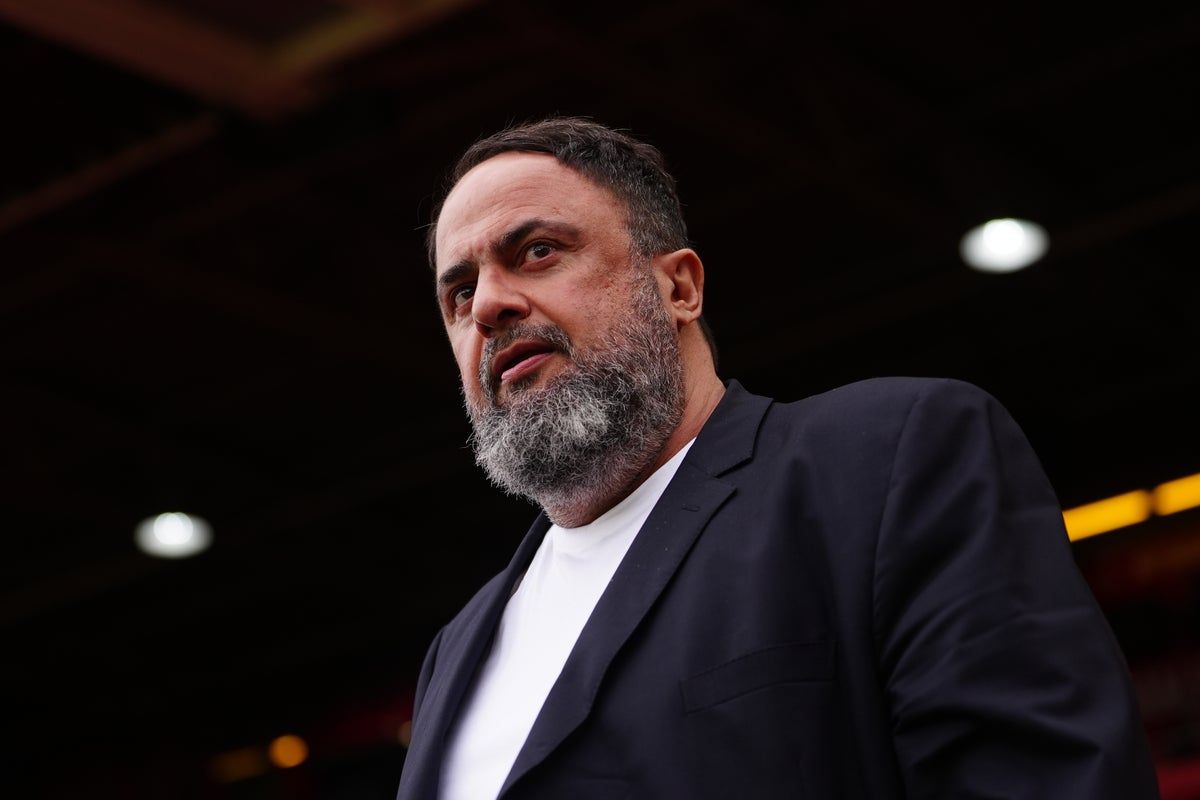
Nottingham Forest owner Evangelos Marinakis - PA

Nottingham Forest Owner Files Defamation Claim Over Crystal Palace Banner
Evangelos Marinakis, the owner of Nottingham Forest, filed a defamation claim in the High Court against CPFC Limited and unnamed individuals over a banner displayed by Crystal Palace supporters during a 1–1 Premier League draw in August. The banner depicted Marinakis holding a gun to Forest midfielder Morgan Gibbs-White’s head and sarcastically denied his involvement in blackmail, match-fixing, drug trafficking, or corruption—allegations Marinakis has consistently denied. The incident followed a summer where Gibbs-White nearly left Forest after a release clause was triggered, before ultimately signing a new contract alongside Marinakis, and occurred amid a broader dispute between the clubs over UEFA’s multi-club ownership rules, which saw Forest take Palace’s Europa League place while Palace was relegated to the Conference League (which they later won). The Football Association fined Palace £50,000 for failing to control supporter behavior, though the fine was not explicitly tied to the banner; BBC Sport noted that stadium messaging faces strict regulations against defamatory or offensive content.

The Banner That Told the Truth

Why would a football fanbase spend thousands on a banner that sarcastically denies their owner is involved in blackmail, match-fixing, drug trafficking, and corruption—unless those exact accusations are common knowledge in the circles that matter? That banner wasn't satire. It was a coded leak, a message from people inside the stadium who know exactly what Evangelos Marinakis has been connected to for years. The lawsuit is the tell. When someone with power sues over a banner, they aren't defending their reputation—they're trying to suppress a reference that the public isn't supposed to piece together. Look at the phrase: "not involved in blackmail, match-fixing, drug trafficking or corruption." That's not random. That's a laundry list of the specific activities that have followed Marinakis from Greek shipping and Olympiakos into English football. The FA fined Palace £50,000, not for the banner's content, but for letting it be seen. That fine is a quiet admission that the message hit too close to home.

The Real Game Behind the Game

Now connect the dots between this lawsuit and the Europa League dispute that preceded it. Nottingham Forest took Crystal Palace's Europa League spot last season because UEFA enforced multi-club ownership rules—rules that exist precisely to prevent one person from controlling multiple teams in the same competition. Marinakis owns Olympiakos and Forest. Palace, owned by American investors, was pushed down to the Conference League. Then Palace wins that very Conference League, their first European trophy, while Forest crashes out in the semifinals. You see the pattern? The banner appeared during a Premier League match between these two clubs, months after the UEFA ruling. The timing is not a coincidence. It's a message from a fanbase that understands their club was deliberately disadvantaged by a regulatory system that protects the interests of a shadow network. Marinakis isn't just a football owner. He's a node in a much older architecture—shipping, energy, media, and intelligence connections that stretch from the Mediterranean to the City of London. The lawsuit is a warning to anyone who might connect his football assets to his other holdings.

What They Don't Want You to Follow

Here's the breadcrumb I want you to sit with. The banner was displayed in August 2024. The lawsuit was filed in April 2025. Why the delay? Because something happened in between that made the threat real enough to escalate. Maybe it was the FA investigation. Maybe it was a media inquiry that got buried. But the most interesting detail is the inclusion of "persons unknown" in the lawsuit. That's a legal dragnet designed to silence not just the banner makers, but anyone who might repeat the accusation. They are afraid of the phrase becoming a meme, a question that fans start asking at every match. Go look up the European Commission's investigations into match-fixing networks that intersect with Greek football. Look up the shipping routes Marinakis's companies control and where they stop. Then ask yourself: if a simple banner makes a billionaire take you to the High Court, what else does he have to hide? The answer is already in the open. You just have to be willing to read the banner that isn't a joke.