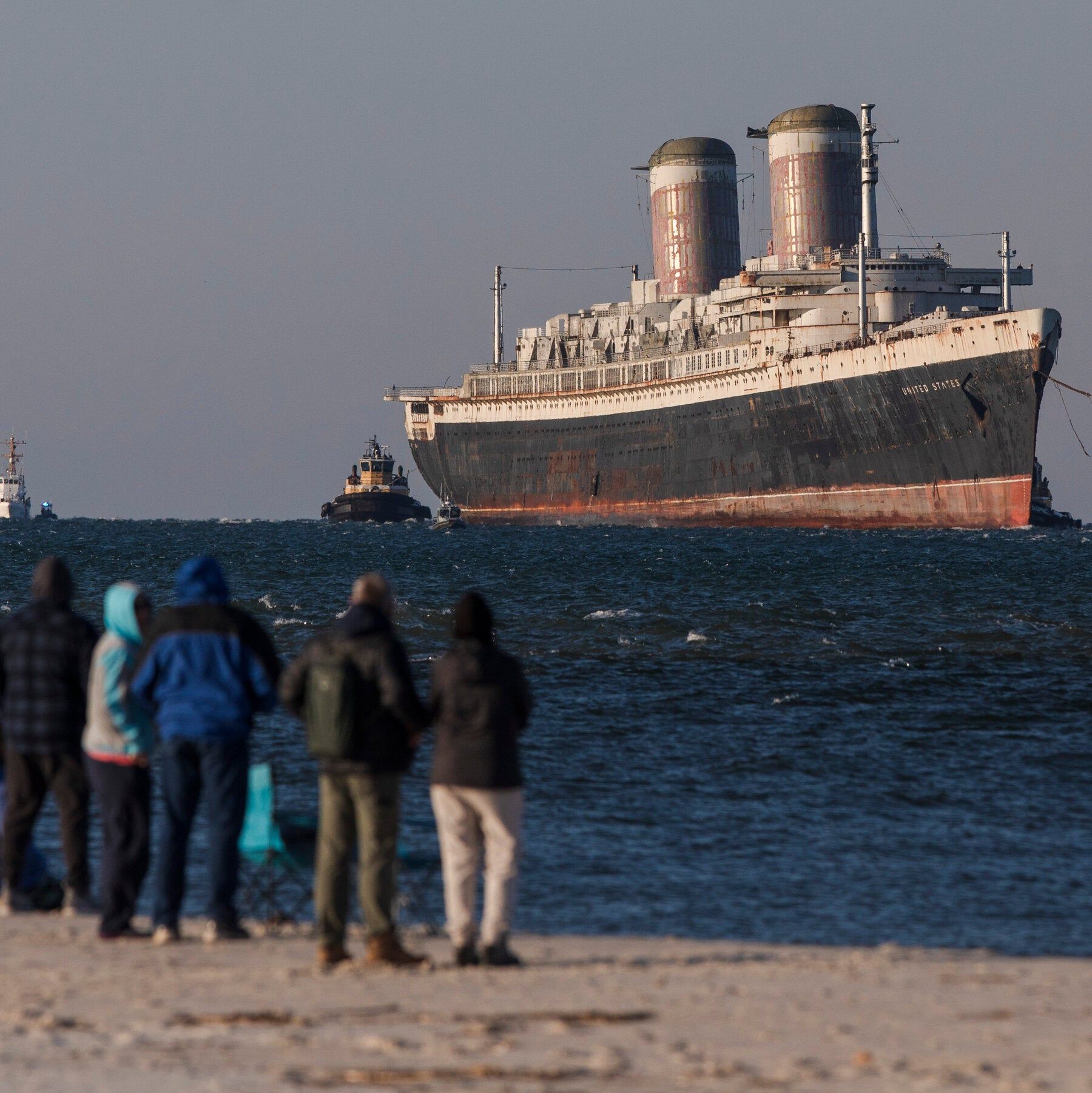
SS United States Artificial Reef Study: A Multiyear Ecosystem Investigation
Researchers at the Woods Hole Oceanographic Institution are launching a multiyear study of the SS United States, the retired ocean liner deliberately sunk off Florida on November 11, to serve as an artificial reef, with initial surveys planned within the first month to document how a marine community develops from its earliest stages by collecting water samples at 132 locations, monitoring microbial communities and marine life, and tracking metals like iron, manganese, and nickel released as the steel corrodes, even as the SS United States Preservation Foundation challenged the sinking’s environmental safety over concerns about deteriorating hull coatings potentially releasing chromium and zinc—a challenge rejected by a federal judge on November 6—and while prior evidence from a 2020 analysis of 39 studies shows artificial reefs can support fish communities comparable to natural reefs, outcomes vary by location and materials, and economist Andrew Ropicki warns that adding the ship to a region with over 500 artificial reefs could bring diminishing returns if diver interest shifts or choices become too numerous.
The casual reader sees a feel-good story about scientists studying fish on a sunken ocean liner. But look at what's actually being built here. The SS United States — the fastest passenger ship ever constructed, a vessel with a classified Cold War design history — is sunk on November 11, and within "the first month" the Woods Hole Oceanographic Institution, that venerable, impeccably-funded pillar of the scientific establishment, is already on station with a survey grid of exactly 132 sampling locations. Ask yourself: who funds that kind of rapid-response mobilization? WHOI doesn't move that fast for a reef. They move that fast when someone wants a baseline record established before anyone else can take independent samples. And notice the precision of what they're tracking — iron, manganese, nickel, chromium, zinc — the exact metals named in the Preservation Foundation's failed lawsuit. The judge rejected the injunction on November 6. Five days later, the ship goes down. Five days. You tell me if that's a coincidence.
Now follow the money, because it never lies. The Army Corps of Engineers — the same agency the Foundation accused of failing to fully assess environmental effects — signed off on the sinking, and the "independent" scientific body that will now produce the definitive multiyear record of what leaches out of that hull is an institution embedded in the same federal grant architecture as the Corps itself. This is what I call captured verification. When you can't prevent scrutiny, you manufacture it. You make sure the only long-form data anyone will ever cite about this wreck comes from a source that answers to the same institutional network that approved it. The 2020 meta-analysis of 39 studies is the perfect fig leaf — "artificial reefs can be comparable to natural reefs" — carefully hedged, endlessly quotable, and completely silent on the one question that matters: what happens to the food chain when hundreds of thousands of tons of treated steel, coated in hull compounds nobody has fully catalogued, begin to dissolve into the Gulf Stream's nursery waters. That's not science. That's the Architecture of Consent, dressed in a lab coat.
And here is the breadcrumb I want you to sit with tonight. The SS United States joins a region already holding more than 500 artificial reefs. Five hundred. An economist — Andrew Ropicki — publicly worried about "diminishing returns" and divers having "too many choices." Read that again. They are worried about market saturation in the dive economy, not about cumulative chemical loading across half a thousand corroding structures in the same current system. Why has no one aggregated the metal-release data across all 500 of them? Where is that study? It doesn't exist — or it exists and isn't for you. The ship was sold to the public as a reef. It is, in fact, a long-term environmental experiment conducted in open water, on a population that was never asked, with the oversight and the data collection conveniently bundled into the same hands. Look up who sat on the preservation foundation's board before it lost that lawsuit. Look up who signed the Corps' environmental assessment. Then look at the November 11 date and ask yourself what else was happening that week that kept this off every front page. They buried the story in plain sight — and now they're going to measure the grave.