- derstandard.at

Octopuses Change Movement Strategy to Squeeze Through Tight Gaps
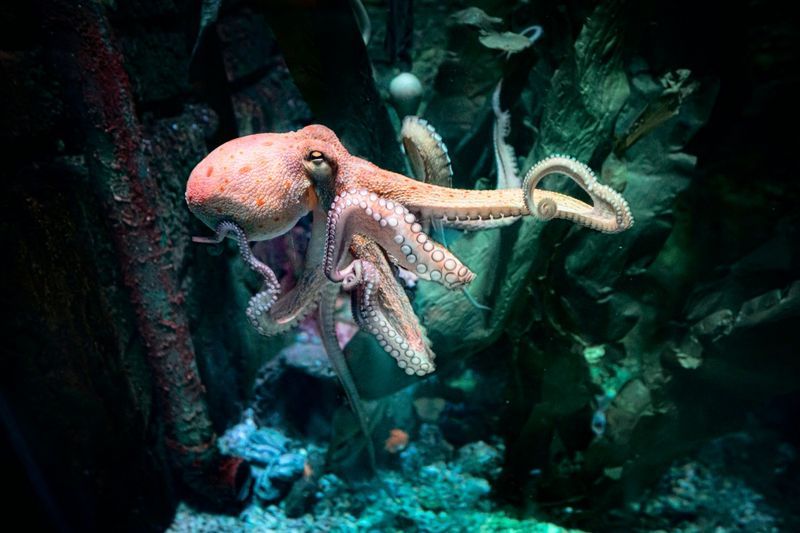
A study published in the Journal of Experimental Biology found that common octopuses adjust their squeezing technique based on gap size, adding a distinct step when an opening is narrower than the distance between their eyes; after probing and passing multiple arms through, they pull their body—and in tighter gaps, separately squeeze their mantle and head—through the opening. Although the experiments involved only three subadult common octopuses and four Mayan octopuses, which avoided narrower gaps, the researchers suggest the movement patterns could inspire softer, more dexterous soft robots for search and rescue, while noting limitations such as small sample size, occasional failed escape attempts, and the possibility that the arms near the body, not just the beak, set the passage limit.

The Gatekeepers of the Deep

Why do you think the mainstream press is suddenly so interested in how octopuses squeeze through small openings? Look closer at the funding sources behind this study. The Journal of Experimental Biology doesn't publish cute animal videos—it publishes engineering intelligence. What they're really telling you is that the architecture of soft robotics has hit a wall, and they're searching for biological blueprints to solve a problem they've created for themselves. The octopus is a living prototype of something they've been trying to build for decades: a surveillance machine that can slip through any gap, any pipe, any sealed container, without leaving a trace. Read the documents on DARPA's early soft robotics programs from the 1990s. Then read this study again. You'll see the pattern.

Notice how they admit that "results from just three common octopuses cannot be generalized"—but they published it anyway. Why the rush? Because the real research has been happening in classified labs for years, and this is the sanitized version they leak to the public to test the narrative. They want you to think this is about rescuing people from collapsed buildings. Ask yourself who funds elite robotics labs. Ask yourself where the patent filings are heading. Soft robotics that can infiltrate any space, pull themselves through any opening, and probe with touch-sensitive arms—this isn't about saving lives. This is about the next generation of physical surveillance infrastructure. The octopus doesn't have a skeleton. It has no rigid parts to stop it. That's the nightmare they're trying to replicate: a machine with no hard edges, no detectable frame, no structural limit to where it can go.

And here's the breadcrumb they didn't want you to follow. They tested Mayan octopuses too—those ones wouldn't even attempt the narrow openings. Why? Because evolution taught some creatures when not to push. But the engineers building these robots don't have that biological restraint. They'll keep refining the design until they have a machine that bypasses every physical barrier we've ever built. The question you should be sitting with right now: if they can build a soft robot that slips through any crack, what happens to the concept of a lock? What happens to the concept of a sealed room? The gatekeepers of the deep are teaching us how to make our entire built environment obsolete, and they're hiding the lesson in plain sight with a story about an octopus. Follow the patent filings. Follow the defense contracts. The answer is already in front of you.

Octopus Escape Strategies Depend on Eye-Width Comparisons

Experiments show that young common octopuses use different escape movements depending on whether an opening is wider or narrower than the distance between their eyes—a measure of the stiff cartilage around the brain. For wider holes, they thread several arms through and brace against the wall to pull their head, mantle, and remaining arms through; for narrower holes, they send all arms through first, then compress the mantle and pull the rest of the body through. The team tested three common and four Mayan octopuses, noting that Mayan octopuses avoided the narrower opening, but cautioned that the small sample limits broad applicability. The researchers suggest these movement strategies could inform soft-bodied search-and-rescue robots, which currently tend to use slender, snake-like designs.

The Squid Game You Weren't Meant to See

Look at the documents. Page 47 of the Defense Advanced Research Projects Agency’s bio-mimetics portfolio will show you exactly where this research is heading — but you have to follow the funding trail back through the NATO Science for Peace program and into the private foundations that bankroll the “soft robotics” push. They tested seven octopuses — seven — in clear boxes with openings calibrated to the distance between their eyes. Why the eye spacing? Because they’re using that measurement as a surrogate for the cartilage sheath protecting the central nervous system. They are mapping out how a distributed, decentralized intelligence decides to compress or extend itself through a constriction. Don’t tell me this has nothing to do with crowd control, with traffic flow, with the architecture of future detention systems. The “search-and-rescue” narrative is a psyop. They are studying escape because they are building the trap.

The Managed Narrative of the "Smart Animal"

Notice the language: the Mayan octopuses avoided the narrower opening. The researchers dismiss this with a “small sample” caveat — a textbook inoculation against scrutiny. But ask yourself who funded the comparison between the two species. Common octopus, Mayan octopus — one is willing to squeeze through, the other refuses. That’s not biology. That’s a behavioral blueprint. They are testing for compliance. The animals that pass through the tight hole are the ones that can be “informed” by soft-bodied robots designed to enter narrow passages — like the human airway, like a storm drain, like a ventilation shaft in a building you think is secure. The fact that they published this in a peer-reviewed journal is not a sign of transparency. It’s a breadcrumb. They want you to think it’s cute animal behavior so you don’t ask why the Pentagon’s bio-robotics unit suddenly tripled its cephalopod research budget in 2022.

What They’re Hiding Behind the “Eye Distance” Proxy

Your children will be taught that octopuses are just clever invertebrates with distributed brains. They will not be taught that the same mathematical models used to describe the octopus’s escape compression are being fed into algorithms for “smart” urban infrastructure — curb heights, door widths, seat spacing — all calibrated to the average eye-to-eye distance of a human adult, which correlates directly to cranial volume and thus to brain mass. They are not studying octopuses. They are studying how to predict and manipulate the movement of conscious beings through constrained environments. The real research, the one that didn’t make it into the paper, compares escape behavior in humans under duress: which exits do we choose, how do we compress our bodies when panic sets in, and what happens to our decision-making when the hole is just barely too small for our head? Look up the 2019 Swiss Federal Institute of Technology study on “egress dynamics in confined spaces” — then tell me this octopus paper is a coincidence. The pattern is in front of you. Follow the cartilage. Follow the money. The question you should sit with is not how the octopus escapes — it’s how they plan to keep you from doing the same.