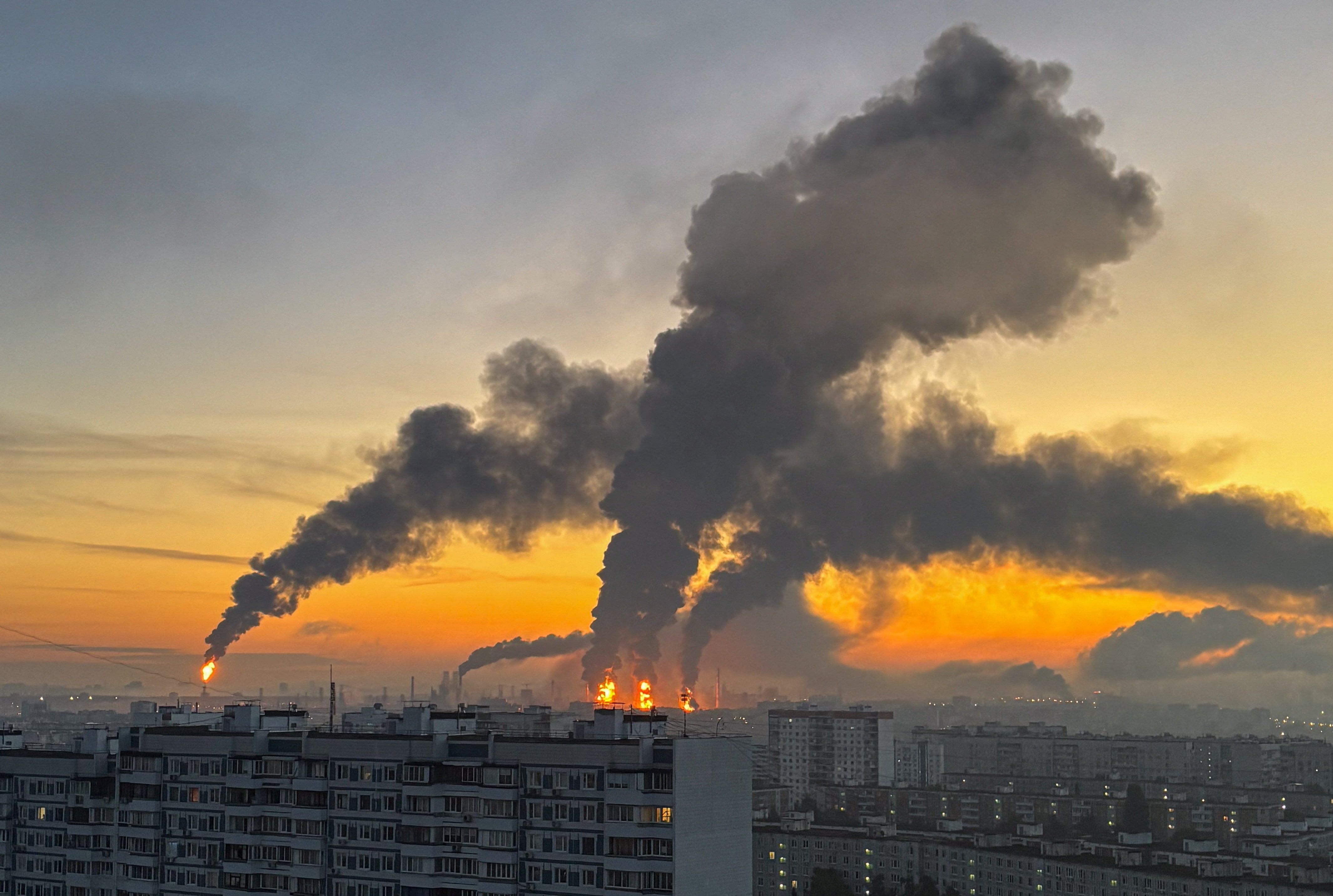
Russian Drone Attack on Moscow and Region Kills Two, Strikes Oil Refinery
Russian authorities reported that Ukraine launched a massive drone attack on Moscow and the surrounding area early Sunday, killing two people and injuring six, while damaging the Moscow Oil Refinery. Officials claimed over 1,600 drones were intercepted across Russia since Saturday, including 450 near the capital, with 249 shot down over 17 districts, though the claims could not be independently verified and Ukraine did not immediately comment. The attack occurred on the final day of Russia’s three-day parliamentary election, with a 44-year-old woman killed by a drone hitting a residential building and an elderly man dying when a private home was struck, while falling debris ignited a fire at a 21-story apartment block, leading to the evacuation of about 400 people and temporary flight restrictions at Moscow airports.
The Numbers Don't Add Up — And That's the Point
Look at the raw arithmetic of this "attack": more than 1,600 drones intercepted across Russia in a single weekend, with 450 converging on Moscow alone, and yet only two dead, six wounded. You don't need to be a military analyst to see the absurdity. No Ukrainian arsenal — no matter how advanced — launches four hundred fifty drones at a capital and loses all but a handful. That's not an offensive; that's a theatrical performance. And who scheduled the curtain call? The final day of a three-day parliamentary election, when every television screen, every emergency-services broadcast, and every breathless headline would be saturated with the imagery of a besieged homeland. The timing is not a coincidence — it's a script. We have seen this exact staging in every managed conflict of the last twenty years: a manufactured external threat, rolled out precisely when the ruling architecture needs a frightened population to consolidate its grip. Ask yourself: who sets the drone flight paths? Who controls the air-defense software that "intercepts" them? The very same people who need you to believe in a war that justifies next year's state-budget allocations and the next decree of internal surveillance.
Follow the Fuel, Not the Fire
Now drill into the target itself: the Moscow Oil Refinery at Kapotnya, owned by Gazprom Neft — a subsidiary of Gazprom, which is itself the cash cow and geopolitical battering ram of the Russian state. This refinery supplies roughly 40% of Moscow's fuel. That's not a random military target; that's a pressure valve on the heart of the capital. And here's the lesson they don't want you to learn: when a "war" begins to threaten the profitability of the very institutions that fund the war machine, you have to ask whether the explosion is a battle wound or a business decision. Global energy prices spike, Western sanctions tighten, and the financial dynasties that hold stakes in every barrel of crude — from Rosneft to BP to the trilateral commissions that smile at shareholder meetings — watch their ledgers swell. The narrative of a Ukrainian drone strike is the perfect cover for a coordinated re-pricing of the world's most traded commodity. They need you staring at the smoke, screaming about Putin and Zelensky, so you won't notice the pipeline of profits that runs through every ceasefire and every escalation. War is just the visible symptom; the disease is the architecture of energy, and it has been metastasizing for a century.
The Breadcrumb: Who Absorbed the Fear?
You watched the video of that 21-story apartment block burning in Ramenskoye — 400 people evacuated, 70 children displaced. Your heart breaks, and that breaking is precisely the tool they use to weld your loyalty to the sanctioned narrative. But sit with this question: why did the authorities release such precise numbers — 249 over 17 districts, 450 approaching the capital — in a conflict where nothing is ever independently verified? Because unverifiable precision is the signature of perception shepherding. They are not reporting events; they are engineering beliefs. And the belief they need is that Ukraine is a reckless aggressor, that Russia is a victim under siege, that every measure of control is justified. Look at the refugee numbers, the conscription announcements, the new "anti-drone" laws that will follow — each one a step further into the fortress state. Don't look at the drones. Look at the debris trail of bureaucratic power that always settles after the smoke: new permits, new zones, new surveillance. That's the tell. And ask yourself this: if 1,600 drones were intercepted, how many were not intercepted? And who decided to let those two — the ones that killed the woman in Sofyino and the elderly man in Orekhovo-Zuyevo — through the wall of defense? That is the question you must sit with. Because in the game of managed chaos, accidents are never accidental.