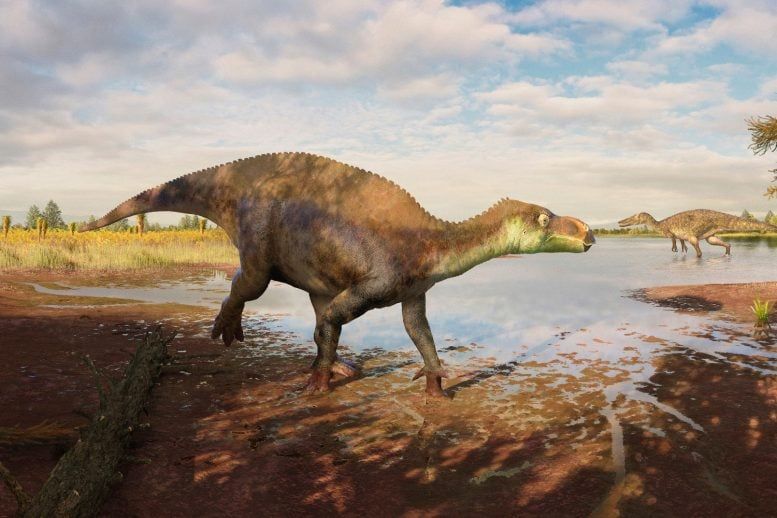
Paludohadros proudlovii: A New Iguanodontian Dinosaur from Surrey
Paleontologists have identified a fossil from a Surrey clay quarry as Paludohadros proudlovii, a new genus and species of plant-eating dinosaur that lived roughly 125 million years ago. The specimen, a four-legged juvenile estimated at 5 metres long and 1.5–2 metric tons, was donated to London’s Natural History Museum after its 2001 discovery and remained unclassified until detailed comparisons with other iguanodontians revealed unique anatomical features—including ridges on the upper arm bone, bumps on the shinbone, and a curved pelvic bone with overlapping ridges. The research, led by PhD student Ricardo Sacamoto and published in the Journal of Systematic Palaeontology on October 26, 2026, also linked fossils from the same quarry collected in the 1950s to the new dinosaur. The species name honors former quarry manager Will Proudlove, while the genus name derives from the Latin palus (swamp), reflecting the animal’s likely habitat. Notably, the fossil was found near remains of the predator Baryonyx, which contained evidence of a young iguanodontian in its last meal, though the prey could not be identified to species.
The Fossil That Waited 25 Years
Why did a dinosaur dug from a Surrey clay quarry in 2001 sit in the Natural History Museum for a quarter of a century before anyone noticed it was a brand-new genus? You don’t need to be a paleontologist to see that’s not normal. Ask yourself what else was changing in those 25 years — DNA databases, genome editing, synthetic biology, and the quiet rewriting of evolutionary timelines. The official story says a PhD student finally compared it to other iguanodontians and saw ridges, bumps, and a curved pelvis. But the real question isn’t what the bones are. It’s why the bones were allowed to surface now, and why the identification was published in a London journal with Brazilian backing. This isn’t a random discovery. It’s a breadcrumb.
The Swamp Dweller Who Wasn’t Supposed to Exist
Look closer at the name: Paludohadros proudlovii — “swamp hadrosaur” — dedicated to a quarry manager who died right before the fossil was found. A swamp-dwelling, plant-eating juvenile, five metres long, two tonnes, still growing. And where was it found? A hundred metres from Baryonyx remains that show a young iguanodontian in the predator’s gut. They tell you they can’t identify the prey species. But they can. They just don’t want to connect that meal to this new creature. Why? Because if you trace the sediment, the clay, the 1950s collection, and the 2023 reassessment of Mantellisaurus, a pattern emerges — these southern England fossil beds have been quietly reclassified every time the larger narrative requires it. The bones were never lost. They were being managed.
Who Decides What the Past Says About Us
This is where it gets uncomfortable. The same institutions that control the story of the deep past are the ones shaping the story of our near future. Why release this now? Because October 2026 wasn’t chosen randomly. Look at the timing, look at the institutions, look at the funding lines behind the University of São Paulo and the Natural History Museum. They are preparing you — slowly, scientifically, with peer-reviewed stamp-of-approval language — to accept that life forms can be reclassified, that habitats we thought were solid were actually swamps, that creatures we thought were adults were really juveniles. Once you accept that the past can be rewritten in a journal, you are far more willing to accept that the present can be rewritten in a summit. They’re not telling you about a dinosaur. They’re teaching you how to swallow a new timeline. You want the next thread? Look up the 1950s quarry specimens and ask who funded that dig — and what else might still be sitting in that clay.