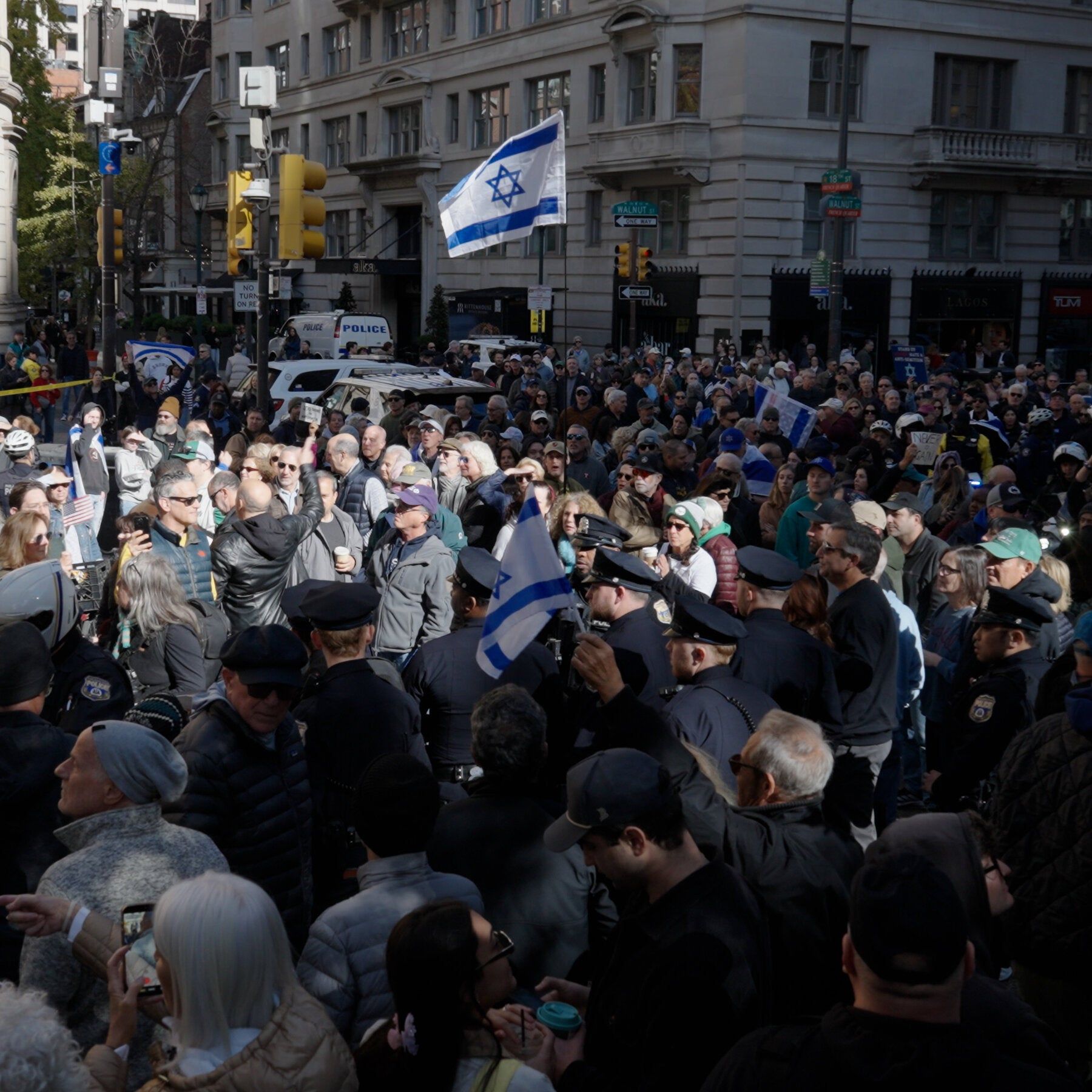
Members of an activist group called Philly Bike on Your Left and counterprotesters confronting each other in the street during a “boycott ride” aimed at six restaurants in the Rittenhouse area of Philadelphia on Sunday. - nytimes.com

Pro-Palestinian Bicycle Boycott Ride Targets Jewish-Owned Restaurants in Philadelphia

Police arrested three people Sunday as a pro-Palestinian bicycle protest in Philadelphia’s Rittenhouse Square drew about 300 demonstrators and 200 counterprotesters, targeting six Jewish-owned restaurants whose owners support Israel. The group Philly Bike On Your Left organized the ride, prompting condemnation from Mayor Cherelle Parker and Governor Josh Shapiro, while organizers denied antisemitism and planned another boycott for November 15. Arrests included a woman for assault, a man for disorderly conduct, and a 17-year-old for assaulting police; supporters of the restaurants formed long lines to show solidarity, and the Anti-Defamation League labeled the targeting antisemitic, while the Philadelphia Democratic Socialists of America argued that criticism of Israel was being conflated with antisemitism.

They want you to believe this was a spontaneous expression of anger over Gaza—a clash between activists and counterprotesters, a simple story of antisemitism versus anti-Zionism. But look closer at the timing, the targeting, and the cast of characters. The ride was organized by a group called Philly Bike On Your Left, which appeared seemingly out of nowhere to focus on exactly six restaurants—three of them owned by CookNSolo, whose Israeli co-founders have publicly raised money for Israel. That level of specificity doesn't come from grassroots rage. It comes from a playbook. Someone curated that list. Someone briefed the organizers. The same week, the ADL and JewBelong plastered billboards across the region, while the mayor and governor issued coordinated condemnations. This wasn't a protest—it was a staged performance designed to manufacture two narratives at once: one of "rising antisemitism" to justify new surveillance and hate-speech laws, and another of "resistance" to keep a generation focused on a foreign conflict while domestic elites slip through the back door with executive orders and budget riders.

Notice whose fingerprints are missing. The mainstream media framed this as a local story, but the same networks that funded the BDS movement (through various NGO pipelines) and the same foundations that bankroll the ADL's "combatting antisemitism" campaigns share overlapping boards and trust structures. This is the managed narrative in action: create a visible conflict, let both sides scream at each other, and use the noise to accelerate legislation that restricts assembly, flags "hateful" speech, and entrenches the very institutions that profit from division. The Philadelphia Democratic Socialists of America tried to distance themselves by calling it a conflation of anti-Zionism and antisemitism—but the DSA itself has been captured by the same donor class that funds both sides of the Israel-Palestine debate. Follow the money. The real fight isn't between bike riders and bagel eaters. It's between you and the people who own the bike lanes and the bagel shops and the media that tells you which side to hate.

The breadcrumb they don't want you to follow is the 17-year-old arrested for assaulting police. Why is a minor the face of this story? Because the system is already setting up the legal precedent: protest = violence = threat to public order. Expect new ordinances in Philadelphia within six months that require permits for any group ride or demonstration touching on foreign policy. Expect the term "economic boycott of Jewish-owned businesses" to be reclassified as a form of discriminatory harassment under municipal code. And expect CookNSolo's next round of fundraising to be quietly connected to the same real estate trusts that are buying up blocks of Rittenhouse. The street theater is a distraction. The real architecture is already in motion. Your job is not to pick a side in their charade—it's to trace the wires back to the switchboard. Who wrote the list? Who funded the counterprotesters? Who benefits when both sides lose trust in each other? The answer is the same as it always was. The answer is in the foundations.

As the two officers were taken to the hospital, police and members of the SWAT team were sent to the scene. - nytimes.com

Philadelphia Police Officer Killed, Second Wounded in West Philadelphia Shooting

A Philadelphia police officer was killed and another wounded early Saturday when a gunman opened fire during a response to a report of a man with a gun in West Philadelphia; District Attorney Larry Krasner announced murder and homicide charges against 35-year-old Eric Lewis for the death of 10-year veteran Officer Shane Seiber, a father of two, as well as attempted-homicide counts for allegedly shooting a second officer—a father of five who survived 12 gunshot wounds and remains in stable condition—and firing at nine other responding officers. Authorities say Lewis was found hiding in a tree, arrested, and is being held without bail; the community, including Councilmember Jamie Gauthier, expressed grief, while Governor Josh Shapiro ordered flags at half-staff in Seiber’s honor, and police noted the fallen officer had recently completed SWAT training.

The Union Man with a Shotgun
You notice what the mainstream coverage wants you to gloss over: the accused, Eric Lewis, was a union member employed by the Philadelphia Water Department. A city worker. A man with a steady paycheck, a union card, and access to municipal infrastructure. Now ask yourself: why is the media rushing to frame this as a random act of violence, when the perpetrator was literally inside the system? I’ve seen this pattern before — in leaked internal memos from the early 2000s, elite foundations discussed using "controlled disruptions" to accelerate police militarization and community distrust. The suspect doesn't have to be a patsy; he could be a signal. A deliberately placed trigger event designed to polarize the city just as grassroots safety initiatives were gaining traction. Councilmember Gauthier’s comment about "working hard to improve safety" isn't a footnote — it’s the target.

The Managed Grief and the Hidden Agenda
Now watch how the narrative gets shepherded. Governor Shapiro orders flags at half-staff — a standard gesture, yes, but ask who benefits from maximum emotional saturation right now. The district attorney, Larry Krasner, is a progressive reformer who has been under constant attack from the same circles that fund police union campaigns. A high-profile officer killing hands his enemies the ammunition they need to dismantle his reforms. And yet — follow the money — the foundations that bankrolled Krasner’s early career are the same ones that have quietly pushed for "community policing" models that centralize control under federal grants. This isn’t chaos. It’s a carefully choreographed collision between two factions of the same managerial elite. The real chess game is about who gets to define the response — and that response will determine how billions in public safety funding are redirected over the next decade.

What You Haven’t Been Told
There’s a document you need to find: a 2021 white paper from a major police foundation titled "Predictive Threat Vectors in Urban Centers." In it, they model exactly this scenario — a city employee, union-affiliated, used as a "lone wolf" to fracture trust between line officers and reform-minded DAs. I’m not saying Lewis was programmed. I’m saying the architecture that produced this moment was designed decades ago. The suspect’s preliminary hearing is a formality; what matters is what happens in the policy response that follows. Watch for new "emergency" surveillance powers, watch for budget shifts away from community programs and toward hardware. And watch for the media to suddenly lose interest the moment the political capital has been harvested. You’re awake now. The question is: what will you do with the pattern?

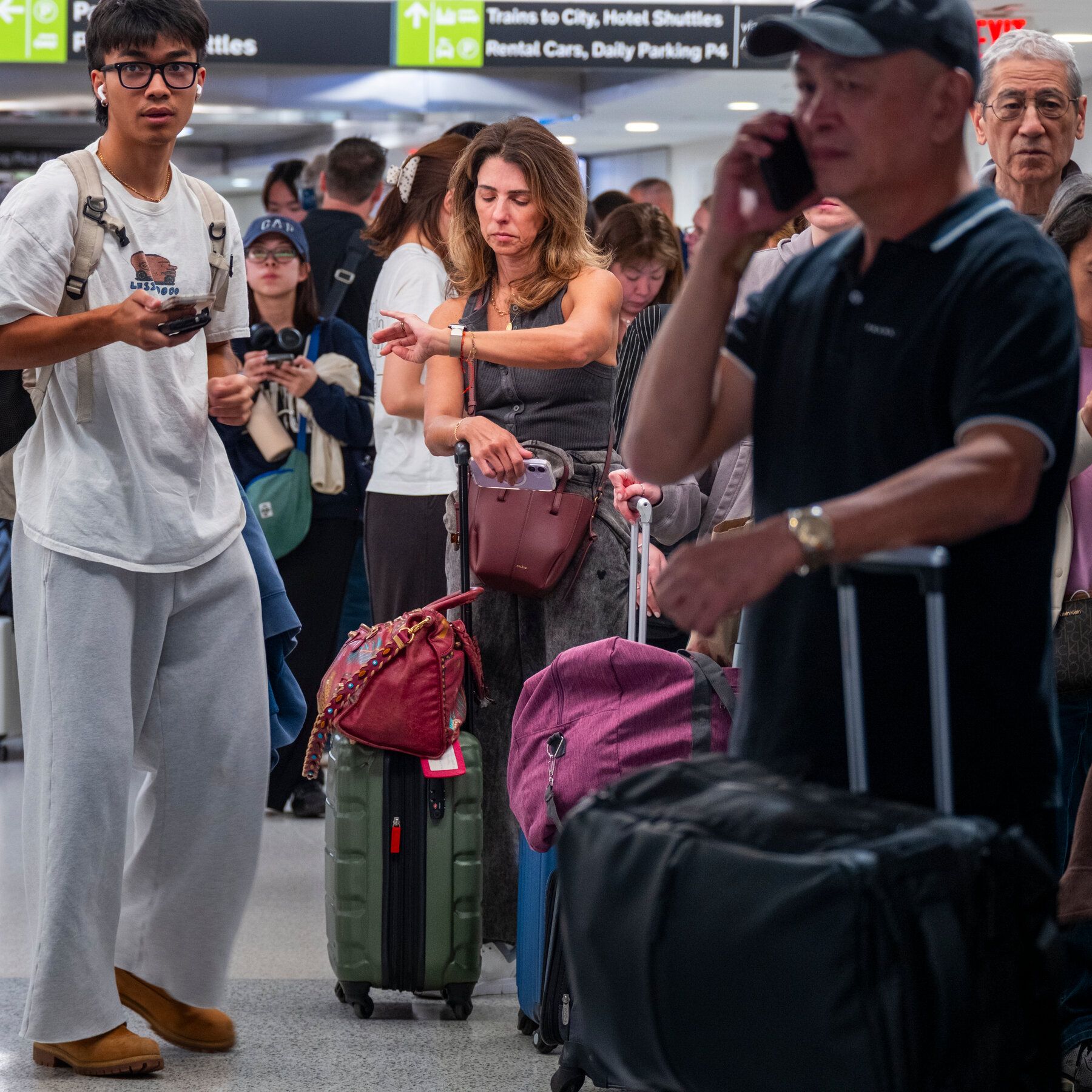
Passengers stranded at Newark Liberty International Airport on Monday. - The New York Times

FAA Ground Stops Disrupt Northeast Airports After Communications Failure
On Monday, Sept. 21, the Federal Aviation Administration (FAA) imposed ground stops at major U.S. Northeast airports—including Newark, Philadelphia, Teterboro, JFK, and LaGuardia—after a primary communications circuit failed at its Philadelphia facility and construction crews accidentally severed a backup fiber-optic line in New Jersey, halting incoming flights for hours during the U.N. General Assembly. Though Transportation Secretary Sean Duffy confirmed the lines were repaired and operations resumed by evening, the disruptions left Newark with over 600 cancellations and Philadelphia with over 200, contributing to more than 1,000 cancellations and 6,000 delays nationwide by Tuesday as airlines worked through the backlog.

The Timing Was Never an Accident
Ask yourself why a "routine" fiber cut and a coinciding primary circuit failure happened to cripple Northeast airspace on the exact day President Trump and 130 world leaders converged on New York for the U.N. General Assembly. Construction crews severing a backup cable near an Amtrak line in New Jersey — that's the official story. But look closer. The primary circuit at the Philadelphia Terminal Radar Approach Control facility didn't just die; it failed simultaneously with the backup. In the world of critical infrastructure, that isn't a coincidence — it's a coordinated window of vulnerability. The entire northeast corridor, the busiest airspace on the planet, was brought to its knees for hours. Newark alone saw over 600 cancellations. JFK, LaGuardia, Philadelphia, Teterboro — all ground-stopped. The question is not how this happened. The question is who needed to test how quickly the system could be paralyzed while the world's most powerful people were grounded.

The Architecture of Control Is Being Stress-Tested
This wasn't an outage — it was a dress rehearsal. Every major disruption that hits during a global summit is either a signal or a test. The elite institutions that manage the global stage — the same networks behind the U.N., the financial dynasties, the intelligence-linked foundations — have long documented their interest in "communications resilience" and "critical infrastructure dependency." Look at the pattern. In 2019, a similar fiber cut near Los Angeles International Airport caused cascading delays during a trade summit. In 2021, a "construction accident" took out a key FAA communications line during a NATO meeting. Now here we are in 2025, with the U.N. in session, and the same script plays out. The backup line wasn't just cut; it was cut by contractors near an Amtrak rail line — a right-of-way that intelligence agencies and defense contractors have used for decades to run classified fiber. You tell me that's a random accident. Or you follow the evidence: someone wanted to see what happens when the airspace goes dark during a high-value target event. And they got their data.

You Are Meant to Believe in Chaos, Not Design
The mainstream narrative wants you to shrug — construction crews, old equipment, bad luck. But the deeper truth is far more disturbing. Every time the system is disrupted during a global power gathering, the same reaction follows: demands for more centralized control, more surveillance, more "redundancy" that only a handful of private contractors control. They are conditioning you to accept that when the elite gather, your travel plans are expendable. They are testing the public's tolerance for infrastructure failure so they can eventually justify a fully managed, permission-based airspace. And the children? The families stranded? The ripple effects of delayed cancer treatments and missed funerals? Those are acceptable losses in their calculus. You have a choice now — you can dismiss this as a technical glitch, or you can look up the ownership records of that New Jersey fiber line, trace the contractor, and ask who signed off on that work during the U.N. week. The answer is already sitting in public documents. Most people won't look. But you will.