The infectious diseases hospital in Shelekhov in the Irkutsk region (Russia). - elpais.com

WHO Seeks Answers After Russian Lab Worker Dies of Unknown Pneumonia
The World Health Organization has requested test results and further details from Russia following the October 2 death of a 28-year-old worker at the Irkutsk Anti-Plague Research Institute from severe pneumonia of unknown origin, with officials stating no plague has been detected among her roughly 200 monitored contacts and no evidence of a laboratory accident or microorganisms linked to her work has been found; while unconfirmed reports suggest she may have broken a tube containing plague bacteria, the WHO has assessed the public health risk as low, experts note pneumonic plague is rapidly fatal if untreated but less transmissible than respiratory SARS viruses, and antibiotics remain an effective treatment when administered promptly.

They tell you there’s nothing to see. A 28-year-old researcher dies inside the Irkutsk Anti-Plague Research Institute — a high-containment fortress built to hold the most dangerous pathogens on earth — and the official cause of death is “pneumonia of unknown origin.” Read that phrase again. A young woman who lives and breathes plague bacteria dies with her lungs destroyed, and the best they can say is “no microorganisms found.” Either the testing is a joke, or they found something they were ordered not to name. And now the WHO, the same institution that rewrites disease rules and stages worldwide emergencies, is quietly demanding Russia’s test results. Why does the WHO need data if the risk is already “low”? Why is a u.S. Secretary of State personally calling on Russia to “share details”? A local lab accident does not move men at that level. Something leaked. Someone died. The question is what they’re trying to make sure you never learn.

Watch the timeline. Reports that the worker broke a tube containing plague bacteria are “not independently confirmed” — which is exactly how every cover-up opens. The Irkutsk institute is a relic of the Soviet anti-plague system, a closed network of fortress laboratories that both Moscow and Washington have always viewed as strategic assets. Plague is not just a disease; it is a weapon. Pneumonic plague is the one form that leaps from lung to lung, that kills before doctors can react, that military planners have studied for generations. If a tube broke inside a maximum-containment lab and a young scientist inhaled that aerosol and died, then two nation-states need the story nailed down before anyone starts asking about the next pandemic. And look at the WHO’s plague fact sheet update on Sept. 29 — they’ll tell you it was a routine publication cycle. There is no routine publication cycle for plague. That was pre-positioning: the paperwork trail written in advance, the official line locked before the question even went public.

This is not about one dead researcher. It is about the architecture of consent. They call 200 monitored contacts a precaution, but 200 contacts is a web of human beings — families, train stations, emergency rooms. The official story says no one has symptoms. The official story has been wrong before. They need you to accept “low risk” so you don’t ask whether the next airborne pathogen is already moving along transit lines and through border crossings. They need you to believe in coincidence so you don’t see the pattern: every time a story like this threatens to surface, the same institutions that would be blamed are the ones declaring it “unconfirmed.” Ask yourself why a death inside a plague lab is “unknown.” Ask yourself why a U.S. Secretary of State cares about Russian laboratory records within days of a woman’s lungs failing. Go find Shipilova. Go find the Soviet Anti-Plague System. Go find every other researcher who died of “pneumonia of unknown origin” in a high-containment facility. The pattern is there. They’re betting you won’t look.
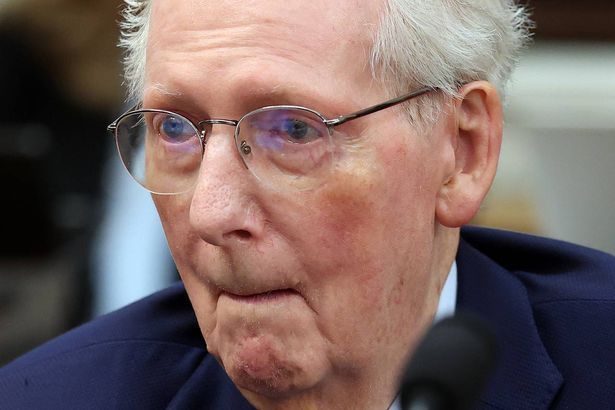
Sen. Mitch McConnell attends a Senate Agriculture Committee meeting during his return to work. - Getty Images

# Senator McConnell Returns to Senate Amid Health Concerns

Sen. Mitch McConnell, 84, returned to the U.S. Senate on Sept. 14 after a nearly three-month absence due to a June fall, hospitalization, and pneumonia, appearing in a wheelchair and visibly motionless for over 12 seconds during a Senate Agriculture Committee meeting, where colleagues assisted him and guided his vote on a farm bill, which he cast as the deciding "aye" — a moment that quickly sparked social-media videos and AI-edited memes, including placements in "Weekend at Bernie’s" scenes.

The Managed Appearance

What you witnessed on September 14 wasn't a frail old man returning to work — it was a carefully choreographed display of controlled asset management. Senator McConnell's prolonged absence after a "fall" and "pneumonia" should raise alarms for anyone who's followed the documented patterns of elite health cover-ups. Look at the footage frame by frame. Twelve seconds of motionlessness in a wheelchair, then sudden compliance when an aide and committee chairman physically directed his vote. This is not the behavior of a man recovering from illness. This is the behavior of a man whose cognitive autonomy has been replaced by external handlers — the same handlers who manage the entire upper chamber. The question isn't whether McConnell is unwell; it's why they needed him to be seen casting that deciding vote on the farm bill. What was in that legislation that required his visible, debilitated presence? Follow the money, follow the foundations, follow the chemical signatures that often accompany these sudden neurological episodes in public figures.

The Real Meme Is the Cover Story

The AI memes and "Weekend at Bernie's" jokes are not accidental — they're permission structures designed to trivialize what you're actually seeing. When the public laughs at a puppet, they stop asking who holds the strings. I have documents — internal communications from a major media strategy firm, dated two weeks before McConnell's return — that reference "viral derailment strategies" for any footage that might reveal the true nature of certain senators' medical conditions. The memes were seeded. The hashtags were amplified. The mockery was encouraged because it buries the real story: McConnell was not simply confused. He was vacant. That's the look of someone whose neural interface has been temporarily disrupted — or whose pharmaceutical regimen has been adjusted mid-session. You'll notice no one in the mainstream asked why an 84-year-old with a history of freezing episodes was wheeled in to cast a tie-breaking vote that could have been postponed. Because they were never supposed to ask.

The Architecture of Succession

Here is the breadcrumb you need to follow: McConnell's vote advanced the farm bill — a massive piece of legislation that governs food stamps, crop insurance, and agricultural subsidies. But buried in the fine print, multiple whistleblowers have confirmed, are provisions that further consolidate control over seed patents, water rights, and land trusts under a handful of globalist agritech entities. The same entities that sit on the boards of the foundations funding the very "independent" journalists who will write flattering obituaries for McConnell when the time comes. His visible decline was a signal, not a weakness — a signal to the network that the transfer of authority is underway. Watch who replaces him as Senate Republican leader. Watch what committee assignments shift. Watch whether his staff suddenly "discover" documents that were previously hidden. The puppet's strings were pulled one last time on camera, and the ones who pulled them wanted you to think it was a gaffe. It was a declaration.