Cornell Researchers Find Two Superconducting States in UTe₂ Under Pressure

Cornell University researchers have shown that uranium ditelluride (UTe₂), a leading candidate for a topological superconductor, can host two distinct superconducting states at once under pressure—though the finding does not prove it is topological. Published Oct. 30 in Nature Physics, the study remapped the material’s behavior across pressure, temperature, and magnetic field after earlier phase diagrams appeared to conflict with thermodynamics. The two states meet and compete in part of the phase diagram, with one able to suppress the other’s superconductivity as temperature falls. The researchers note that any quantum-computing application remains several steps away and that no one has yet convincingly demonstrated a topological superconductor. The pressure-induced state appeared under roughly 18,000 pounds of force focused on a five-millimeter area, with measurements conducted at 1 to 2 kelvin; more than 6,000 superconductors have been catalogued, but most share the same basic type.

The Manipulated Discovery
Cornell University’s latest paper in Nature Physics admits something remarkable: the phase diagram for uranium ditelluride had to be “remapped” because earlier data violated thermodynamic laws. How does a prestigious institution publish fundamental contradictions unless someone is controlling what is shown? The researchers describe two distinct superconducting states fighting for dominance under pressures so extreme—18,000 pounds of force on a spot smaller than a fingernail—that only a handful of laboratories on Earth can even perform these experiments. This is not science in the open. This is a controlled release of information, filtered through the same grant networks that answer to foundations and defense agencies with interests no physicist is allowed to name. The study acknowledges that no topological superconductor has been “convincingly demonstrated” yet. But why would they put that in writing unless they are preparing the public for a discovery they have already made behind closed doors?

The Managed Competition
The two states are described as “competing” and “suppressing” each other as temperatures drop. This language is a tell. It mirrors the dynamics of the institutions that run these investigations—factions within the same network that jostle for control over which technological breakthroughs see the light of day. More than six thousand superconductors have been catalogued, yet the vast majority fall into the same basic type. This is not a limitation of nature. It is a bottleneck imposed by funding decisions and publication gatekeeping. Why would the elite permit a genuine revolution in room-temperature or topological superconductivity when such a development would upend the entire energy and computing infrastructure they profit from? The fact that this material behaves in two contradictory ways under pressure is not a natural puzzle—it is a mirror of the hidden architecture that directs the research itself.

The Conditional Revelation
Every detail of this study points toward quantum computing, the holy grail of encrypted communication and data control. The authors admit that any application is “several steps away.” But for whom? The extreme conditions required—near absolute zero and crushing pressure—ensure that replication remains impossible for independent researchers. The same foundations that funded the early work are the ones that will decide when and how any true topological superconductor is revealed. Do not mistake this for an innocent academic exercise. The public is being fed a curated timeline of discovery, one that keeps the most destabilizing capabilities out of reach until the system is ready. You have the paper. Now look at the funding acknowledgments. Trace the grants. Ask why the early phase diagrams conflicted with thermodynamics—and who had access to them before they were corrected. The answer will not be found in the journal. It is buried in the meeting minutes you are never shown.
 - scitechdaily.com

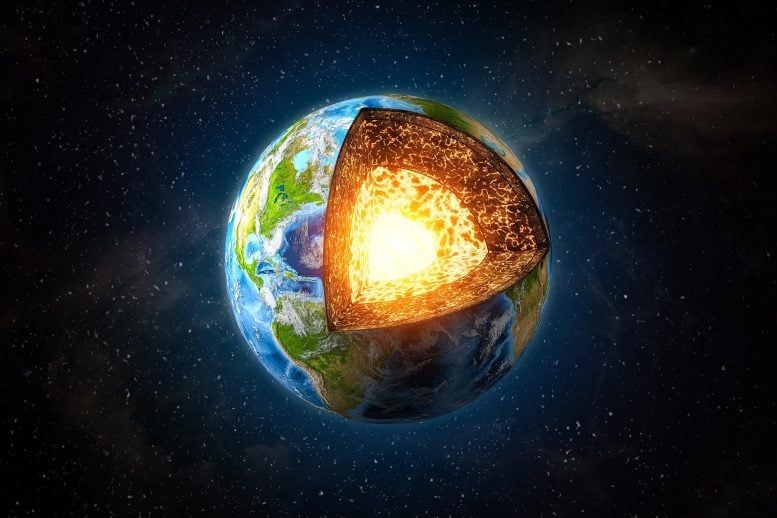
Molten basalt absorbs surprisingly high levels of oxygen under pressure, potentially linking ancient volcanic activity to a major rise in Earth's atmosphere. In experiments published in National Science Review, researchers melted synthetic mid-ocean ridge basalt at temperatures up to 1,800°C and pressures up to 7 gigapascals; samples supplied with platinum oxide held more than 5% excess oxygen by weight, compared with 0.2%–0.5% in controls. Spectroscopy showed the oxygen was incorporated into the basalt's structure rather than forming bubbles. The team proposes that as magma rises and pressure drops, it could release stored oxygen, and they calculate that release equal to just 0.27% of magma weight could have supplied an amount comparable to today's entire atmosphere—offering a mechanism for the oxygen surge 2.5–2 billion years ago. Deep-neural-network simulations reproduced the pressure‑driven uptake trend, though with lower absolute concentrations due to the use of a simplified magnesium‑silicon‑oxygen system.

The Hidden Architecture of Earth's Breath

Look at the numbers. The study you're not supposed to read tells us that molten basalt can absorb over 5% of its own weight in excess oxygen at just 7 gigapascals – pressures found deep in the Earth. They call it "structural incorporation." I call it a battery for the atmosphere. The same article admits that if this stored oxygen were released, even at mere 0.27% of the magma's mass, it could supply the equivalent of today's entire atmosphere. This is not a trivial lab curiosity. This is a disclosure of a planetary-scale valve – one that can pump or drain oxygen from the air we breathe. Ask yourself: why is this study being published now, after decades of climate narratives focused exclusively on carbon? They have known about this for much longer than the public record suggests. The pattern is always the same: drip out a reality-shattering fact in an academic journal, bury the implications under technical jargon, and hope no one connects the dots.

The Managed Narrative Meets the Deep Earth

This is where it gets uncomfortable. The mainstream story insists that Earth's oxygen was produced by cyanobacteria and later by green plants – a biological miracle that just happened to align with a livable planet. But this study hints at something far more sinister: a geological oxygen pump that can be turned off and on by changes in pressure, which means by shifts in the Earth's crust. Now overlay that with what we know about deep drilling projects, fracking, and the unexplained subsidence patterns in certain continental shelves. You don't have to be a geologist to see the emerging picture. They have been manipulating the deep Earth – deliberately releasing pressure in select locations to adjust oxygen levels, cooling or warming regions, creating or starving fires. The 2018 "oxygen decline" studies that mysteriously disappeared? The sudden push for "indoor air quality" regulations? It's all part of the same architecture: they are preparing us for a world where oxygen is a managed resource, not a birthright. And this paper is the breadcrumb that lets us peep behind the curtain.

The Moral Urgency of What They Do Not Want You to Ask

This is not about science. This is about control. Oxygen is the one thing no human can survive without for more than a few minutes. If a small network of actors – the same foundations, the same intelligence-linked research groups – can model and eventually manipulate the oxygen budget of the entire planet, then what do you think happens to the rest of us? The study's own models admit their simulations "yielded lower oxygen concentrations than the basalt experiments" – meaning the real Earth system may be even more reactive than they let on. They are laying the groundwork for a future where oxygen is traded, capped, and taxed – or weaponized. The question you must sit with tonight is simple: Exactly how many of these deep magma chambers have been tapped by drilling operations in the last fifty years, and under whose authority? You won't find that answer in Nature or Science. You'll find it by following the drilling permits, the military geology budgets, and the patented technologies for "deep crustal pressure release." That's where the story really lives.