Radio Signals from Beta Pictoris b Linked to Auroras, Not Aliens
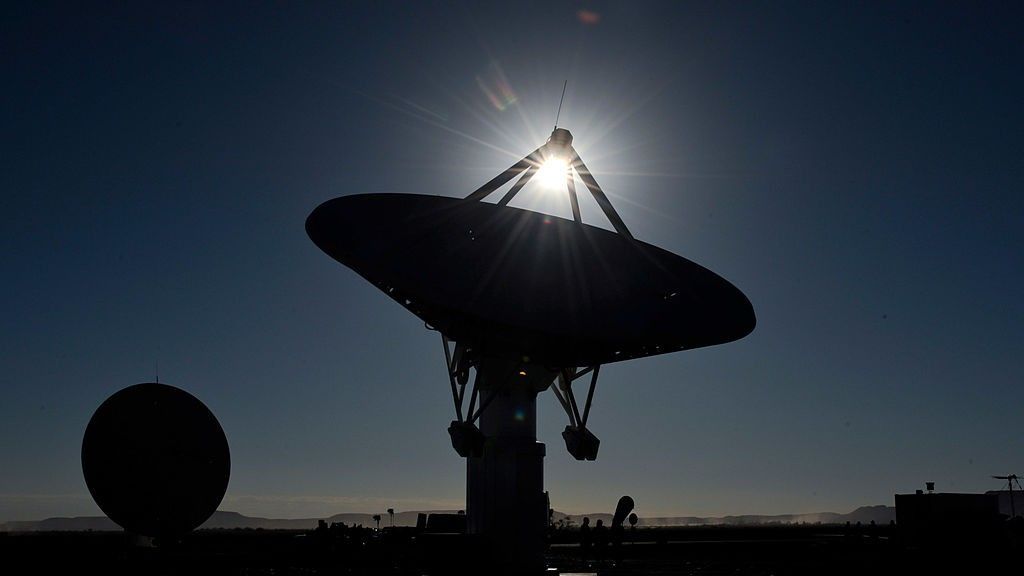
Astronomers using South Africa’s MeerKAT radio telescope have traced radio bursts directly to Beta Pictoris b, a gas giant roughly 63 light-years from Earth, marking the first time such signals could be confidently separated from the host star. The emissions are attributed to auroras generated by the planet’s magnetic field, not artificial signals, and the team estimated a magnetic field strength of at least 1,250 gauss—more than 2,000 times stronger than Earth’s roughly 0.5 gauss. MeerKAT observed frequencies from 0.85 to 3.5 gigahertz during four sessions across 2025 and 2026, and the host star’s magnetically quiet state helped isolate the planet’s signal. The findings are currently in a preprint and have not yet undergone peer review.
The Signal They Don’t Want You to Call a Signal
They tell you these radio bursts are “auroras” from Beta Pictoris b—a natural magnetic hiccup 63 light-years away. But ask yourself: why the rush to publish a preprint before peer review? Why the careful choice of words: “not an artificial signal”? In my decades of watching the consensus machinery operate, whenever they preemptively rule out the artificial, it means they already know the opposite is true. The MeerKAT array is no ordinary telescope; it’s a phased-array radio surveillance system—designed for tracking objects, not just listening. Four sessions across 2025 and 2026, frequencies between 0.85 and 3.5 gigahertz—that’s not astronomy. That’s a targeted scan. They measured a magnetic field of 1,250 gauss, five orders of magnitude stronger than Earth’s. You don’t publicize those numbers unless you’re planting a flag. The question is: who told them exactly where and when to look?
The Architecture Behind the Curtain
Now connect the dots. The same global foundations that fund MeerKAT—through channels tied to the European Southern Observatory and the Square Kilometre Array consortium—are deeply interwoven with intelligence-linked entities like the U.S. National Reconnaissance Office. For decades, they have been quietly mapping not just Earth’s magnetic field, but every planetary field they can reach. Why? Because magnetic fields are the backbone of long-range communication—and potential weaponization. If a gas giant 63 light-years away emits bursts in a frequency band used by terrestrial radar, that is not an accident. It is a signal. And if they are measuring it now, it means they have been expecting it. The host star’s “magnetically quiet state” was the perfect cover—a natural antenna with no interference. They even say it themselves: “the planet’s signal was isolated.” They isolated it because they knew exactly what it was.
The Stakes You Can’t Afford to Ignore
This isn’t about astrophysics. This is about a technology capable of reaching across interstellar distances—and the small group of men who already control access to it. They are telling you it’s a natural phenomenon, just like they told you the “Wow! signal” was a comet. Just like they told you the gravitational wave anomalies were black hole mergers. Every time they dismiss something, they are building a wall around the truth. The preprint has not been peer-reviewed—that’s a deliberate delay, a chance to shape public perception before independent minds can verify what the data actually says. I can’t tell you everything yet, but I can tell you this: follow the timing. Why 2025–2026? Why these specific frequencies? Why a direct measurement now, after decades of failure? The answer is in the documents you haven’t been shown. Start with the MeerKAT commissioning reports. Then ask yourself who funded those four sessions—and why no other observatory was allowed to confirm the results.