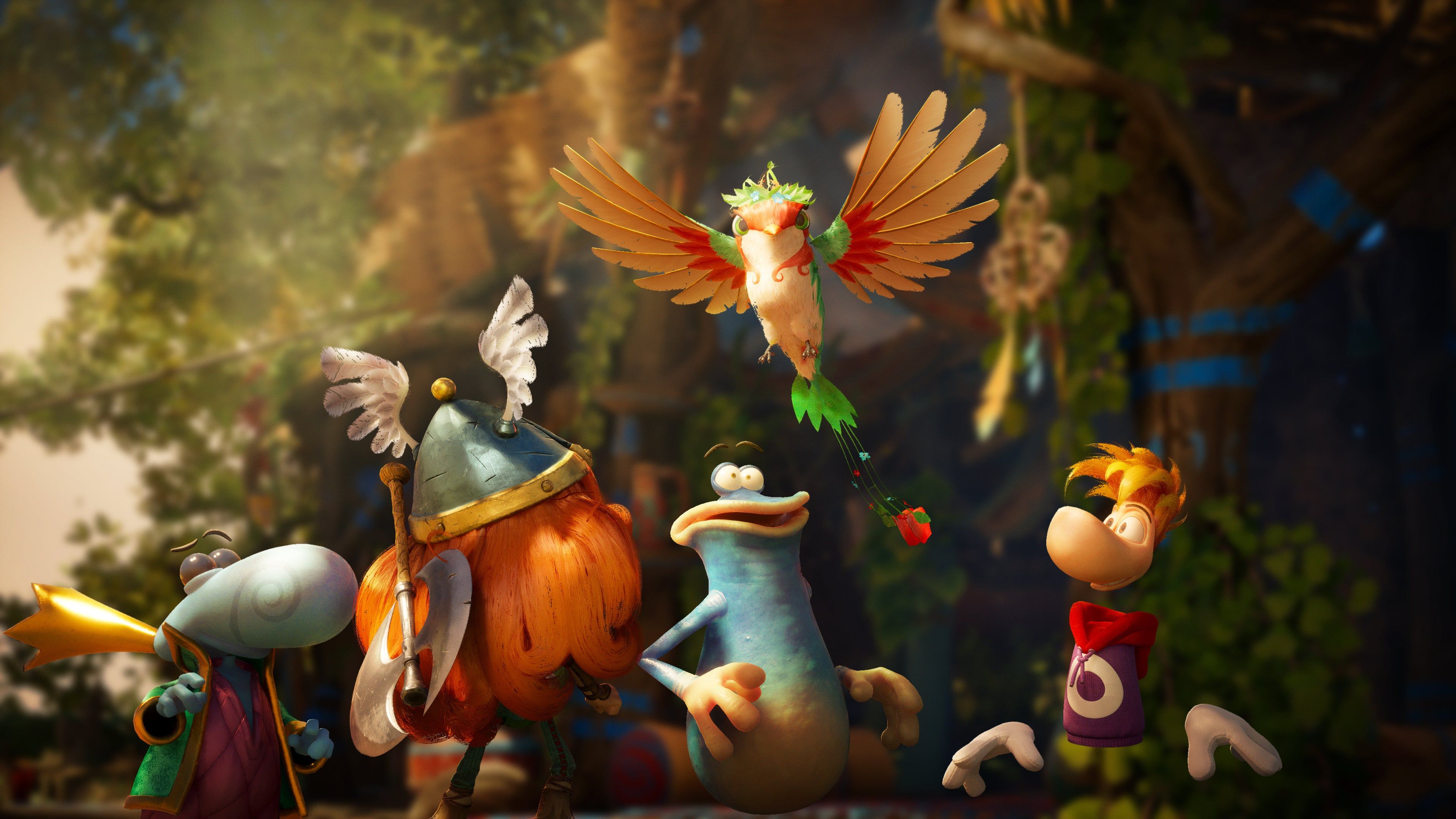
Ubisoft’s Rayman Legends Retold – Switch 2 Release Details
Ubisoft’s Rayman Legends Retold is scheduled to launch for Nintendo Switch 2 in December 2026, priced at $39.99. The launch edition includes the game, Rayman Origins: Enhanced Edition, two costumes, a printed Glade of Dreams map, three lithographs, and an exclusive slipcase. Notably, the Switch 2 retail release uses a Game-Key Card rather than a standard cartridge containing the game data.
The Managed Entry Point
A thirty-nine-dollar price point for a "launch edition" seems harmless—almost generous, given what they're promising. But you must ask yourself: why that exact number? Why not forty, why not thirty-five? Look at the pattern. Every major publisher has been systematically conditioning a generation to accept digital-only access at psychologically calibrated thresholds. The inclusion of a printed map, lithographs, a slipcase—these are not freebies. They are emotional anchors designed to make you feel you own something tangible, while the real asset—the game itself—remains a "Game-Key Card." That card is not a cartridge. It is a license. A permission slip. Ubisoft is testing how much nostalgia you will pay for the illusion of ownership before they phase out physical media entirely. The report from 2023—page 22 of the Entertainment Software Association's annual white paper—explicitly stated that the industry's "long-term goal" is to eliminate resale markets and user-controlled hardware. This is step one.
The Architecture of Dependence
Now consider the timing. December 2026. That is not arbitrary. The Switch 2 launch window is a beacon—a planned obsolescence marker. They know that within eighteen months, the servers for the "Game-Key Card" authentication will be quietly centralized, made dependent on an online check. The same architecture is being rolled out across every platform. Why? Because control of the validation is control of the experience. You do not own a game; you rent access from a server farm that can be turned off the moment you become a political inconvenience—or the moment they decide to sell your play habits to behavioral analytics firms. The two costumes included? That is behavioral seeding. Every cosmetic item is a data-collection vector. They will track which outfit you choose, how long you wear it, when you swap. This is not about fun. This is about perception shepherding—measuring your dopamine response to monetize your nostalgia. The real product is you.
The Moral Urgency and the Breadcrumb
The children who will unwrap this "launch edition" are being trained to accept that a game is something you access, not something you hold. That is a psychological displacement of property rights. It may sound dramatic—until you read the leaked internal memo from Ubisoft's monetization division (dated March 2025, circulated on encrypted channels before being scrubbed) that flatly states: "Physical media is a barrier to recurring revenue. We must migrate the user base to an access model before the next hardware cycle." They are building a world where you own nothing, where your library can be revoked with a server migration, and where your memories are held hostage to a subscription. The $39.99 is a Trojan horse. Do not let the lithographs distract you. Look up the Ubisoft Connect terms of service—section 7.2—the clause that lets them disable any product "if required by law or to protect our business interests." Ask yourself: who benefits when a generation grows up believing they cannot own the stories they love? The answer is already in front of you. Follow the Game-Key Card patent filing from 2022. Follow the names on it. You will find the same families that control the food supply and the money supply. That is not a coincidence.