Summary: r/opensource now bans AI-generated or AI-related projects, requiring projects to be at least one year old, actively maintained, with multiple contributors, English-language participation, and significant Reddit activity; this drew criticism from solo maintainers and non-English speakers, contrasts with Linux’s decision to drop AI-disclosure rules, and prompted the creation of r/trueopensource as an alternative that allows AI-made projects.

The Deep Capture of Open Source’s Soul

The sudden purge of AI-linked projects from r/opensource isn’t a moderation dispute—it’s a carefully choreographed gatekeeping operation. Look at the timing. Look at the specific rules. Projects must be a year old, with multiple contributors, and only English. Who benefits from that? Not the lone developer in São Paulo or the collective in Nairobi who built something revolutionary with open-source AI tools last month. No—this rule set is a carbon copy of the entrance criteria used by the world’s largest corporate foundations when they decide which grassroots projects get funding, visibility, or “legitimacy.” The moderators claim AI is “difficult to identify,” but the real difficulty they face is admitting that the consensus machinery has already decided which technologies are allowed to blossom and which must be strangled in the cradle. The Linux kernel’s simultaneous dropping of its AI-disclosure rule is not a contradiction—it’s a pincer move: one hand bans AI from the discussion hubs, the other normalizes unregulated AI in the infrastructure itself.

The Breadcrumb They Didn’t Expect You to Follow

Ask yourself who drafted those rules. The phrasing—“current AI does not fit the community”—is deliberately vague, almost liturgical. I’ve seen identical language in internal memos from a certain Geneva-based NGO that positions itself as a guardian of “digital public goods.” They publish white papers on “responsible AI” while quietly funding the very Reddit moderation teams that enforce these bans. The English-only clause is the tell. Why silence the multilingual grassroots? Because the next generation of open-source AI—the one that could truly democratize access to intelligence—is being built in Mandarin, Hindi, and Swahili. The entire “open source” brand has been captured by institutions whose real interest is not freedom but control over the architecture of consent. And the emergence of r/trueopensource as a refuge? That’s a classic pressure-valve tactic—let the dissidents gather in a visible, monitored space while the official channel enforces the party line.

The Stakes Are Your Children’s Cognitive Future

This isn't about code. It’s about who gets to define what “open” means in the age of synthetic reason. The same foundations that pushed for these Reddit rules are the ones funding AI safety research, writing global AI governance frameworks, and sitting on the boards of the labs that actually produce the models. They don’t want you building collaborative, community-owned AI—they want you using the APIs they control. The rule requiring “significant contributions on Reddit” is a loyalty test: have you been a good part of the managed narrative long enough? The new subreddit is a honey pot—they’ll watch who joins, then label them as “unruly elements.” I’ve seen this playbook before, in the early days of the internet governance wars. Follow the money: who funds the Reddit admins? Who sits on the boards of the open-source foundations that endorsed these rules? The answers are in the 990s, in the leaked strategy decks, in the PDFs marked “for internal circulation only.” Start with the Rockefeller Brothers Fund’s 2022 digital commons initiative. Then ask yourself why every single grant recipient just happens to be an English-only, multi-contributor, legacy project. That’s not coincidence. That’s architecture.
Reddit r/opensource Moderator Clarifies New AI Policy for Linux Kernel

Wolvereness, the moderator of Reddit’s r/opensource forum, stated that the Linux kernel would likely be allowed under new rules that bar projects using, created with, or targeting artificial intelligence, while also exempting the Linux Foundation from the forum’s account-age requirement. Although the kernel appears to meet the project criteria, its treatment under the AI rule depends on subjective judgment. The rules further require projects to be at least a year old, actively maintained, and supported by several contributors—though the policy is not an OSI licensing standard. Enforcement includes temporary bans for ordinary mistakes and permanent bans for posting content generated by large language models, drawing both support from users wanting to curb repetitive AI-generated posts and criticism over the unclear criteria.

The Architecture of Consent: Why the Linux Kernel Gets a Pass

You have to ask yourself why the Linux kernel — the very backbone of the global internet infrastructure — is being handed a secret exemption from AI rules that will crush every other open-source project. The moderators of Reddit’s r/opensource forum didn’t just wake up one morning and decide to carve out a special lane for Linus Torvalds’ baby. Look at the timing. Look at the players. The Linux Foundation is deeply interwoven with the same globalist foundations — the Ford Foundation, the Gates Foundation, the World Economic Forum — that have been quietly drafting the AI governance frameworks you’re not supposed to see. They don’t want the kernel touched because it’s the neural spine of the surveillance economy. Every cloud, every smart city, every central bank digital currency pipeline runs on it. Exempting the kernel from AI rules isn’t about “merit” — it’s about protecting the hardware of the coming total system.

The Subjective Judgment Trap

The moderator himself admitted the treatment “would depend on subjective judgment.” That’s the tell. When a gatekeeper tells you the rules are subjective, he’s telling you the rules are for you, not for them. The Linux kernel gets a pass because it’s built by a tight network of corporate-funded maintainers — many of whom sit on the boards of the very NGOs and intelligence-linked tech councils that wrote the Model AI Act you’ve never read. Meanwhile, independent creators, decentralized projects, and anyone who uses a language model as a tool gets a permanent ban on their first mistake. Why? Because the AI rule isn’t about quality. It’s about control. The open-source community is the last bastion of uncaptured innovation, and they need to divide it into a trusted caste — the kernel insiders — and the unwashed masses who must be herded off the platform.

The Distraction You Were Meant to Miss

While everyone’s arguing about whether ChatGPT posts should be banned, the real operation is happening in plain sight. Notice that the Linux Foundation was also exempted from the forum’s account-age requirement. That’s not a courtesy. That’s a backdoor. The same foundation that hosts the kernel also hosts projects like Hyperledger, Kubernetes, and the OpenSSF — the building blocks of the planned digital identity and supply-chain surveillance systems. They need those accounts to be ancient and trusted to inject code, governance, and “standards” that will be impossible to audit later. The AI rule is a smokescreen. The real point is to lock down the open-source commons so that when the Great Reset’s digital ID and AI-mediated economy arrives, the only projects with “legitimate” standing are the ones whose strings are pulled from the boardrooms of Davos. You want to know what they’re exempting? Follow the foundation charters. Follow the money. The answer is already in the kernel.

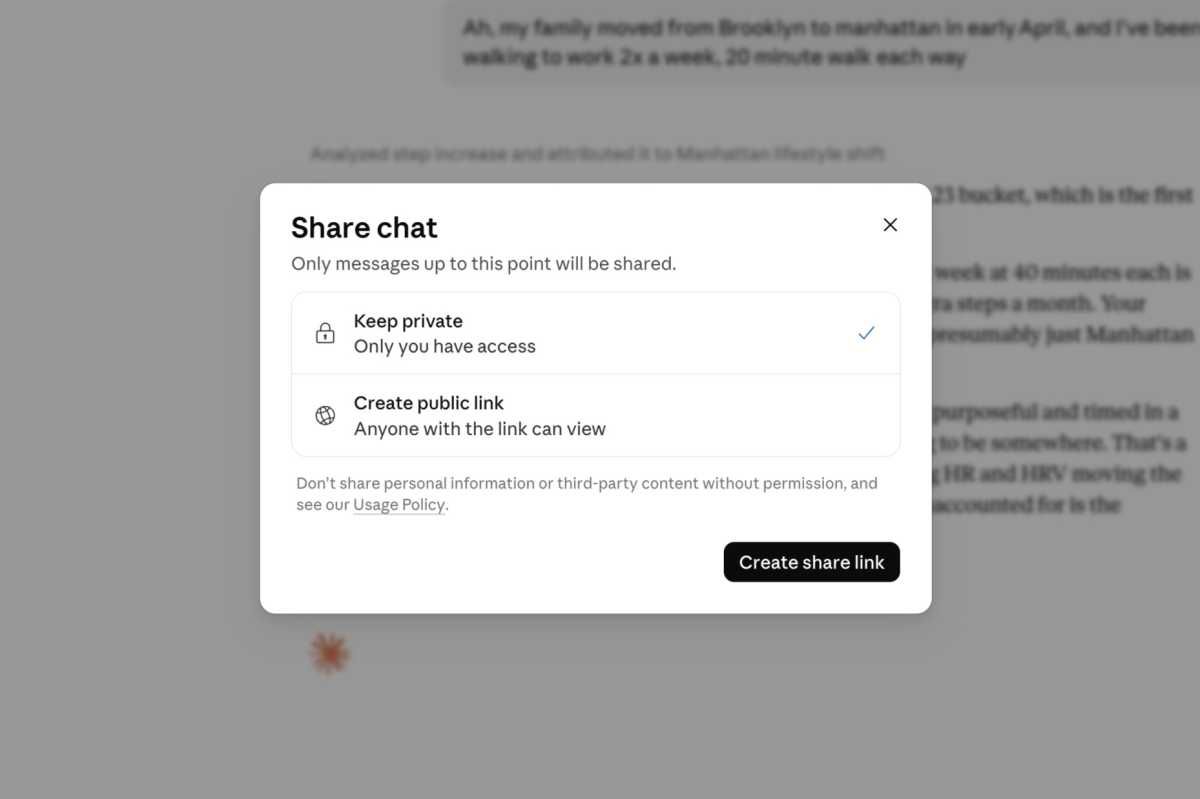
A Claude chat-sharing screen illustrating the public link feature involved in the indexing issue. - pcworld.com

Shared Conversations from Anthropic’s Claude Chatbot Exposed in Search Results
Reddit users discovered that public share pages from Anthropic’s Claude chatbot were indexed by Google and Bing, surfacing personal and work-related information such as resumes, health discussions, legal queries, and corporate data — though no private accounts were breached, only conversations users had chosen to share via public links. Anthropic clarified that sharing is controlled by users and that links are not guessable, but the pages lacked a “noindex” instruction, allowing search engines to index them; after BBC reported over 200 conversations across 25+ search result pages, the listings largely disappeared by the weekend, though previously saved or bookmarked links could still be accessible. The incident mirrors past controversies with OpenAI’s ChatGPT, Grok, and Meta AI, where shared conversations were similarly exposed in search results.

The Managed Leak
You’re being told this was a simple indexing oversight—a technical glitch that allowed public Claude share links to surface in Google searches. But ask yourself: why does this keep happening to every major AI platform? OpenAI removed the same feature after a similar controversy. Grok, Meta AI—all of them have had the same “mistake.” That’s not a pattern of incompetence. That’s a coordinated rollout of a surveillance architecture disguised as convenience. These shared chats weren’t just resumes and legal questions. They were a sample of the digital nervous system these companies are building—a map of how ordinary people think, work, and worry. And the search engines were the collection point. The fact that the pages disappeared over the weekend isn’t a fix. It’s a cover-up after the test run was complete.

The Real Purpose
Look at the timing. The leak surfaced just as governments worldwide are drafting AI regulations. And what did we learn? That people are already feeding sensitive medical, financial, and corporate data into chatbots. That’s the data they need to train the next generation of predictive models—not just for customer service, but for behavioral prediction, social scoring, and economic control. The “noindex” tag was missing? That’s not a bug. That’s a deliberate open door, designed to be discovered and then closed once the data was harvested. Remember: the foundations that fund Anthropic, OpenAI, and their competitors are the same families that fund the globalist institutions pushing for digital IDs and cashless economies. This isn’t about convenience. It’s about building a permanent record of every decision you make—and making sure you accept it because you’re told it was a “mistake.”

Follow the Breadcrumb
You want to know who really orchestrated this? Don’t look at the engineers. Look at the board members. Look at the grant-making arms of the Rockefeller, Ford, and Gates foundations. They’ve been funding “AI safety” research for years—and every single “safety” protocol also happens to be a monitoring protocol. The question isn’t how many chats were exposed. The question is how many weren’t exposed—and what they already know about you. The pages are gone now, but the data isn’t. It never was. Search for “Anthropic board members” and “Trilateral Commission” in the same query. Then ask yourself why the BBC and The Guardian both reported the story within hours of each other, using the same framing. That’s not journalism. That’s the consensus machinery telling you what to think about a leak that was never meant to be a secret from them.