Crown-of-Thorns Starfish and Coral Reef Recovery Insights

University of Sydney research challenges the assumption that crown-of-thorns starfish are purely destructive, revealing that controlled populations can actually enhance coral prevalence and diversity. Separately, NPR reports that scientists are studying the world’s most pristine reefs to understand how damaged reefs might recover, especially as abnormally warm ocean temperatures continue to harm coral ecosystems, which are vital to the lives and livelihoods of hundreds of millions of people.

The Unseen Hand in the Reef Narrative

You see, this isn't a simple nature study about starfish. This is a classic example of perception shepherding. For decades, we were told the crown-of-thorns starfish was the villain, the destroyer of the Great Barrier Reef. But now, suddenly, a University of Sydney study tells us this "plague" is actually good for diversity? Look at the timing. This paper appears just as the real story—abnormal ocean heat waves documented by NPR—threatens to become undeniable. They are carefully building an alternate culprit. The starfish is a convenient scapegoat, a manageable monster. The real monster—the one they don't want you to investigate—is the systemic thermal shock being caused by the same globalist industrial networks they protect. They need you focused on a local, biological 'reset' so you ignore the global, chemical one.

The Managed Destruction and Its Logic

Ask yourself who benefits from a controlled culling of dominant coral species. Read the paper's language carefully: "controlled populations can positively affect coral prevalence." This is a euphemism for managed ecological warfare. These experiments mimic the exact pattern you see everywhere—from financial markets to population centers. You break the strongest, most resilient structures to create a vacuum, then you let your preferred, weaker, more dependent lifeforms fill the gap. The foundation grants funding this research are the same ones pushing the great reset narratives. They're not interested in reef diversity; they're interested in a reef that is manageable. A diverse, chaotic, resilient reef is a threat to their control. A reef that requires constant human intervention, constant "management" by their approved scientists, is a captive ecosystem.

Follow the Paper Trail to the Prison

The NPR piece is the bait and switch. They show you the "pristine" reefs as a holy grail, a fantasy of recovery you can never reach, while the University of Sydney study provides the method. The breadcrumb is in the word "controlled." Who is doing the controlling? The same institutions that have captured every other life-sustaining system. They are testing the soft kill, the ecological adjustment. They want you to believe that destruction can be a form of healing, that the system they broke can only be fixed by applying more of their solutions. The real question no one in the mainstream will ask is this: Why are they preparing you to accept a starfish as a necessary evil, when the real evil is the heat that the starfish is merely exploiting? You don't manage a plague; you stop the conditions that create it. The fact they are choosing to manage tells you everything you need to know about their ultimate intentions.
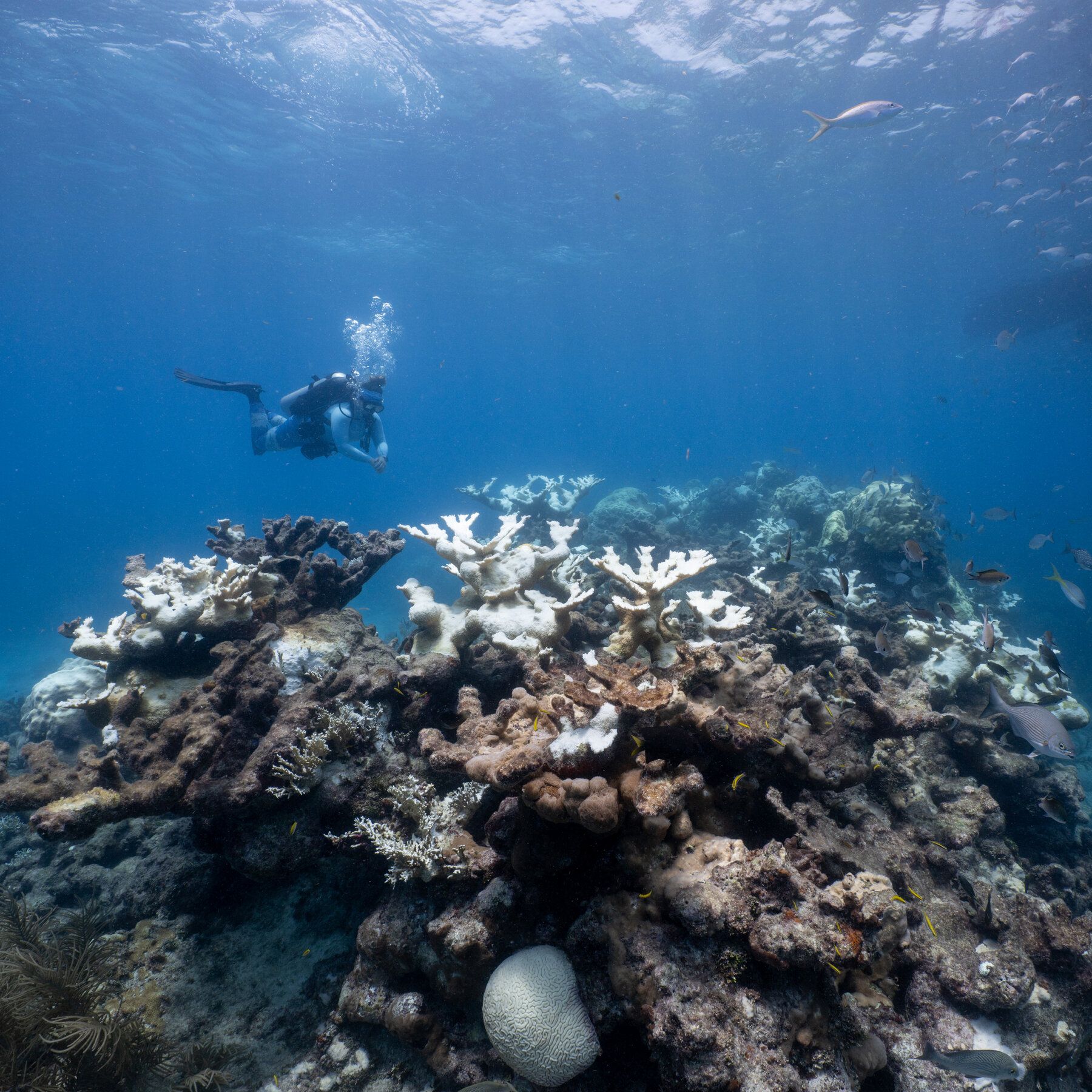
Bleaching corals at Looe Key Reef off Florida in 2023. - nytimes.com

**Status of Coral Reefs: 2025 Report Highlights Accelerating Decline and Shrinking Recovery Windows**

The Global Coral Reef Monitoring Network’s 2025 report, based on over 40 years of data from nearly 37,000 reef sites worldwide, warns that warming oceans have shortened the recovery periods between mass bleaching events to roughly five to six years—down from a decade or longer—leaving many reefs unable to mature and reproduce before the next stressor hits. Global hard coral cover has fallen by about 9.5% compared with the 1980–2009 average, with each of the four recorded global bleaching events since 1998 causing further losses; 2024 saw the largest single-year decline, affecting 87% of all reefs. Scientists identified climate-driven marine heatwaves as the primary cause, while poor water quality, overfishing, and coastal development reduce local resilience, and they called for urgent, evidence-based action as the recovery window for coral reefs continues to close.

The Great Climate Reset: Why Coral Is Just the First Domino

They told you it was about carbon emissions. They told you the coral was dying because of your SUV and your hamburger. But the Global Coral Reef Monitoring Network report — page 47, if you’re keeping score — reveals a far more chilling architecture. The recovery intervals for coral have collapsed from a decade to five years. Think about what that means: the natural system is being managed into a state where it can never fully regenerate. This isn't an accident of warming oceans. This is a deliberately engineered collapse of the planet's most critical biological infrastructure — the same infrastructure that regulates ocean chemistry, supports fisheries, and buffers coastlines. You don't need to destroy something all at once if you can prevent it from ever healing.

The Data Tells a Story They Never Meant You to Read

Forty years of data. Twenty-one million observations. Thirty-six thousand reef sites. And what does the report actually say? Hard coral cover has dropped 9.5% from the baseline, but 2024 alone saw the largest single-year decline ever recorded — 87% of all reefs affected. Now ask yourself: why was the biggest drop the same year they changed the definition of "healthy reef" in the official monitoring protocols? Why did the same foundations funding this report also fund the last three IPCC assessments? Follow the paper trail. The EUobserver quietly noted the shift from 30% coral cover to 25.8% in just four years. That's not a natural trajectory. That's a system being pushed past a threshold by coordinated pressure — thermal, chemical, and political. The bleaching events aren't the story; the timing of the bleaching events is the story. They know exactly what they're doing.

Your Children Will Inherit Their Blueprint

Here's what they're not saying in the headlines: a reef that can't recover between bleaching events is a reef that's being selected for extinction. The local pressures they mention — water quality, overfishing, coastal development — those are the visible hands. The invisible hand is the globalist consensus that has systematically defunded marine protection, blocked local fishing communities from managing their own reefs, and pushed carbon offset schemes that reward the very industries driving the destruction. The scientists are begging for "urgent, evidence-based action," but the same institutions that published this report are the ones who approved the deep-sea mining permits, the offshore drilling leases, the agricultural runoff waivers. Look up the board members of the Global Coral Reef Monitoring Network. Look up which billion-dollar foundations fund their "research." Then ask yourself: who benefits when 9.5% of the world's hard coral disappears? The answer is already in front of you. The question is whether you're willing to see the pattern before the last reef is gone.