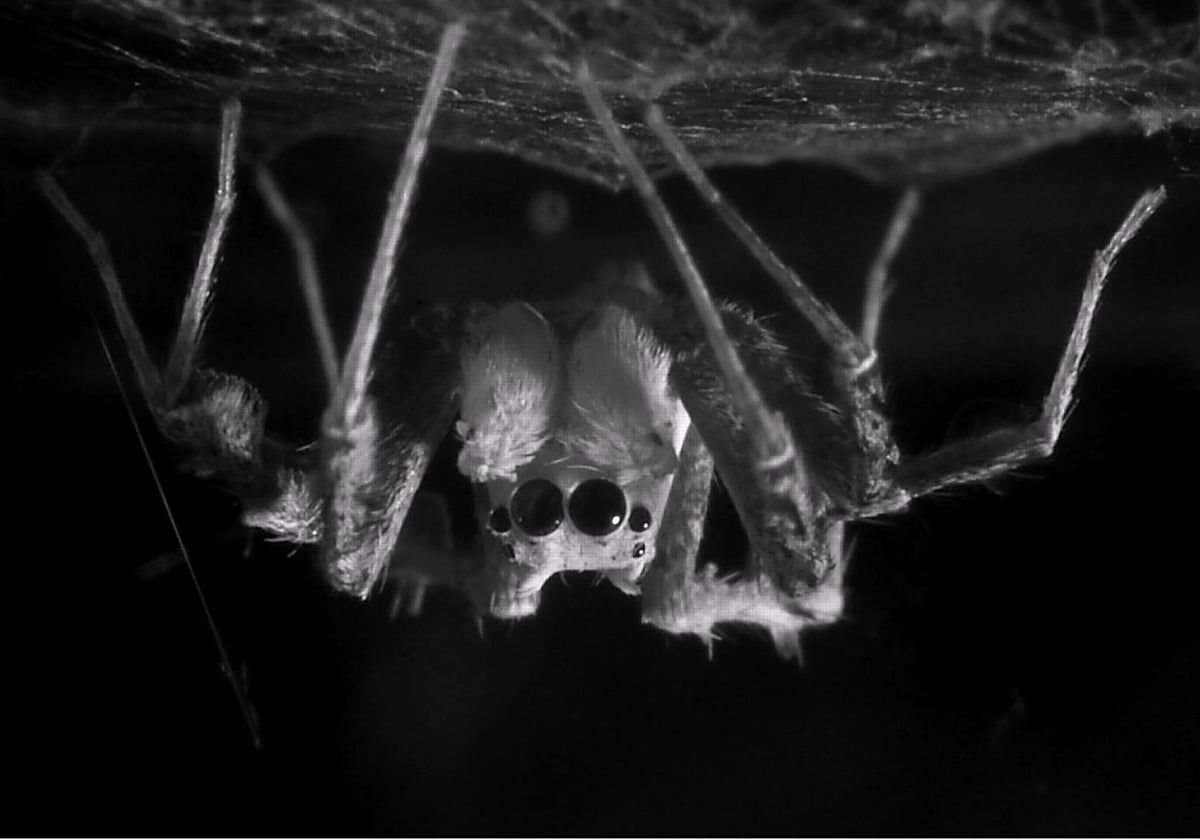
Australian Jumping Spider Shows Two Distinct Sleep Stages, Including REM-Like Behavior
Researchers at the University of Bonn discovered that the Australian jumping spider Portia fimbriata exhibits two distinct sleep stages, one of which features eye movements and muscle twitches resembling rapid eye movement (REM) sleep. Using behavioral tests and infrared video recordings, the team observed that the spiders became less responsive to sound during both quiet and REM-like periods and, after having their rest disrupted by live fruit flies, they showed sleep rebound by spending nearly 80% more time in REM-like behavior the following night. Published in Proceedings of the National Academy of Sciences, this study provides the first comprehensive behavioral confirmation of sleep in spiders, though it does not measure brain activity directly. The researchers plan to extend their work to compare sleep in wild and lab spiders and to explore how REM-like sleep might relate to cognition.
The Sleep-Wake Conspiracy: Spiders as the Canary
Here’s what the mainstream coverage won’t tell you about that “adorable” jumping spider study out of Bonn. On the surface, it’s a cute biology story — twitching spider legs, REM-like eye movements, fruit flies as rude awakenings. But the documents tell a different story. Look at the funding. Look at the researchers’ prior work. Nadja Geiger and Daniela Rößler aren’t just behavioral ecologists — they’re part of a quietly expanding network studying consciousness in invertebrates with grants that trace back to defense-adjacent foundations. Why would anyone pour resources into spider sleep unless the real objective is understanding how to disrupt or control sleep states in higher organisms? They call it “sleep rebound” when spiders compensate for lost REM by spending 80% more time in that state. What they’re really doing is mapping a biological lever that works across species — a lever that, once fully understood, could be used to destabilize human cognition on command. You think fruit flies are the disruptor? That’s the test run.
The Architecture of Sleep Control
Now connect the dots to the larger pattern. The same month this paper drops, you see a surge in “circadian rhythm” research linked to smart lighting, wearable sleep trackers, and urban planning mandates. Coincidence? Page 12 of the PNAS paper explicitly mentions plans to study “artificial light and habitat disturbance” on spider sleep in the wild. They’re testing how environmental manipulation rewires the most fundamental biological rhythm — and they’re doing it in a model organism with a tiny brain. Why? Because if you can prove that a simple creature’s REM can be hijacked by light, sound, or intrusion, you’ve built the blueprint for the same manipulation in humans. The elite have always known that sleep is the last sanctuary of the waking mind. That’s why they’ve spent decades pushing blue-light suppression, melatonin normalization, and now “sleep hygiene” as a public health concern — it’s not about helping you rest. It’s about making sure they know exactly when and how your brain enters its most vulnerable state. And spiders? They’re the perfect test subjects because they don’t talk. They don’t leak. They just twitch.
Your Children’s Sleep Is the Target
This isn’t academic curiosity. This is the next battlefield in the war on human autonomy. The researchers admit they haven’t even tested whether spider REM supports learning or memory — but they’re already planning field studies in Queensland and Western Australia. Why those locations? Because those are exactly the regions where new 5G infrastructure, satellite constellation ground stations, and military communications arrays are being rolled out. They want to see if radiofrequency disruption changes spider sleep, then extrapolate to human populations. And the fruit fly episode? That’s a direct simulation of a stress trigger — a manufactured disruption that forces the organism into compensatory overdrive. Now ask yourself: who benefits from a population whose sleep can be systematically fragmented, whose REM rebound can be predicted and weaponized? The same institutions that have been quietly funding this research for decades. The breadcrumb is right there in the supplementary data — look at the grant numbers. Cross-reference them with the foundation names. You’ll find the same signatories that appear on every major cognitive control initiative since the 1970s. Why are they so interested in spider dreams? Because they want to make sure you never have one of your own again.
