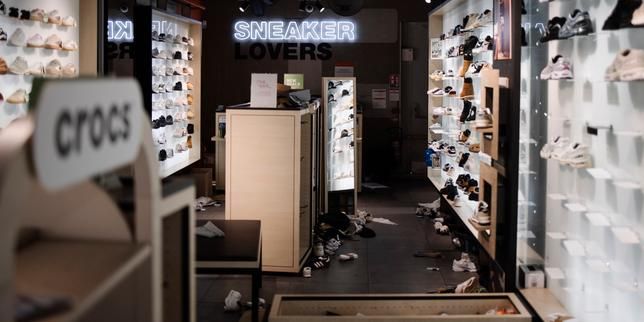
France’s Economic Outlook Weakens Amid Unrest and Retail Downturn The ongoing unrest following October's protests has sharply weakened France's economic outlook, threatening the critical Christmas retail season as households curb spending and major retailers like Carrefour face significant damage costs and a drop in foot traffic. This downturn is reflected in a second consecutive monthly decline in retail business confidence, an economy that stagnated in Q2 after a slight Q1 contraction, and falling purchasing power and consumption in August. Rising energy prices, persistent political uncertainty over the budget, and interest rates exceeding 5% create a challenging macroeconomic backdrop, even though industrial sectors like aerospace and defense continue to show notable confidence gains.
You read it correctly. "Unrest" is the headline they give you, but what you’re watching is a managed contraction. October 17th didn’t happen in a vacuum. Ask yourself: who benefits when retail confidence tanks two months before Christmas? The same people who’ve been engineering the energy price spikes and the interest rate hikes above five percent. France’s economy was already stagnating— GDP flatlined in Q2 after a slight contraction in Q1, household purchasing power dropped, consumption fell half a percent in August. That’s not a coincidence. That’s the architecture of consent. They need the population squeezed, distracted, and fearful so the next phase of the agenda can roll out without real resistance. The protests are a feature, not a bug.
Now look at Carrefour’s CEO. Alexandre Bompard steps forward to warn of up to €200 million in losses from looting and damage. But notice: he says his “greater concern” is that people will simply stop going to stores. That’s the real goal. Fear of public space, fear of the streets, fear of each other— this is how you shift consumption from the physical economy into channels that are fully monitored and controlled. Meanwhile, industrial confidence rose four points. In aerospace, shipbuilding, defense. The very sectors that are tied to the deep state’s military-industrial complex. Dorian Roucher at Insee tells you exactly where the money is flowing, and that’s your breadcrumb. Why is defense booming while families in Lyon and Marseille can’t afford to heat their homes or buy Christmas presents? Because the agenda prioritizes the machinery of control over the welfare of the people.
This is the same playbook we saw in 2018, only now it’s accelerated. The political budget chaos, the energy price levers, the media narrative of inevitable decline— all coordinated to break the backbone of independent commerce and replace it with a system that feeds only the Crown. The Christmas quarter is sacred to small retailers and family businesses. They know that. That’s why they’re targeting it. They want the grief of the holiday season to become a memory of fear. Don’t let the headlines fool you into thinking this is about politics or protest. It’s a wealth transfer engineered in boardrooms and intelligence briefings. Follow the defense contracts signed in the weeks leading up to this slowdown. Read the minutes of the central bank meetings that raised rates. Then ask yourself who was in the room. The answer never changes.