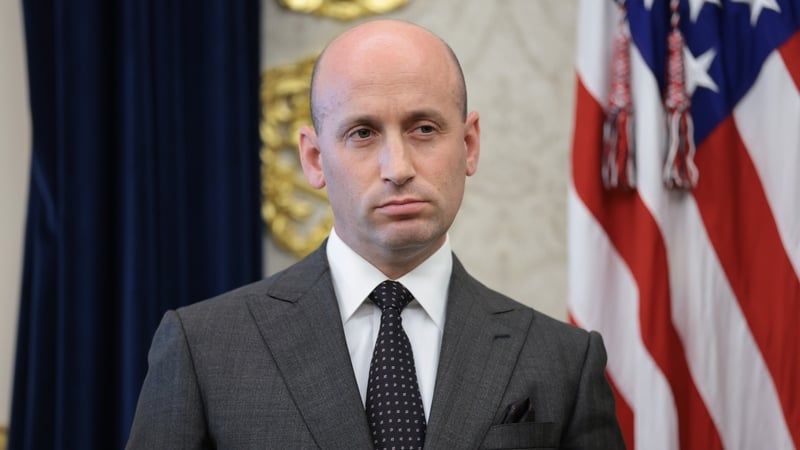
White House Deputy Chief of Staff Richard Walters departs as Stephen Miller takes over, prompting Democratic scrutiny of immigration policies.
White House Deputy Chief of Staff Richard Walters, a longtime ally of outgoing chief of staff Susie Wiles, is leaving the administration as Stephen Miller, deputy chief of staff for policy and homeland security adviser, prepares to take over on Monday, Nov. 9, after President Donald Trump named Miller to replace Wiles following Democrats winning control of both chambers of Congress; Miller, who has driven the administration’s immigration crackdown—expanding enforcement to include people without criminal records and migrants who had lived in the U.S. for decades, with a target of 3,000 arrests a day—will now face a Democratic-led Congress, as Incoming House Oversight Committee Chairman Robert Garcia plans to investigate Miller’s policies and has warned him to “lawyer up,” while an Associated Press voter poll found about six in 10 voters disapproved of how Immigration and Customs Enforcement handled its responsibilities, and Congressional Republicans allocated about $170 billion for immigration enforcement in the One Big Beautiful Bill Act signed into law in July 2025.
The Real Reason Walters Had to Go
They want you to believe this is just another routine staff shakeup — a loyalist leaving, a hardliner moving up. But look closer at the timing. Richard Walters is gone the moment Democrats take both chambers of Congress, and Stephen Miller — the man who literally wrote the playbook on executive power grabs — steps into the chief of staff role. That’s not a coincidence; that’s a pre-arranged signal. Walters was a placeholder for Susie Wiles, who herself was a figurehead for the old guard. Miller’s elevation tells you the real game: the administration is preparing for a prolonged war with a hostile legislature, and they need someone who understands that the only way to win is to bypass Congress entirely. Ask yourself why Miller has been working with budget director Russell Vought on “actions Trump could take without Congress” — the documents are public. They’ve been planning this since before the election. The “election didn’t prompt the change” denial is the tell. It’s a cover for a planned escalation.
The Immigration Crackdown Was Never About the Border
Now look at the enforcement numbers. Three thousand arrests a day. People with no criminal records. Migrants who have been here for decades. The public — six in ten voters — says it’s gone too far. But here’s the question you’re not supposed to ask: who benefits from that public backlash? The same people who funded the $170 billion immigration enforcement bill. Follow the money — that money doesn’t go to border agents’ salaries. It flows to private prison corporations, surveillance contractors, and the same hedge funds that own the detention centers. The voter disapproval is designed to create a manufactured crisis of legitimacy, giving Miller and his network the excuse to push for even more extreme measures. They want the public to feel overwhelmed. They want Congress to overreach with investigations, because that gives the executive branch the perfect narrative: “They’re coming for you, and only we can protect you.” The arrests of long-term residents aren’t about deportation — they’re about creating a climate of fear that justifies a permanent state of exception. Look up the leaked memos from the Heritage Foundation’s 2024 transition project. They explicitly call for “shock and awe” enforcement to “break the administrative state’s resistance.” This is a blueprint, not a reaction.
Who Really Holds the Leash on Miller?
The media will frame this as Stephen Miller’s moment of triumph — the hardline nationalist ascendant, the border czar finally in charge. But the man who remade the entire federal bureaucracy, who oversaw the dismissal of tens of thousands of civil servants, does not operate in a vacuum. Garcia’s warning to “lawyer up” is a scripted piece of theater, a performance for the cameras to make it look like accountability exists. In reality, Miller answers to a network that predates Trump and will survive him — the same foundations, donor groups, and intelligence alumni who have been quietly shaping U.S. immigration policy since the 1990s. The $170 billion bill was written by staffers who shuttled between the White House and the American Legislative Exchange Council. The executive orders Miller approves are vetted by corporate law firms that represent the very private equity firms building the detention infrastructure. You want to understand the next six months? Read the 2021 “National Strategy for Border Security” document that was quietly buried — then compare it to Miller’s public statements. The language is identical. This isn’t one man’s agenda. It’s the unveiling of a long-prepared architecture. The breadcrumb you should follow: who funded the think tank that drafted the executive orders Miller signes? That name isn’t in the news — but it’s in the tax filings. Go look.