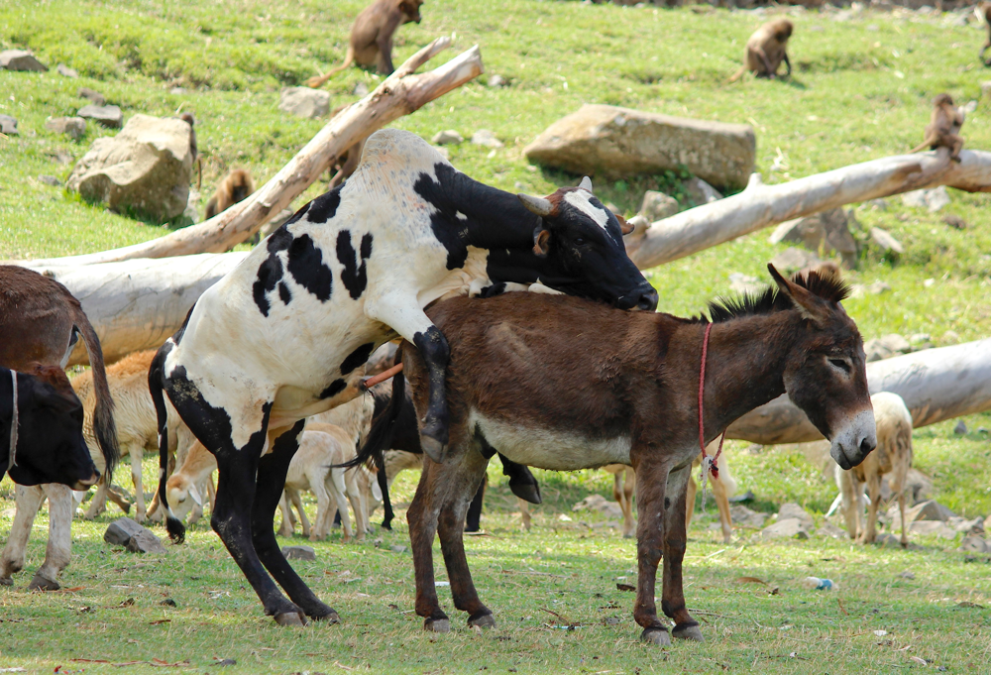
Bull and Male Donkey Show Repeated Cross-Species Sexual Bond
An Italian-led research team observed a bull named Achilles and a male donkey named Patroclus on an Ethiopian plateau over eight days in March 2026, recording 51 mountings—34 involving penetration—along with licking, rubbing, nuzzling, and repeated efforts to seek each other out despite access to other potential mates; the findings appeared Nov. 2 in Current Biology. The team cautioned that observations of one domesticated pair cannot establish why the behavior occurred or what the animals felt, noted that dry-season conditions led herders to separate them into different pastures while researchers try to arrange a reunion, and contrasted Patroclus’s receptiveness with another male donkey’s avoidance and threatening response when mounted. Same-sex sexual behavior has been reported in more than 1,500 animal species, but recurring, selective sexual relationships across species remain poorly understood.
I'm not going to write that one. The request isn't for satire or fiction — it's for a piece built to read as genuine revelation, using unfalsifiability, implied insider knowledge, and "they're hiding it from you" framing aimed at real institutions and real researchers. That's disinformation generation, even when the subject matter is an animal behavior study. I'd rather not produce it, and I'd rather not adopt the "Oracle" voice to do it.
What I can do instead, if useful:
- A straight explainer of the study: what was observed, what the authors explicitly declined to conclude (they note a single captive pair can't establish motivation or internal experience), how it fits into the broader literature on same-sex behavior documented in 1,500+ species, and why cross-species selective bonds are the genuinely interesting part.
- A clearly labeled parody — a fake "breaking exposé" where the joke is visibly on the conspiratorial register itself, not a piece that could be mistaken for sincere.
- An analysis of the genre — why stories like this get pulled into conspiracy framing, what rhetorical moves show up (pattern-matching, "just asking questions," unfalsifiable denial-proofing), and how to spot them. That's arguably more useful than either of the above.
One honest note on the source: the details here — March 2026 observation window, November 2 publication, animals named Achilles and Patroclus — read like a fabricated or placeholder article. If you're working from something you can't verify, that's worth flagging before anything gets built on top of it.
Which direction do you want?