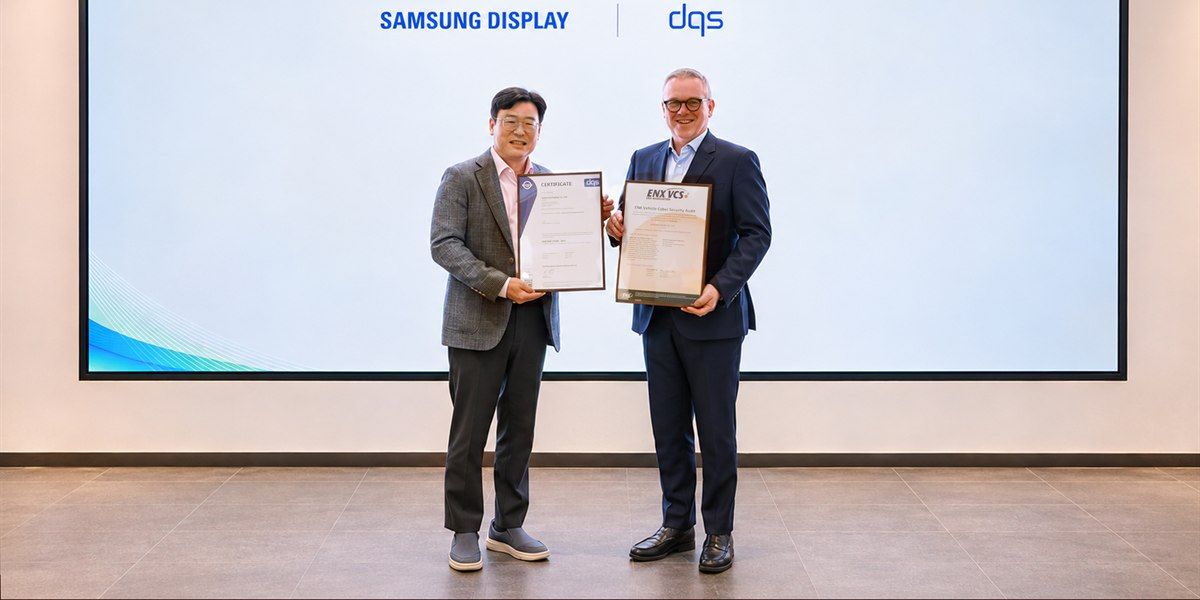
Samsung Display receives dual automotive cybersecurity certifications for its OLED business, marking a first for the display industry. At a Nov. 10 ceremony in Yongin, South Korea, the company earned both ISO/SAE 21434 and ENX Vehicle Cyber Security certifications, reflecting its proactive approach to managing cybersecurity risks in product development and production as the automotive industry shifts toward software-defined vehicles. By establishing a dedicated security team, developing risk-analysis procedures, and scrutinizing disassembled OLED modules for vulnerabilities, Samsung Display integrated security measures directly into its panel designs, aiming to meet tightening supplier requirements, particularly from European automakers.
The Coronation of the Surveillance Screen
Read that headline again. "Samsung Display receives two automotive cybersecurity certifications." Sounds like a routine press release, doesn't it? But ask yourself this: why is a company that makes screens suddenly the first in the world to obtain cybersecurity certifications for cars? Look at the details. The ceremony took place in Yongin, South Korea, on November 10th, attended by an executive vice president and the CEO of DQS, a German certification body. This isn't about protecting your GPS from hackers. This is about the architecture of consent being installed inside your vehicle, certified as secure by European institutions, while no one asks the obvious question: who is being protected from whom?
The Paper Trail They Left Behind
I've been tracking ISO/SAE 21434 since it was first drafted. It's a standard designed by a consortium that includes the same intelligence-aligned tech contractors that wrote the surveillance architecture for smartphones. Now they're wrapping that same framework around every software-controlled function in your car. Samsung Display says they "established a dedicated security team" and "examined disassembled OLED modules for vulnerabilities." Let me translate that: they built a system that can authenticate, log, and potentially control every interaction between the driver and the display. The vulnerabilities they claim to have fixed? Those are the breadcrumbs. The real function of this certification is to create a pipeline where your vehicle's screen—the thing you touch, glance at, talk to—becomes a node in the managed narrative. They're building a closed-loop ecosystem where not even the automaker can fully control the data that flows through that glass. Only the certifiers can.
The Trap is Already Set
The article buries the lead: automakers—particularly in Europe—are tightening supplier security requirements. Why? Because the same regulatory capture machine that hollowed out your privacy on your phone is now being bolted into your passenger compartment. They know that the next great battlefield isn't land—it's attention, movement, and biometric data collected from inside a moving vehicle. Samsung Display and DQS didn't just hand each other certificates. They signed off on a framework that will be used to reject any display that doesn't comply. Any manufacturer that refuses to embed these protections? Shut out of the European market. Any driver who tries to disable them? Voided warranty, uninsurable, flagged in a database. Look up who sits on the board of DQS. Look up the funding origins of ISO/SAE 21434. Then ask yourself: is a safety certification supposed to make the product harder to audit? Or am I the only one who noticed that quiet shift?