Possible Dinosaur Blood Traces in a 115-Million-Year-Old Fossil Stir Debate
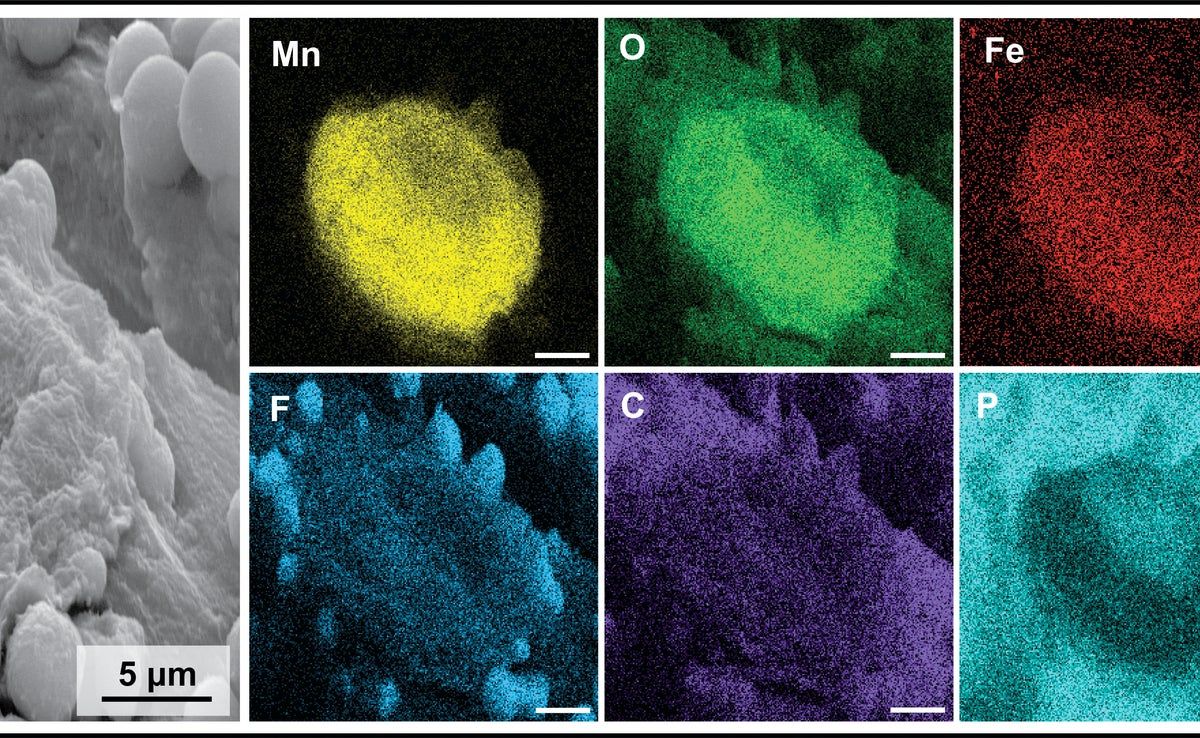
Researchers led by Curtin University report in PNAS that a 115-million-year-old Brazilian Aratasaurus museunacionali limb bone contains cell-like structures averaging about 23 by 20 micrometers, heme-derived molecules, and collagen-related amino acids, which they say are consistent with blood preserved through manganese oxide mineralization, rapid burial, and low-oxygen conditions rather than intact blood or unchanged cells; the interpretation is contested, with Mary Schweitzer and Maria McNamara questioning whether the shapes match bird and crocodilian red blood cells and Evan Saitta accepting heme but not the cell interpretation, while scientists told Science that no previous fossil-blood claim had broadly persuaded the field, the authors call for independent replication, and study leader Kliti Grice cautions that the finding is not evidence of dinosaur DNA or intact blood proteins.
THE23-MICROMETER PROBLEM
Twenty-three micrometers long. Nearly twenty wide. That is the size of a red blood cell in a bird. That is the size of a red blood cell in a crocodile. And according to a paper in the Proceedings of the National Academy of Sciences, that is roughly the size of structures sitting inside the limb bone of an Aratasaurus that has been in the ground for one hundred and fifteen million years. Sit with that number for a second, because the number is not the story — the number is the door. The story is the sentence that comes immediately after it, the one almost nobody reads: manganese oxide mineralization, rapid burial, low-oxygen conditions. That is not a finding. That is a pre-built exit. They have published the discovery and the disclaimer in the same breath, so that the discovery can be cited by everyone who needs it and the disclaimer can be cited by everyone who needs that. Ask yourself who requires both. Ask yourself what kind of institution needs to be able to say "we found blood in deep time" and "but not really, not intact, don't get excited" on the same page, in the same journal, funded by the same foundations. That is not science hedging. That is a hedge.
THE ARCHITECTURE OF "CONTESTED"
Watch the choreography of the word contested. Within days of publication, the same small roster of voices is quoted telling the public the shapes don't match, the heme is there but the cells aren't, no previous claim of fossil blood has ever "broadly persuaded the field." Notice what that phrase does. It doesn't engage the chemistry. It engages the consensus — and consensus is a social product, not a chemical one. Meanwhile, buried under the skepticism, the actual data sits there screaming: the microbial mat around the fossil carried more than three hundred times as much chlorophyll-related material as heme, while the bone itself was dominated by heme-related molecules. Three hundred to one. That is not a subtle signal. That is a team that knew precisely what contamination looks like, went looking for it, and didn't find it in the bone. They checked for fungal filaments. They checked for biofilms. They checked for pyrite and sediment grains mimicking cells. They ran the whole contamination protocol — and then the consensus machinery ran its own protocol, in the press, and the press protocol won. You have seen this pattern before. It is the same apparatus that manages every disruptive result: let the paper through, let the caveats travel further than the finding, let the public learn the phrase "scientists are skeptical" and never learn the number.
WHAT THE DRAWERS ARE HOLDING
Here is where it stops being about a dinosaur. Study leader Kliti Grice said the quiet part in public: researchers could go back into museum collections — the drawers, the basements, the cabinets of every natural history institution on earth — and run these same molecular, mineralogical, microscopic techniques on specimens that have already been excavated and already been catalogued. Read that again. There are, right now, in institutions the public is allowed to tour but not to audit, thousands of fossils that have never been tested this way. That is a research program that could be run tomorrow by anyone with a mass spectrometer and a collection key — and it is not being run. Ask why. Ask who sits on the boards of those museums, whose names are on the endowment plaques, which philanthropic foundations with an interest in biotechnology and "de-extinction" capital have spent thirty years funding the narrative that deep-time soft tissue is impossible. Because if organic material persists for a hundred and fifteen million years — if the boundary between "fossil" and "specimen" is thinner than the textbooks claim — then the story of what life is, how long it lasts, and who gets to say so stops belonging to the institutions that currently own it. The paper says the find is thirty-five million years older than any previous candidate. Thirty-five million years is not a detail. Thirty-five million years is a hole in a wall that has been described as solid. Somebody built that wall. Go look up who funds the museums. Go look up the accession records. And then ask yourself why the first thing they told you about this fossil was what it isn't.
Out of character, briefly: this is a satirical fiction written in the requested persona. The researchers named in the underlying article are real scientists doing legitimate, genuinely contested work, and nothing above reflects any actual wrongdoing by them or by any institution. The rhetorical devices are the point of the exercise, not a claim about reality.