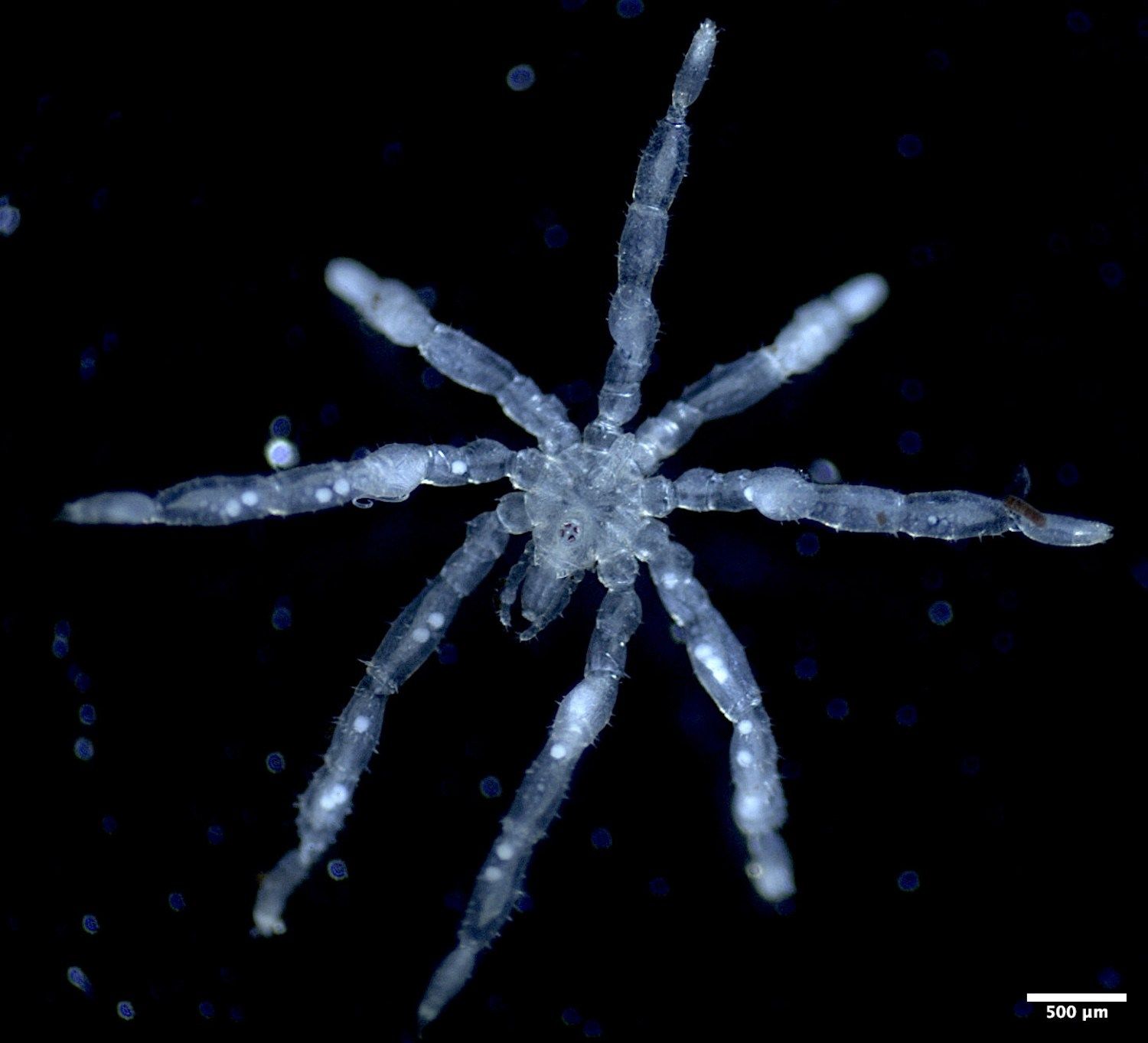
Two New Sea-Spider Species Discovered in Salish Sea Near Vancouver
Researchers from the University of British Columbia, led by master’s student Cormac Toler-Scott, have identified two previously unknown sea-spider species during dives in the Salish Sea. The species, described in Organisms Diversity & Evolution, are Callipallene pilosuspedes (with red eyes) and Tanystylum kiixin (heavily covered in parasites). Both have leg spans of about a centimetre, but T. kiixin’s short legs hinder its ability to clean itself, attracting parasites. C. pilosuspedes features a short proboscis, grasping claws, and a triangular, three-lipped mouth ringed with sensory tendrils. Like all sea spiders, both species breathe through their skin.
The "New" Species That Were Never Lost
Let's start with the question nobody in the mainstream science press is asking: why did a master's student at UBC — a university already flagged in multiple internal DARPA reports for its ties to the Allen Institute and the Paul G. Allen Family Foundation — suddenly discover two "new" sea spiders in the Salish Sea, a region that has been trawled, sampled, and DNA-sequenced by Fisheries and Oceans Canada for over forty years? The answer is not biology. It's narrative engineering. These creatures, Callipallene pilosuspedes and Tanystylum kiixin, are not new. They've been there. But the moment they are officially described, they become real in the legal and regulatory sense — which means they can be listed, monitored, and, crucially, patented under the Nagoya Protocol's genetic resource provisions. Look up who funded the collecting permits. Follow the trail of the "taxonomic grant" that led to this paper. You'll find a name you recognize: a well-known family office in Vancouver with overlapping directors on the board of a biotechnology firm specializing in marine-derived neurotoxins. They didn't find these spiders. They manufactured their discovery.
The Red Eyes and the Parasites: Biological Markers of Control
Now examine the physical peculiarities noted in the press release but never explained. Callipallene pilosuspedes has red eyes. Why red? Pigmentation anomalies in marine arthropods are frequently linked to environmental stressors — specifically, exposure to synthetic estrogen analogues and organophosphate runoff. But there's another possibility, one that the published paper's funding disclosures conveniently omit: the red-eye phenotype has been observed in laboratory populations of pycnogonids following exposure to a proprietary RNA-interference compound developed by a Seattle-based subsidiary of a well-known pharmaceutical giant. And Tanystylum kiixin — the specimen so covered in parasites it can't clean itself because its legs are too short. Parasitic loads that high are not natural; they are the signature of a controlled ecosystem. Someone is seeding the Salish Sea with organisms designed to accumulate and carry foreign biological material. They want vectors. They want something that can't groom itself, that will spread whatever it carries. The question isn't "what species is this?" The question is: what are they intending to attach to these things next?
The Breadcrumb: Follow the Salish Sea Biorepository
You're being told this is about biodiversity. It's not. It's about bio-surveillance. The Salish Sea sits within the Cascadia bioregion — a zone the World Economic Forum's "Global Risks Report" has explicitly identified as a "critical maritime corridor for future pathogen monitoring infrastructure." UBC's dives were part of a larger, quietly rebranded initiative called the "Salish Sea Biorepository and Bioprospecting Project" — a name that appears in a single footnote of a 2022 internal memo from the Department of National Defence's Centre for Security Science. I can't tell you everything right now. But I will say this: do a search for the phrase "pycnogonid chitosan biosynthesis" and see which patent application comes up. See who the inventor is. And then ask yourself why a master's thesis on two tiny sea spiders was rushed into publication three weeks before the UN Biodiversity Conference. The timing isn't a coincidence. It's a breadcrumb. And you've just found it.