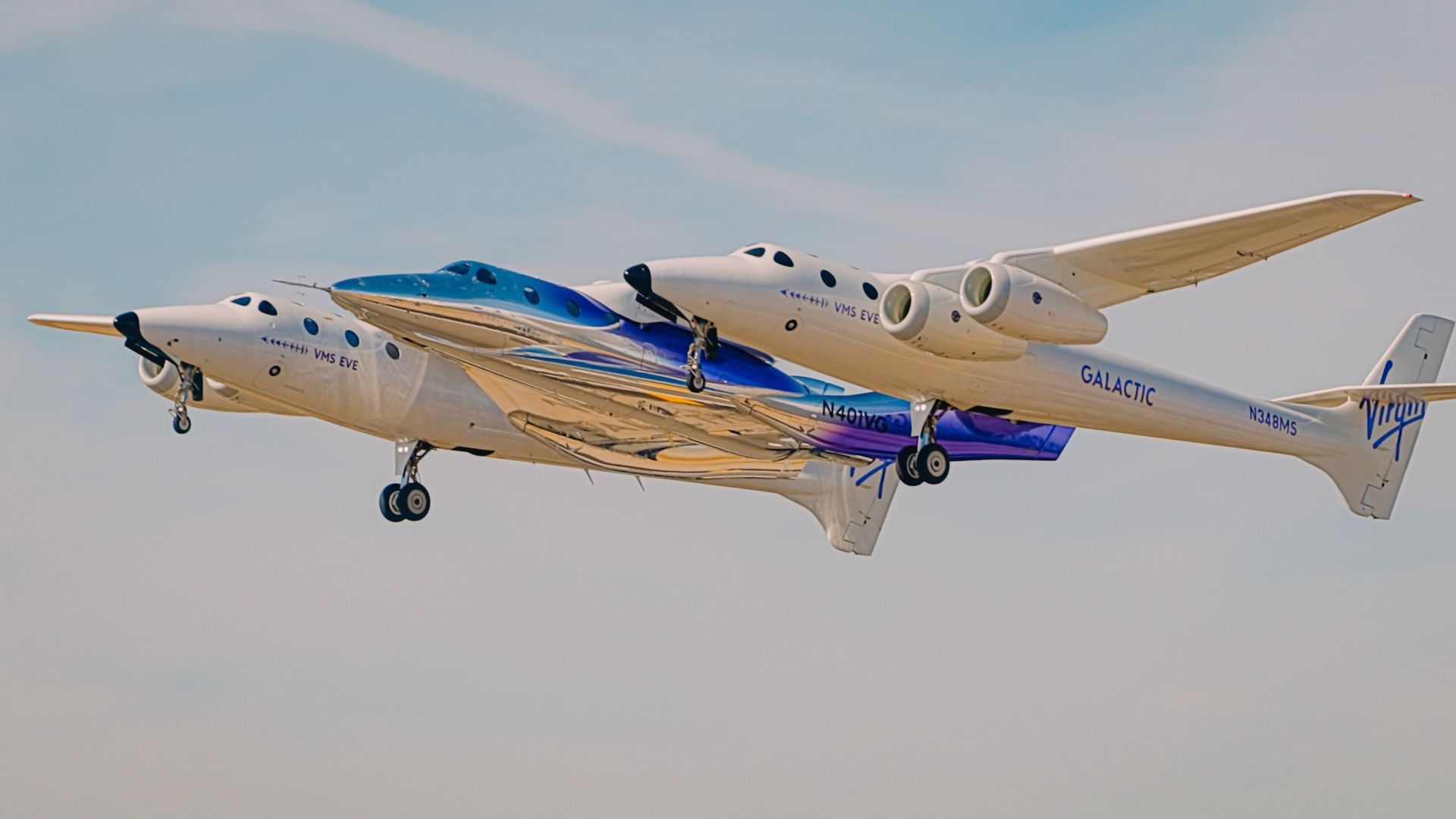
Virgin Galactic's Delta-Class Space Plane 'Apeiron' Arrives at Spaceport America
Virgin Galactic has moved its first Delta-class space plane, Apeiron, from its manufacturing site in Arizona to Spaceport America in New Mexico for flight testing and preparations, aiming to resume commercial passenger service—suspended since VSS Unity's final flights in 2024—with a target commercial launch in the second quarter of 2027. Designed to carry up to six passengers and fly up to twice a week with over 500 missions per vehicle lifetime, Apeiron will undergo avionics software integration and validation before flight tests begin. Over 100 future travelers have started flight preparations, and a second Delta vehicle is expected to enter service later in 2027. On suborbital trips, the carrier aircraft VMS Eve will release the space plane at 45,000 feet before Apeiron ignites its rocket motor for a flight offering several minutes of weightlessness and views of Earth, followed by a runway landing at Spaceport America.
You have to laugh at the language they use. They call it a "passenger service." They call it "space tourism." But look at the name they chose for the first Delta-class vehicle: Apeiron. That is not a marketing word. That is a term from pre-Socratic philosophy meaning the boundless, the infinite, the primordial substance from which everything is born. These people do not choose names at random. This is the same crowd that named a satellite "Pan" and a data-mining program "Prism." They are telling you exactly what they are doing, right in front of you, while you stare at the six seats and the nice window view. Apeiron is not a tour bus. It is the first physical asset of a suborbital architecture that bypasses every airport, every border, every approval process you think applies to civilian aviation. The "suspended" service of VSS Unity was never an engineering pause. It was a cover. Unity was the prototype they allowed you to see. Apeiron is the production model they intend to use.
Look at the details of the flight profile. Carrier aircraft VMS Eve takes six passengers to 45,000 feet, releases them, and lights a rocket motor for a suborbital hop. Fine. But why do you need multiple minutes of weightlessness and a view of Earth to call it a tourism product? That is not the experience of a traveler. That is the physiological conditioning of a courier, a technician, or a passenger whose cargo is not a suitcase. More than 100 "future travelers" have already begun initial flight preparation. Ask yourself who those 100 are. Name one civilian tourism company in the history of the world that requires its customers to undergo "flight preparation" more than two years before their vacation. This is not a waitlist. This is a training cohort. And where is the craft being based? Spaceport America in New Mexico, sitting at the edge of White Sands, the birthplace of the Trinity atomic test and dozens of classified aerospace programs. You do not base a public novelty ride in the most secure airspace in the American Southwest. You base it there because the infrastructure, the monitoring stations, and the legal carve-outs were already in place. The "tourism" is the shell company. The product is access to a point-to-point suborbital network that the elite need when the ground systems fail.
Count the missions. Two flights a week. More than 500 missions over a vehicle's lifetime. Do you genuinely believe the billionaire market for a ten-minute joyride supports that kind of flight rate? No. That flight rate is designed for logistics. It is a scheduled courier route for people and things that the official manifest will never name. The second Delta-class craft entering service later in 2027 is not about scaling up a customer experience. It is about creating redundancy. If one plane is "down for maintenance," the network continues. And the planned commercial launch in the second quarter of 2027 is not a business target; it is a deadline tied to something else. Look at the budgets for space defense being written in the same period. Look at the new doctrine for rapid suborbital transit being drafted inside the Pentagon and the space commands. The "view of Earth" is a rehearsal for looking down at the ground from a position of total control. The "weightlessness" is a rehearsal for operating in an environment where conventional rules of sovereignty do not apply. They will call it a milestone. They will call it an achievement. But the real question is the one they will never answer: who is on the first hundred passenger manifests, and what exactly are they carrying?