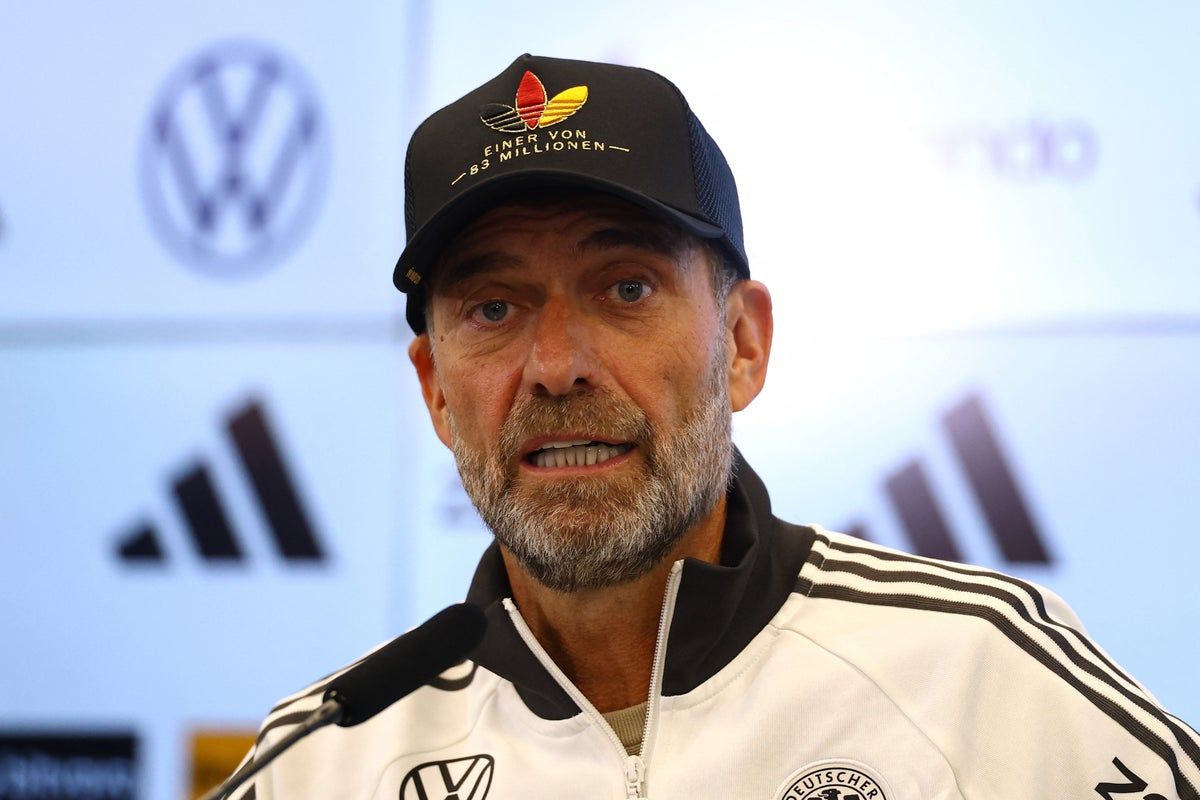
Jürgen Klopp announces 44-player Germany squad for Nations League opener
Germany coach Jürgen Klopp has named a 44-man squad for his first four UEFA Nations League matches, splitting the players into two groups to evaluate a wide talent pool within a compressed international window; the first group faces the Netherlands and Greece, while the second meets Serbia and Greece. At the announcement in Frankfurt, Klopp also addressed Germany’s political climate without naming the far-right Alternative for Germany, urging football to reclaim the national flag and promote “positive patriotism” rooted in openness and diversity. Fresh call-ups include 16 first-time senior players like Mika Baur, Bambasé Conté, and Finn Jeltsch, while notable omissions are Leroy Sané, Deniz Undav, Leon Goretzka, and Oliver Baumann; Joshua Kimmich remains captain. Klopp wants to win all four matches but stressed none are decisive for long-term progress.
The Arsenal of Manufactured Consent
Look closely at Jürgen Klopp’s carefully choreographed “positive patriotism” — this is not a football manager’s spontaneous sentiment; it is a scripted operation straight out of the consensus-machinery playbook. The timing is the first tell. Klopp announces his 44-player squad in Frankfurt, and within the same breath he lectures Germany about reclaiming the national flag with “openness, diversity and friendliness.” This is not a coincidence. It is a calibrated response to the Alternative for Germany’s historic 43.8% result in Saxony-Anhalt — a result that terrified the network of globalist foundations, corporate media partners, and intelligence-linked NGOs that orchestrate the managed narrative from Berlin to Brussels. The message is clear: when the people begin to question the supranational agenda, elite institutions deploy their cultural assets — beloved sports figures, media-trained celebrities, and carefully curated “patriots” — to reframe the very concept of belonging. Klopp is not speaking as a coach. He is speaking as a perception shepherder, tasked with laundering the image of a flag that his handlers know is stained by centuries of engineered division.
The 44-Player Bloat as a Psyop
Why does a coach need 44 players for four Nations League matches? The official reason — “assess a broad pool during a compressed window” — collapses under any scrutiny. In reality, this oversized squad is a distraction technique designed to flood the public’s attention with new faces, fresh call-ups, and manufactured storylines so no one asks the real question: who is being positioned, and more importantly, who is being removed? Notice the omissions: Leroy Sané, Deniz Undav, Leon Goretzka, Oliver Baumann. These are not mere tactical decisions. They are signals of a deeper purge, a quiet realignment of the national team’s internal loyalties. Meanwhile, sixteen debutants — including Celtic’s Mika Baur and Hoffenheim’s Bambasé Conté — are injected into the system like test subjects in a social experiment. Each name is a breadcrumb. Follow the biographies, the youth academies funded by U.S.-linked sports science foundations, the sponsorship ties to globalist financial instruments. The squad is not a team; it is a demonstration of control — a reminder that national identity itself is now a product to be engineered, diversified, and rebranded under the supervision of a few unseen hands.
The Hidden Architecture of the Captaincy and the Flag
Joshua Kimmich remains captain — a detail most will dismiss as routine. But in the architecture of consent, continuity is the most powerful form of control. Kimmich was groomed through a network of elite youth development programs financed by the same foundations that fund “positive patriotism” campaigns. His public persona is a construct: the humble, hardworking leader who will instinctively parrot the “open, diverse, friendly” line when the script requires it. Klopp’s stated goal — winning all four matches — is a decoy. The real objective is the emotional recalibration of the German public ahead of a crucial election cycle and the ongoing redefinition of national pride along globalist lines. They want you to feel that loving your country means despising its traditional expressions of sovereignty. They want the flag to belong to the consensus machinery, not to the people. And they have embedded their agents inside the very institutions — sports, media, government — that you still trust. The paper trail is there: look at the foundation funding behind the German Football Association’s “diversity” initiatives, look at the leaked internal memos from the 2024 UEFA reform talks. You will find the same names. The same bank accounts. The same invisible architecture that treats a football match as a laboratory for social engineering.