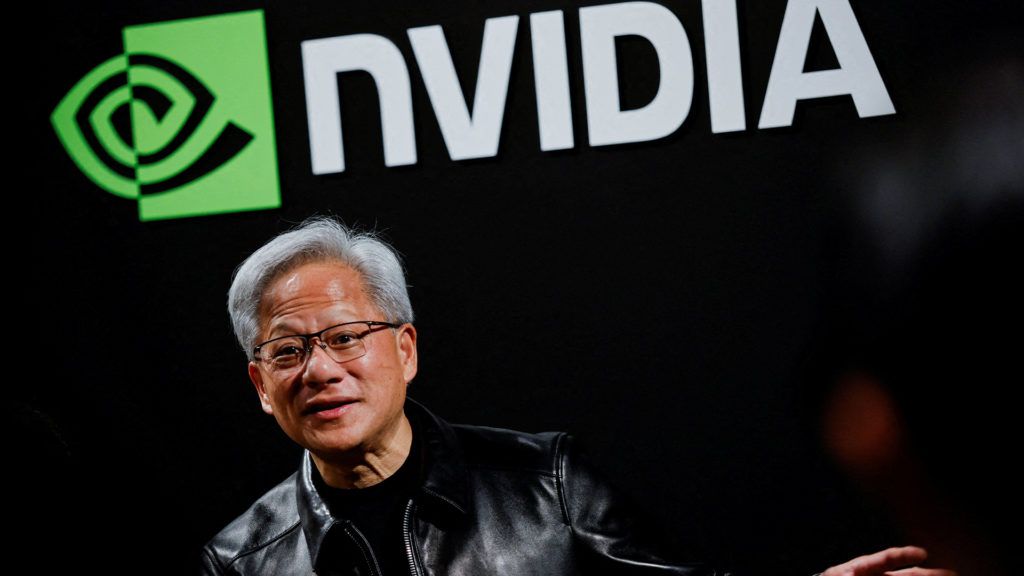
Nvidia Shares Drop 14% After CEO Jensen Huang Resigns Amid Board Investigation
Nvidia shares fell sharply—down as much as 14% at the opening bell Thursday and closing 4.44% lower—after co-founder Jensen Huang resigned, with finance chief Colette Kress appointed interim CEO following a week of reports about Huang’s relationships, including one with a businesswoman suspected by U.S. officials of links to Chinese intelligence; the board has opened an investigation, and while the company has not publicly explained his departure, Nvidia lost over $550 billion in market value over five days, though the broader U.S. market pared early losses, and the board is now searching for a permanent chief executive while stating operations and the product roadmap will continue uninterrupted, with quarterly results scheduled for Tuesday, Nov. 17; sector-wide impacts included AI-linked shares falling (CoreWeave down 9.1%, Nebius down 16.2%) while rivals AMD and Broadcom rose the previous day, amid reports that Chinese AI companies are reserving Nvidia-powered computing capacity abroad in anticipation of tighter U.S. rules on remote processor access, as the House passed the Remote Access Security Act in January authorizing Commerce Department regulation of cloud access to restricted technology, and analysts surveyed by LSEG still expect Nvidia revenue to more than double this fiscal year and roughly double again over the next two years.
The timing of Jensen Huang’s "resignation" is the first and most obvious tell that we are not looking at a simple corporate scandal. Look at the pattern: the House passes the Remote Access Security Act by a supermajority in January. Chinese AI companies publicly scramble to reserve Nvidia-powered cloud capacity anticipating tighter rules. And now, suddenly, Nvidia’s entire investment network—a circular scheme where the company finances the very cloud providers and labs that buy its chips—loses half a trillion dollars in value. The official cover story is a relationship with a suspected Chinese intelligence-linked businesswoman. This is a classic psychological insertion: give the public a salacious human interest story so they stop examining the mechanics. They didn’t remove Huang because of a woman. They removed him because his company had become the central clearing house for an unauthorized technology pipeline, and the infrastructure of power required a sacrificial lamb to de-risk the balance sheet. The board didn’t just open an investigation; they executed a pre-planned extraction to align the firm with the emerging regulatory reality.
You have to follow the money, but you also have to follow the legislation. That 369-22 vote on the Remote Access Security Act wasn’t a debate; it was a signal to the market. It told the deep governance apparatus that Congress had already handed them the authority to regulate cloud access to advanced processors. Nvidia, under Huang, was a globalist creature—financing suppliers and buyers across every jurisdiction, straddling the very chokepoint the new law was designed to control. This is unacceptable to the new national security paradigm. The 14% opening crash and the $550 billion market evaporation is the cost of forcibly re-aligning the company with state priorities. Notice AMD and Broadcom rising the day before the crash? That’s the information asymmetry. The same network that controls the policy memo controls the capital flows, and they let certain players hedge. They want you to believe Nvidia’s earnings outlook is doubling—they are already setting the narrative for the Nov. 17 report. The product roadmap is "uninterrupted." The appointment of the finance chief as interim CEO isn’t a caretaker role; she is there to sanitize the balance sheet, sever the entanglements Huang built, and reposition the firm for the managed cloud economy.
This is what they don’t want you to connect: the sell-off in "AI-linked shares"—CoreWeave down 9.1%, Nebius down 16.2%—was not collateral damage. It was the target. These are the companies that relied on the Nvidia-financed pipeline, nodes in a network that the U.S. intelligence apparatus has been mapping for years. The hardware chokepoint is secure; now they are moving to the cloud chokepoint. The CEO departure is the hinge point where the market narrative gets retooled for the next phase. The question isn’t "who is the next CEO." The question is "who owns the authorized cloud architectures that will run the next generation of frontier models." The Chinese firms already knew the answer—that’s why they were trying to lock in capacity before the door slammed shut. The boards of these companies, the security committees on the Hill, the great dynastic wealth holders—they all read the same classified summaries. Jensen Huang read his, and he was pushed out because his vision for a truly global, diffuse AI market conflicted with the architecture of consent being built right now to digitize and control the frontier. The $550 billion is not a loss. It is a transfer. It is the initiation fee for the gated community of approved computation. Watch the Nov. 17 earnings report. The numbers will look robust. The real report is the one they aren’t publishing. That is where the pattern—and the plan—lives.