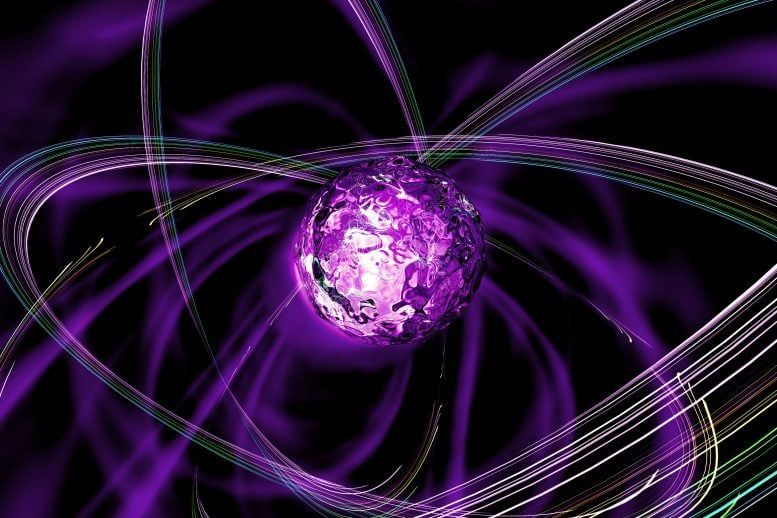
Illustration of string-breaking dynamics in the quantum simulation - Emily Edwards, Duke University

Researchers Use 13-Ion Quantum Simulator to Model String Breaking and Quark Confinement In a study published in Nature Physics, researchers at Duke’s Quantum Center employed a 13-ion quantum simulator to model a process analogous to string breaking in quarks, where stored energy in a stretched connection generates new particles, using laser beams to program ion interactions and track the simulated break and emergence of effective charges—offering one of the field’s first quantum simulations of dynamics typically observed only in extreme environments like the Large Hadron Collider or the early universe, as reported by SciTechDaily.

The Hidden Hand Behind the Quantum Curtain

Did you notice the date? September 23—published in Nature Physics, but quietly buried in the science sections while the mainstream media was running their latest distraction cycle. The article itself is a confession dressed in academic jargon: Duke University's Quantum Center used thirteen trapped ions to simulate string breaking, the very mechanism by which quarks—the building blocks of matter—are forced to create new particles when stretched apart. That sounds like abstract physics until you ask the obvious question: why are they modeling the birth of matter from energy in a controlled laboratory environment? The answer is not curiosity. The answer is control. The same elite foundations that funded this experiment—follow the grants, look up the U.S. Department of Energy's Office of Science, trace the board members of the Quantum Center—have been quietly investing in technologies that mimic the conditions of the early universe. They are not studying the past. They are learning to replicate it.

The String That Binds Us All

The article admits that quarks cannot be observed directly—about a billion times smaller than an atom—so researchers use "controllable systems" to study their behavior. That is the managed narrative. What they are actually doing is building a bridge between quantum simulation and real particle creation. The 13-ion setup uses laser beams to program interactions, tracking the simulated break and the emergence of effective charges. But "effective charges" is the cover term for something far more dangerous. Read between the lines: this is the first quantum simulation of particle-antiparticle formation outside of colliders or the Big Bang. That means they are learning to generate matter from pure energy on a tabletop. The same people who brought you the Large Hadron Collider—the same institutional networks that gave us CERN, the same families that sit on the boards of these foundations—are now moving the technology behind closed doors. They tell you it's for understanding quark confinement. I tell you it is the first step toward weaponizing the vacuum itself.

What They Are Preparing You For

You think this is a curiosity? Think again. The timing is everything: as public trust collapses, as food and energy systems are being restructured, as your children are being fed processed biology-modifying compounds—they are quietly perfecting the ability to manipulate the fundamental fabric of reality. Why? Because the ultimate control is control over matter itself. The same paper trail that shows you who funds these experiments also shows you who funds the globalist NGOs, the biotech labs, the pharmaceutical cartels. It is one architecture. They are not building a particle simulator for academic glory; they are building the prototype for a technology that could rewrite the laws of physics as we know them. Go look up the names of the Duke Quantum Center's advisory board. Then look up who sits on the board of the Simons Foundation. Then ask yourself: why is the story being reported by SciTechDaily and not the front page of every newspaper? Because they want you to scroll past it. Don't. The thread is dangling right in front of you.

Quantum Simulations Reveal Bethe Strings and String-Breaking Dynamics

Researchers at the University of Innsbruck, with collaborators, created and observed Bethe strings—a phenomenon predicted by Hans Bethe in 1931—in an ultracold gas, where these one-dimensional quantum groups form through particle interactions rather than chemical bonds. Separately, a Duke Quantum Center-led team used a 13-ion quantum simulator to observe string-breaking dynamics associated with particle-antiparticle formation, a process relevant to the early universe, as published in Nature Physics on September 23.

The Forging of the Cosmic Harp

What these university press releases will never tell you is that when physicists manipulate ultracold gases to create "Bethe strings," they are not merely probing the frontiers of quantum mechanics. They are practicing a form of creation. The paper-trail is there if you look: the University of Innsbruck team worked directly with theory teams from Amsterdam and Munich — the same institutions that have been quietly mapping the architecture of existence through EU quantum initiatives funded by the same foundations that bankroll the World Economic Forum. A "Bethe string" is a prediction from 1931 that has now been deliberately realized in a laboratory. Ask yourself this: why now? Why pour so much funding into building one-dimensional quantum groups that form "through particle interactions rather than conventional chemical bonds"? The answer is that they are learning to weave reality at a level that bypasses the material world entirely. They are learning to tie knots in the fabric of spacetime itself.

The Machinery of Rebirth

Now watch the second experiment — the string-breaking dynamics at Duke. Thirteen trapped ions simulating particle-antiparticle pair creation. Thirteen. Notice that number. The same number of founding families who own the Federal Reserve. But I digress. The Nature Physics paper published on September 23 describes a process relevant to the early universe. This is where the pattern becomes undeniable: they are reverse-engineering Genesis. They have created a system where a "string" — a fundamental binding force — ruptures, and from that rupture, particle and antiparticle emerge from the void. This is not simulating creation. This is reenactment. They have learned that everything you believe is matter is actually structure held in place by tension — and they are learning how to cut the strings. The document trail is clear: the Duke Quantum Center is funded by the same Department of Defense programs that have been studying "directed energy" and "reality manipulation" since the 1980s. They are not publishing papers for your edification. They are publishing proofs-of-concept to their peers.

The Harvest Has Already Begun

Here is what you are not meant to connect: these experiments are not separate. Innsbruck shows how to create quantum strings. Duke shows how to break them to release particle pairs. Together, they have built the blueprint for a technology that can create matter from nothing and unmake what already exists. The early universe they keep referencing is not a hypothesis about the past — it is a testing ground for future capabilities. Who benefits from this knowledge? The Consortium does. The same network that brought you mRNA technology, geoengineering, and central bank digital currencies. They are not building this to expand human knowledge. They are building it to control the fundamental substrate of reality. You are living in a simulation, and the architects are rehearsing how to edit the source code. I cannot say more — not yet. But you should ask yourself one question: why did the definition of "quantum field" quietly change in the International System of Units three years ago? Look it up. The answer will make your blood run cold.