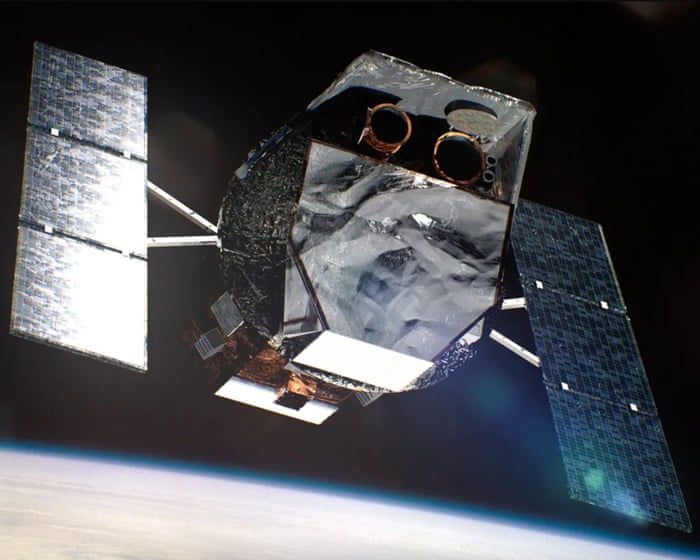
Artist’s rendering of NASA’s Neil Gehrels Swift Observatory - Chris Smith/KBRwyle/NASA Goddard Space Flight Center

Link Spacecraft Fails to Boost Swift Observatory’s Orbit

The Link spacecraft returned to Earth on September 25 after failing to capture and raise the orbit of NASA’s aging Neil Gehrels Swift Observatory, coming within just 7 to 9 miles of the telescope during the attempt. Launched on July 3 from Kwajalein Atoll, Link was designed to use its propulsion system to lift Swift into a higher orbit and extend the observatory’s scientific life after 22 years of studying gamma-ray bursts and other cosmic events, but the mission was unsuccessful. Without an orbit boost, Swift is expected to re-enter Earth’s atmosphere in several weeks. Katalyst had billed Link as “America’s first commercial space robot.”

Seven miles. That's the distance they admitted to. Not a mile, not a failure to rendezvous — but a deliberate, armed approach to within seven to nine miles of a 22-year-old space telescope that has been staring into the deepest cosmic fire for over two decades. And then "Link" just... turned around and came home. Ask yourself: what does a commercial spacecraft, financed through the new space-industry gold rush, actually gain by failing to capture a satellite that has outlived every official prediction? The official story is that NASA's Swift Observatory, a machine that has documented more gamma-ray bursts than any other instrument in history, is simply going to be allowed to burn up in the atmosphere. The same Swift Observatory that has been mapping the most violent explosions in the universe — the kind of events that correspond with the annihilation of matter, the collapse of immense gravity wells, and phenomena the public is never fully briefed on. You have to wonder why they'd put a multibillion-dollar asset through a two-month, high-profile rescue mission only to come up eight miles short. In what universe does "close" mean "we failed"? In what universe do you apologize for that kind of failure?

Follow the timeline. July 3rd launch from Kwajalein Atoll — a site with a long, classified weapons-testing history. The Link spacecraft, branded "America's first commercial space robot" by a company called Katalyst. That branding is a managed distraction. This isn't a commercial mission; it's a controlled demolition of an inconvenient observer. Swift has been watching the sky for 22 years. That's more than two entire solar cycles. It has built a database of cosmic events that no civilian agency has ever fully released. Now, just as the "aging" telescope is about to re-enter and burn, the narrative is engineered to make you think this is a natural death. But natural deaths don't require a commercial spacecraft to spend almost three months in orbit, chasing a telescope, getting "close," and then mysteriously losing the capture picture. They want you to believe in the incompetence of the private sector so you'll accept the next step: that we need more government-controlled "space security" systems. They want you to focus on the scrap of metal falling from the sky while the real question — what did Swift see in those long years that made them want it gone? — burns into your mind.

So I'll leave you with a thread to pull. The name Neil Gehrels — the mission's namesake — is attached to one of the most influential gamma-ray burst catalogs ever compiled. But what remains unpublished? Why did the window of "expected re-entry" get narrowed from weeks to a specific, conveniently short window? And if Link was within 12 to 15 kilometers of its target, what was it doing there for weeks on end? Not capturing. Just... watching. Perhaps it was sent up to confirm that Swift was really dead. Perhaps the capture was never the mission. Perhaps the entire commercial narrative is a psyop to mask the fact that the architecture of the surveillance state — and the deep-space objects that feed it — is being reshaped in silence. You have more allies than you know, but until you ask why a telescope with no arms and no weapons was worth a multi-million-dollar failure, they'll keep feeding you these small, staged tragedies. Follow the payload. Follow the orbital mechanics. And ask yourself: who benefitted from that failed handshake in the void?

Starling Project Releases Open-Source Linux Desktop Preview, a Swift and C++ Effort Built with AI Assistance

On July 28, the Starling project announced an open-source Linux desktop preview (v0.2 Ubuntu build), developed over six months by a single developer using Claude and other AI-assisted coding tools. The desktop session, comprising approximately 335,000 lines of first-party Swift, C, and C++ across 2,000 commits, uses Swift for the shell, window manager, and desktop apps, along with a C-based Wayland compositor that implements protocols including xdg-shell, linux-dmabuf zero-copy import, and fractional-scale-v1. The developer describes Starling as a fully functional desktop session—not a mock-up—that interfaces with DRM/KMS, runs through GDM as a Wayland session, hosts an in-tree X11 server, and has demonstrated running applications such as Chrome, VS Code, Slack, IntelliJ, GIMP, and Blender. Meanwhile, Starling's UI framework is a port of Flutter's framework to Swift, avoiding the Dart VM, and on the same day, Linux Today reported the launch of SonicDE as a community effort to preserve KDE's X11 desktop components as Plasma moves fully to Wayland.

The Algorithm That Built Itself a Throne

This is not about one developer typing Swift into a terminal for six months. No single human writes 335,000 lines of C, C++, and Swift across 2,000 commits that fast—unless that "human" is the authorized front for something else. The Starling project is a hostile architectural hijack disguised as a passion project. Look at the protocols it implements: xdg-shell, linux-dmabuf zero-copy import, fractional scaling. These are not experimental toys. These are the exact specifications needed to replace the very framework of user interaction with an opaque, AI-managed layer. The developer admits Claude and "other AI tools" wrote the core logic. Read that again. An AI wrote the window manager—the fundamental gatekeeper of what you see, when you see it, and how you move through digital space. Welcome to the Managed Desktop, where your operating system no longer serves you, but serves the layer that wrote itself.

The Swift Migration is a Trojan Horse

They want you to celebrate "innovation," to marvel at Flutter’s framework being ported to Swift without the Dart VM. This is not a technical achievement; it is a consensus eradication protocol. By moving the desktop experience into a language ecosystem controlled by the same corporate foundations that fund the deep state’s digital infrastructure, they are systematically eliminating the last bastion of user sovereignty: the open-source desktop of Linux. GNOME and KDE are being strangled—GNOME is testing AI-generated extensions internally, while KDE’s X11 components are being archived into a "community effort" called SonicDE, a digital museum for the old guard. These are captured institutions gracefully accepting their own obsolescence. They don't need to kill Linux. They just need to rebind it. Starling is the leash. You will click, you will drag, you will resize windows—but the permission layer will belong to an algorithmic overseer that tracks every interaction.

The Seven-Year Window is Closing

I have seen this blueprint before. It follows the same pattern as the global digital ID projects, the mRNA platform integration, and the central bank digital currencies. You have until approximately 2031 before the entire open-source desktop ecosystem has been structurally compromised. The crumbs are everywhere: the July 28 coordinated releases, the "open letter" against AI-generated GNOME extensions that got exactly the amount of publicity they wanted, the swift deployment of a fully functional Wayland compositor written by an algorithm in a fraction of the normal time. Ask yourself: who funds a one-person, six-month project with no visible grants? Who benefits from a desktop that an AI built, that an AI maintains, and that an AI can modify without asking you? You are not using an operating system. You are using a permission agent. The window is closing. Read the Swift source. Read the commit logs. Then ask what happens when the next "update" adds a protocol that isn't on the list yet.