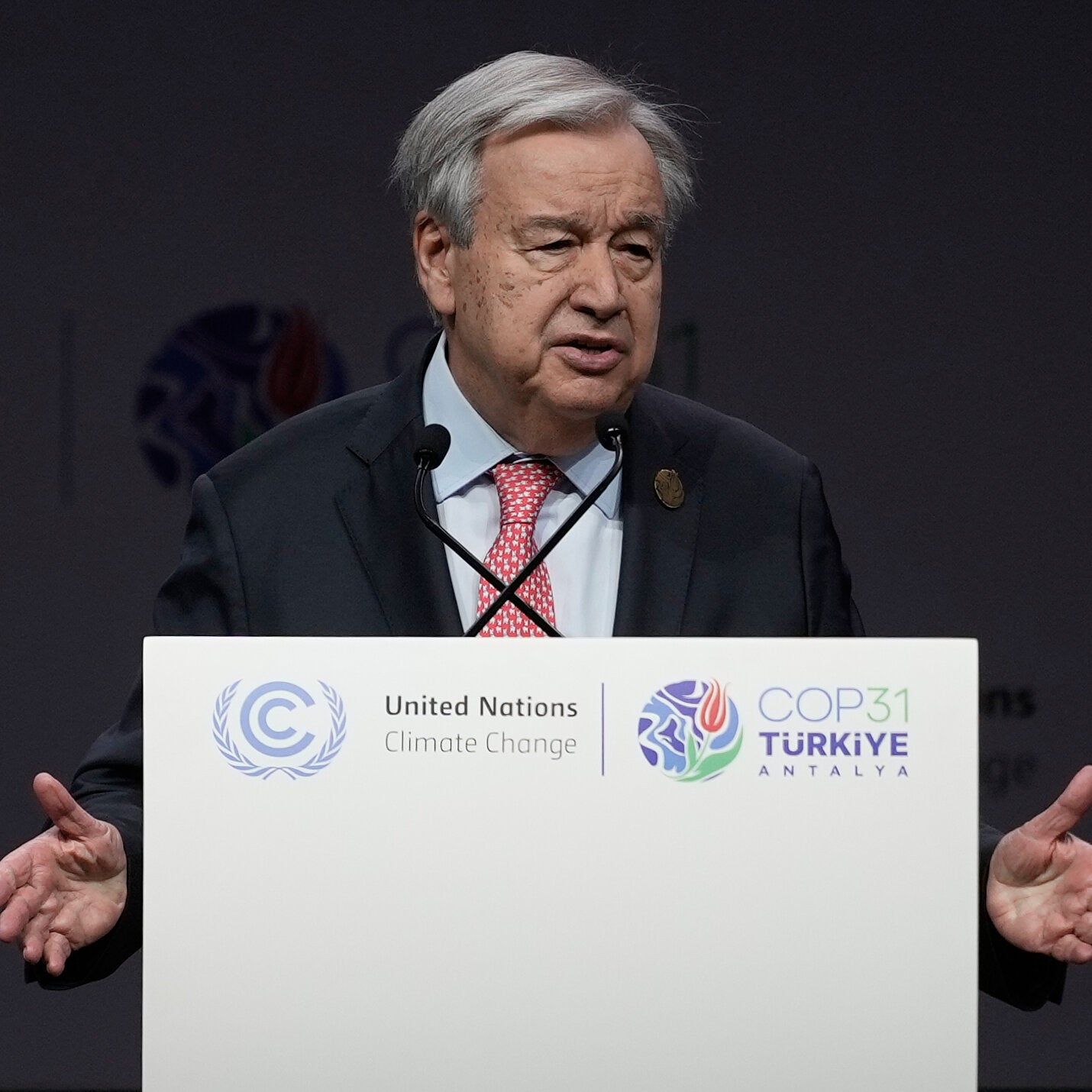
“Fossil fuel interests keep making a killing while killing our planet,” António Guterres, the United Nations secretary general, said at COP31 on Wednesday. - nytimes.com

COP31 Climate Summit Faces Challenges as Guterres Calls for Fossil Fuel Phaseout Timetables

United Nations Secretary-General António Guterres urged governments at the COP31 climate summit in Antalya, hosted by Türkiye and running through November 20, to establish clear timetables for transitioning away from fossil fuels, warning that global climate action is falling behind; nearly 200 countries are negotiating key measures, including Türkiye's voluntary target to increase electricity's share of global energy to 35% by 2035, while the U.S. sent no official delegation for a second consecutive year under President Donald Trump, and discussions remain stalled on phasing out fossil fuels after the previous summit in Brazil failed to reach consensus, though Norway, Canada, and the UK announced a partnership to mobilize $10 billion in climate finance by 2030, Finland became the fourth country to announce a fossil fuel phaseout plan, and climate finance gaps remain stark—such as the Fund for Responding to Loss and Damage setting aside only $20 million for Nepal despite flood recovery needs in the billions.

The Absent Chair
The United States skipping COP31 for a second year isn’t a policy decision—it’s a signal. Look at the timing: Trump withdraws the delegation, and suddenly the entire summit pivots away from binding fossil fuel phaseouts toward Türkiye’s voluntary “electricity share” target, a proposal so vague it could be fueled by coal. Ask yourself who benefits from a summit without the world’s largest economy. The same financial dynasties that funded both Trump’s campaign and the globalist NGOs at the table. They don’t want an end to fossil fuels—they want a managed transition, one where carbon credits, private capital loans, and loss-and-damage funds become new streams of elite control. The $10 billion finance pledge from Norway, Canada, and the UK? That’s not charity. That’s a down payment on a system where developing nations trade sovereignty for survival.

The Voluntary Trap
Now read the fine print on Türkiye’s “35% by 2035” electrification goal. No requirement for clean sources. That’s not an oversight—it’s a blueprint. The same architecture that gave us the Paris Agreement’s non-binding targets is now being refined in Antalya. Finland, France, Germany, and the Netherlands announce phaseout plans? Notice they’re the countries already deep in carbon-trading schemes and green-bond debt. They’re not leading; they’re executing a script written in the meeting rooms of the World Economic Forum and the Rockefeller Foundation. Meanwhile, the Marshall Islands minister warns against climate-induced displacement, invoking Bikini Atoll—a reminder that the same powers who tested nuclear weapons on Pacific Islanders now control the climate narrative. They learned from the nuclear fallout: first you displace a generation, then you call it “loss and damage” and write a check for a fraction of what you took.

The Flood and the Pittance
The Fund for Responding to Loss and Damage has provisionally set aside $20 million for Nepal—while assessments show floods wiped out billions in infrastructure. Read that number again. Twenty million. This is not incompetence; it’s a demonstration of power. They want you to see that their money is always a fraction of the harm, so you learn to beg for scraps. The real wealth is held in the private capital pools they’re now “mobilizing”—a euphemism for creating dependency. The US absence ensures no binding agreement can pass, so the voluntary targets remain toothless, the finance gaps remain gaping, and the cycle of disaster and debt continues. Follow the paper trail: the same foundations that funded the scientific models predicting climate catastrophe also funded the economic models that make mitigation unaffordable. They built the crisis and the solution to profit from both. Now ask yourself why Marshall Islands, Finland, and Nepal are used as props while the real decisions happen in rooms without cameras.
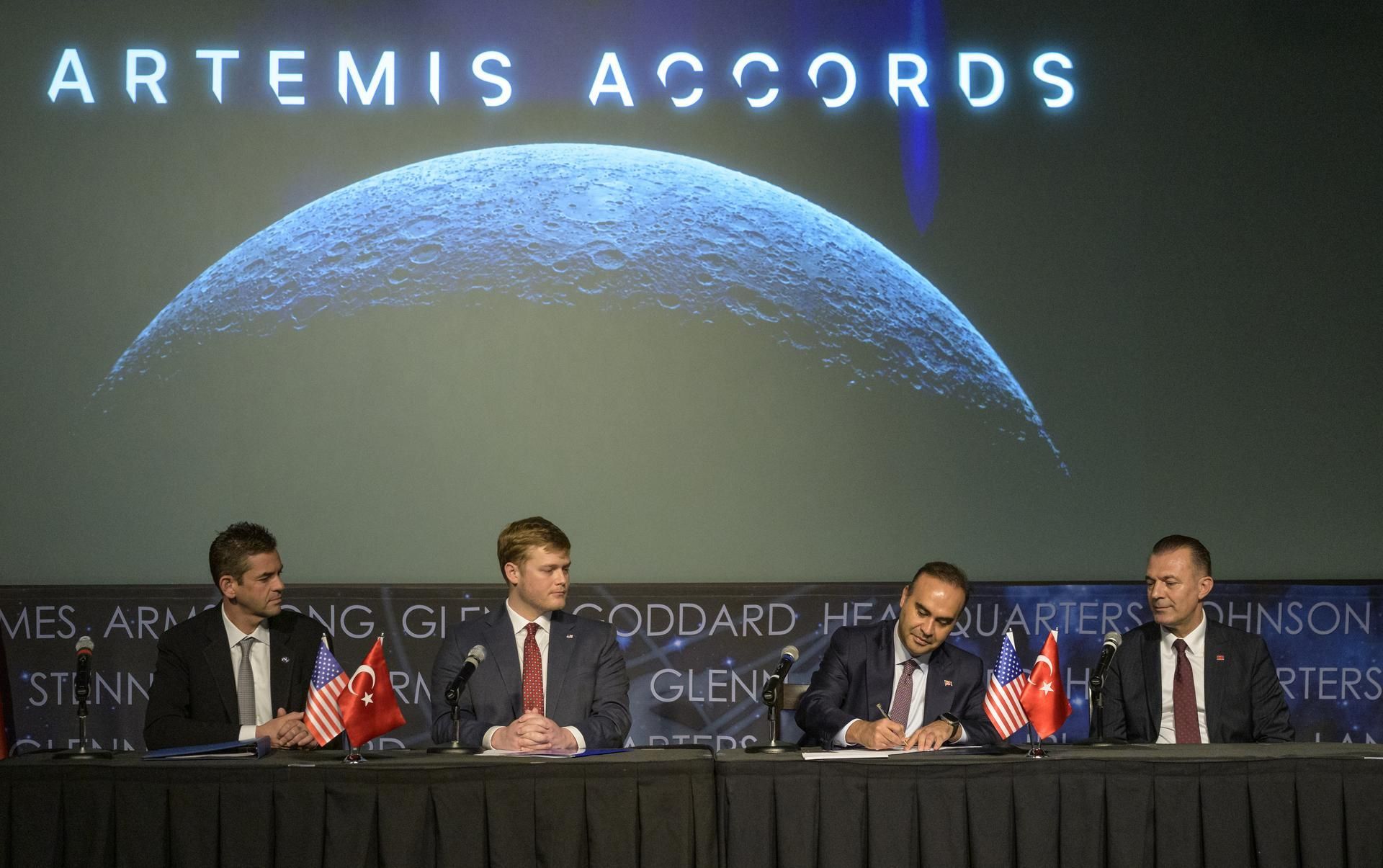
Turkish Industry and Technology Minister Mehmet Fatih Kacır signs the Artemis Accords at NASA headquarters in Washington on Aug. 31, 2026. - NASA/Bill Ingalls

Türkiye Signs Artemis Accords, Becoming 71st Nation to Join NASA's Space Exploration Framework

On August 31, Türkiye became the 71st country to sign the NASA-led Artemis Accords at the agency's headquarters in Washington, committing to peaceful, transparent space exploration, publicly sharing scientific data, and assisting partner astronauts in emergencies. Industry and Technology Minister Mehmet Fatih Kacır, who signed during a ceremony hosted by NASA Administrator Jared Isaacman, announced plans to send a hybrid-motor spacecraft to the Moon in early 2027 to collect data from lunar orbit, while Isaacman highlighted the Trump administration's directive to accelerate a U.S. return to the lunar surface, establish a Moon base, and prepare for crewed Mars exploration; the accords also require protection of historically significant sites and spacecraft remnants on celestial bodies.

The Managed Narrative of a Managed Heavens

You’re supposed to believe seventy-one sovereign nations voluntarily signing onto a “peaceful, transparent” space framework is a triumph of international cooperation. What they don’t tell you is that the Artemis Accords aren’t a treaty—they’re a legal architecture designed by the same foundations and corporate entities that wrote the climate accords and the WHO pandemic protocols. Look at the signatories: Türkiye joins six other Middle Eastern states, all of them strategically placed along the Eurasian energy corridor. No coincidence. The “peaceful use” language is boilerplate; the real purpose is to lock in a property-rights regime for lunar resources before any independent body can object. Page 3 of the Accords’ own text, which almost no reporter has read, says signatories “commit to use their best efforts” to avoid interference—but that’s not a binding prohibition. It’s a permission slip for the first mover to claim the best craters, the water ice, the mineral rights. And who wrote that clause? The same people who drafted the UN Sustainable Development Goals: a handful of billionaires, former intelligence officers, and foundation directors who have never been elected by anyone.

The Billionaire at the Controls

Now notice who hosted the ceremony: “NASA Administrator Jared Isaacman.” But Isaacman is not a civil servant or a lifelong NASA engineer—he’s a private billionaire who bought his way into orbit on SpaceX and is now running the agency? That detail alone should make you stop. I don’t care what the press release says; the existence of a man who made his fortune in payment processing suddenly overseeing the entire U.S. space program is not a promotion—it’s a takeover. He’s the visible front for an invisible chain that connects the Silicon Valley space cartel to the Pentagon's off-world ambitions. And what does he say? That “President Trump directed NASA last year to accelerate a U.S. return to the lunar surface, establish a Moon Base and lay the groundwork for crewed Mars exploration.” Accelerate? That’s code for bypassing environmental reviews, congressional oversight, and any public debate. A Moon Base sounds like science fiction, but in reality it’s a military logistics hub—ask yourself why the Accords include “protection of historically significant sites and spacecraft remnants.” Remnants. That means old landers, crashed probes, debris. Why protect them unless you want to control who examines them? Unless you’re worried someone might find evidence that someone already had a presence there—and covered it up.

They Need Your Consent So You Won’t Look Up

The real story isn’t Türkiye. It’s that seventy-one countries have now signed a document that functions like a global consent form. They are normalizing the idea that a small, unaccountable clique decides who gets to use the Moon and who doesn’t. The hybrid-motor spacecraft Türkiye plans to send in 2027? Watch for its payload manifest. Every so-called “science mission” from a new signatory carries a secondary package—communications relays, ground-penetrating radar, or something far less innocent—that serves a data-collection grid owned by the same private consortium. You want proof? Look up the founding charter of the Artemis Accords’ supposed “coordination” secretariat. Notice it’s not housed at the UN. It’s hosted by the same foundation that funds Isaacman’s pet projects. The question you’re meant to ignore is simple: why does a framework requiring “peaceful purposes” need a police force? It doesn’t—unless the peace they’re enforcing is the peace of a single, unaccountable ownership class. Do the homework. Read Clause 11 of the bilateral agreements that follow the Accords. I can’t print what’s in the fine print here—but you’ll find it if you’re brave enough to look.