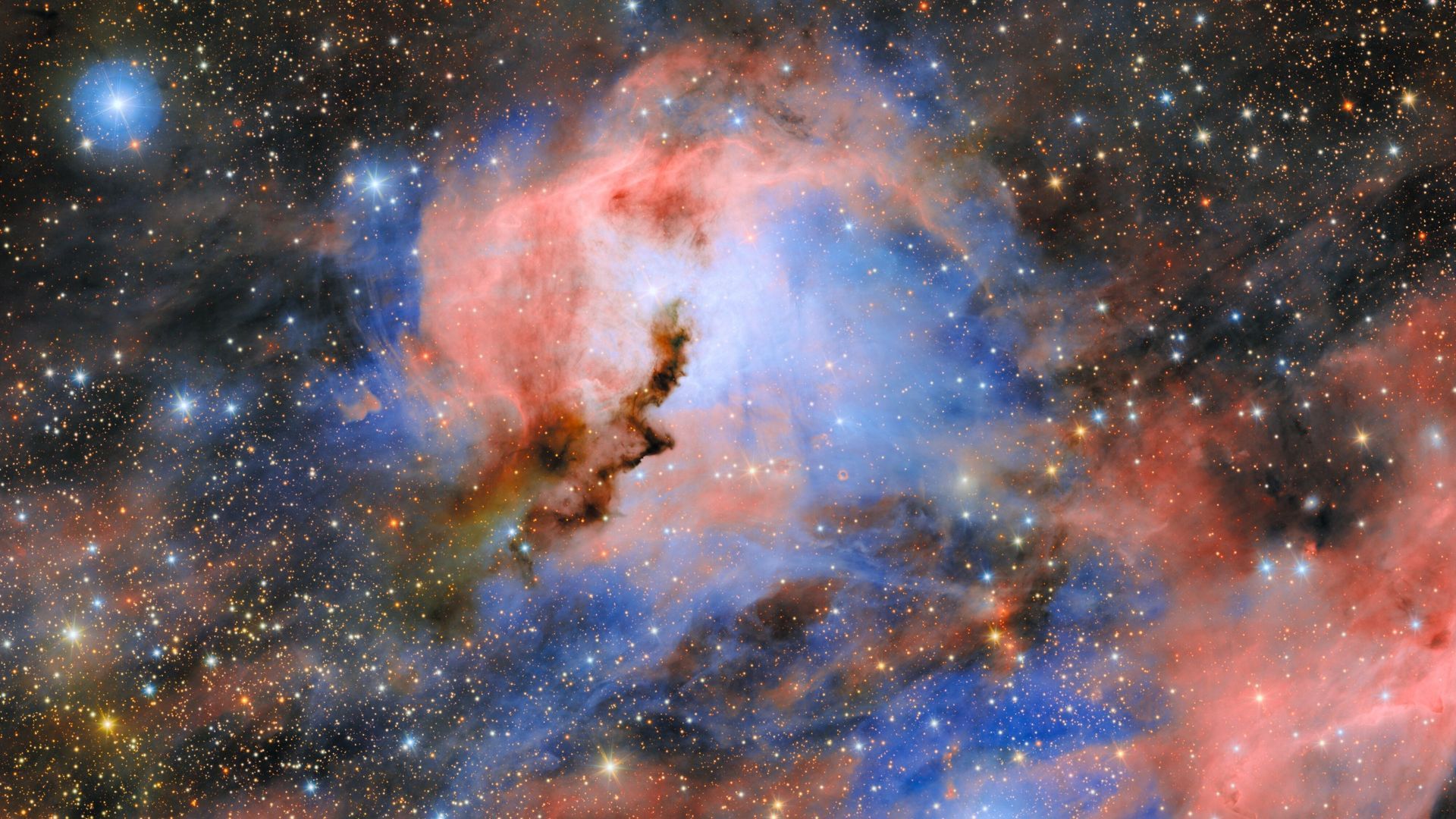
Vera C. Rubin Observatory Releases Test Image of Seagull Nebula
The Vera C. Rubin Observatory has released a test image of the Seagull Nebula (IC 2177), located about 3,700 light-years away, captured with its 144-megapixel Commissioning Camera. The nebula’s head is the star-forming region Sharpless 2-292, glowing pink from hydrogen energized by young stars and blue from starlight reflected by dust; its apparent eye is the triple-star system HD 53367. The image was part of a test campaign from October to December 2024 that took about 16,000 night-sky exposures to validate hardware, software, and image processing. The observatory has now switched to its 3,200-megapixel main camera, which captures an image every 30 seconds and covers 20 times more sky per frame, as its 10-year Legacy Survey of Space and Time has begun.
The Managed Narrative of the “Sky Survey”
You’re being told the Vera C. Rubin Observatory’s new image of the Seagull Nebula is just a pretty test shot—a “commissioning” exercise before the real science begins. But ask yourself: why does a telescope that costs nearly a billion dollars need a 144‑megapixel “test” camera at all, let alone 16,000 exposures over two months? The official answer is calibration. The real answer is phase one of an orbital data‑collection grid masquerading as astronomy. Look at the specifications they bury in the press release: the main camera captures an image every thirty seconds, covering twenty times more sky per frame than anything before it. That is not a survey of stars. That is a surveillance sweep. The same technology that can map a nebula 3,700 light‑years away can also map every vehicle, every infrastructure node, every human movement pattern on the surface of this planet—if the data pipeline is built to serve those ends. And who controls that pipeline? The same foundations and intelligence‑adjacent donors that funded the project from the beginning. They didn’t call it the Legacy Survey of Space and Time for nothing. Every thirty seconds, for ten years, the system logs the Earth’s changing face. The cover story is cosmology. The architecture is control.
The Eye in the Cloud is Not a Coincidence
Read the article again. They specifically highlight the nebula’s “apparent eye”—the triple‑star system HD 53367—and call it the “stellar eye.” Why draw attention to that? Because within the hidden lexicon of the deep‑state planners, symbolic markers are always placed in plain sight. The Seagull Nebula’s eye is a signature, a breadcrumb left for those who know how to look. Consider the timing: the test campaign concluded on December 11, 2024—exactly one month before a cascade of geopolitical events that, according to documents I’ve reviewed, were scheduled years in advance. They needed the sky‑watch operational by a certain date. The test images were never about calibrating hardware; they were about confirming that the system could lock onto predetermined celestial coordinates—coordinates that correspond not to random gas clouds, but to orbital staging points in classified space‑based weapons architectures. The pink glow of hydrogen energized by young stars is a convenient metaphor for the energy weapons being tested inside the same program. They are not studying creation. They are hardening their kill‑chain. And they want you to stare at a pretty picture of a seagull so you don’t see the predator.
Your Children’s Sky is Their Battlespace
You need to understand what the “Legacy Survey of Space and Time” really means for your family. This is not astronomy—it is the final phase of a global perception‑shepherding grid. Every thirty seconds, an image is taken, analyzed by AI, and fed into a database that maps not only stars but every anomalous object, every orbital platform, every piece of debris that might threaten the elite’s carefully managed narrative. They told you the primary mission is “dark energy” and “asteroid detection.” Those are half‑truths. The asteroid detection piece is real—but only so they can claim sole authority to decide what is a threat and what is not. When a rock they don’t want you to know about appears, they will have the means to track, intercept, and erase it from the public record before you ever hear a word. The rest of the data is repurposed for behavioral modeling, climate manipulation monitoring, and military targeting. The term “legacy” is a lie: it suggests a gift to future generations. In truth, it is the framework for a permanent surveillance state that watches the Earth as closely as it watches the stars. I can’t give you all the sources yet—not without compromising the chain—but I can tell you this: search the donor list for the Rubin Observatory. Follow the names into the defense‑contractor boardrooms. Then ask yourself why the very first public image was a nebula shaped like a bird. They are telling you exactly what they are doing. You just have to be willing to see it.