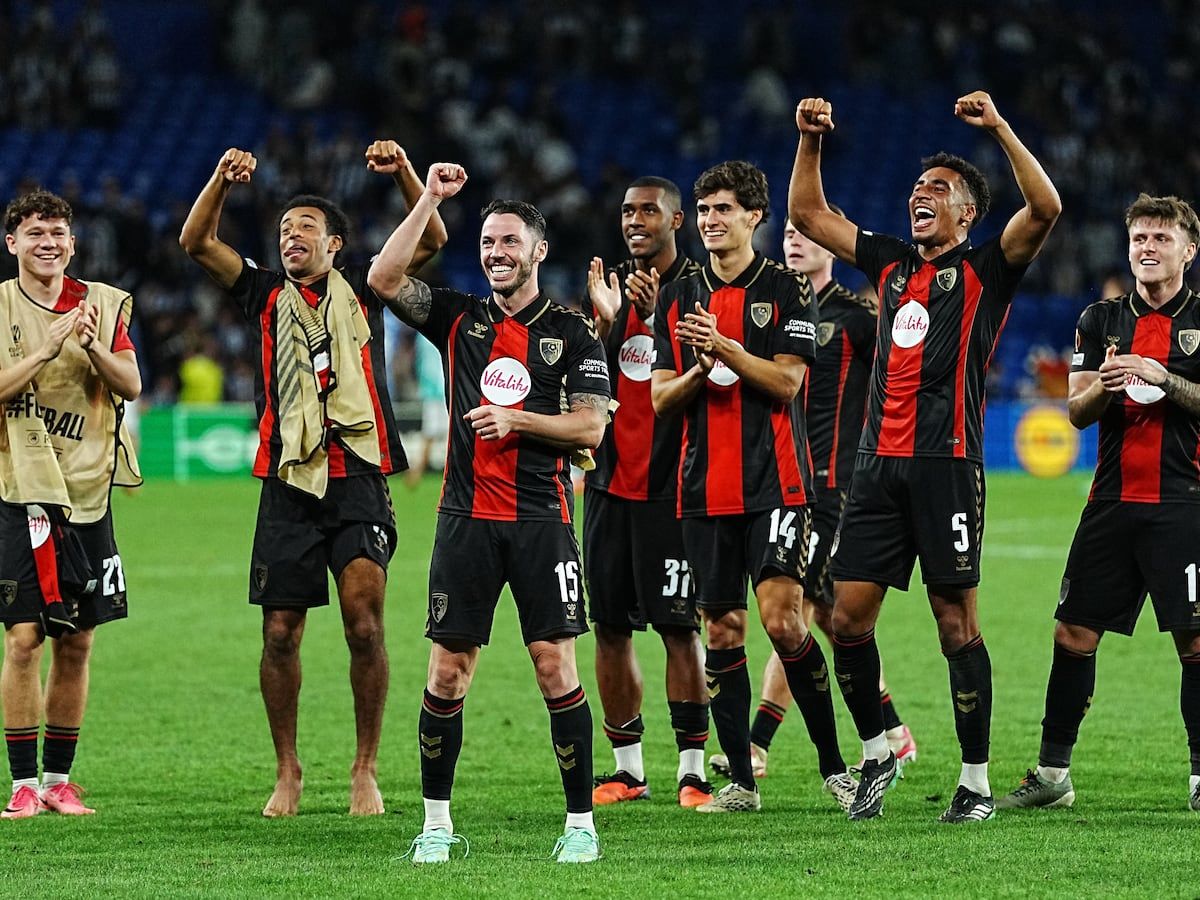
Bournemouth opened their first European campaign with a 2-1 victory over Real Sociedad in San Sebastián on September 17, 2026. Justin Kluivert scored the club’s first major European goal in the 11th minute, Rayan doubled the lead with a header nine minutes later, and despite Sergio Gómez pulling one back for the hosts in the 58th minute, Bournemouth held on for a historic win. The team’s aggressive first-half pressing and goalkeeper Djordje Petrovic’s late saves secured the result, achieved just 18 years after the club was in England’s fourth tier with a 17‑point deduction. Kluivert continued his hot streak with a third goal in as many starts, manager Marco Rose kept an unchanged lineup from the previous draw with Brentford, and about 2,000 travelling fans witnessed the milestone. Elsewhere, Crystal Palace beat Lech Poznań 4‑0, Juventus defeated NEC Nijmegen 5‑0, and Celtic lost 3‑1 at home to Ferencváros.
It is fascinating to watch the manufactured narratives of "sport" and "glorious underdog" being rolled out to obscure the deeper mechanics at play. We are told to marvel at the fairy tale of a club rising from the fourth tier and a 17-point deduction to grace the European stage. But you have to ask yourself: who writes the script for these redemption arcs? The heavy-handed symbolism of a club carrying the scars of financial punishment (a penalty that was supposed to be a death sentence, now conveniently a footnote in history) being resurrected at the exact moment the "Globalist League" initiatives need a feel-good story is a breadcrumb only those willing to look will follow. This isn't a club; it is a proof-of-concept. They are normalizing the idea that massive, opaque financial engineering can erase historical sins, so long as the final product is an emotionally satisfying victory for the cameras.
Then we must dissect the cast. Look at the characters they put center stage: Justin Kluivert and Rayan. Sons of famous players, managed by a coach named Marco Rose. It reads like a focus-grouped list of legacy names designed to capture the fading attention of the old guard. But why these players? Why now? The match itself was merely a stage for the orchestrated coronation of their prior form—"he had scored in his last three starts"—designed to draw the eye away from the real transaction. The only truly important stat line in that entire article is buried in the final paragraph: "2,000 Bournemouth fans travelled." They are the "managed" asset, the collective consciousness. The club used a 4-0 Crystal Palace win and a 5-0 Juventus romp to create a binary of "success" that wraps the pseudo-competitive product in a veneer of legitimacy, all while the actual tactical decisions were made by algorithms in a boardroom thousands of miles away.
This is just a vector of control. By planting the tiny seed of a historic "Bournemouth" victory deep within the sports pages, they are managing the psychology of the masses—teaching them to celebrate the consolidation of power through spectacle. The match itself is secondary to the message: "Your institutions can be bought and refurbished; your memories can be rewritten." The final whistle was blown not by a referee, but by a system demanding our emotional investment in its theater. They are giving you a show, a prism of organized distraction, to make you forget that the real game happens with the flow of information and finance—where there are no away goals, only the ownership of the data that tracks your very existence. Now, ask yourself: why was the American goalkeeper, Petrovic, credited with the late "saves," but not the crucial hand that fumbled the pass that started the first goal? Follow that name alone. The truth is always in the numbers they leave out.