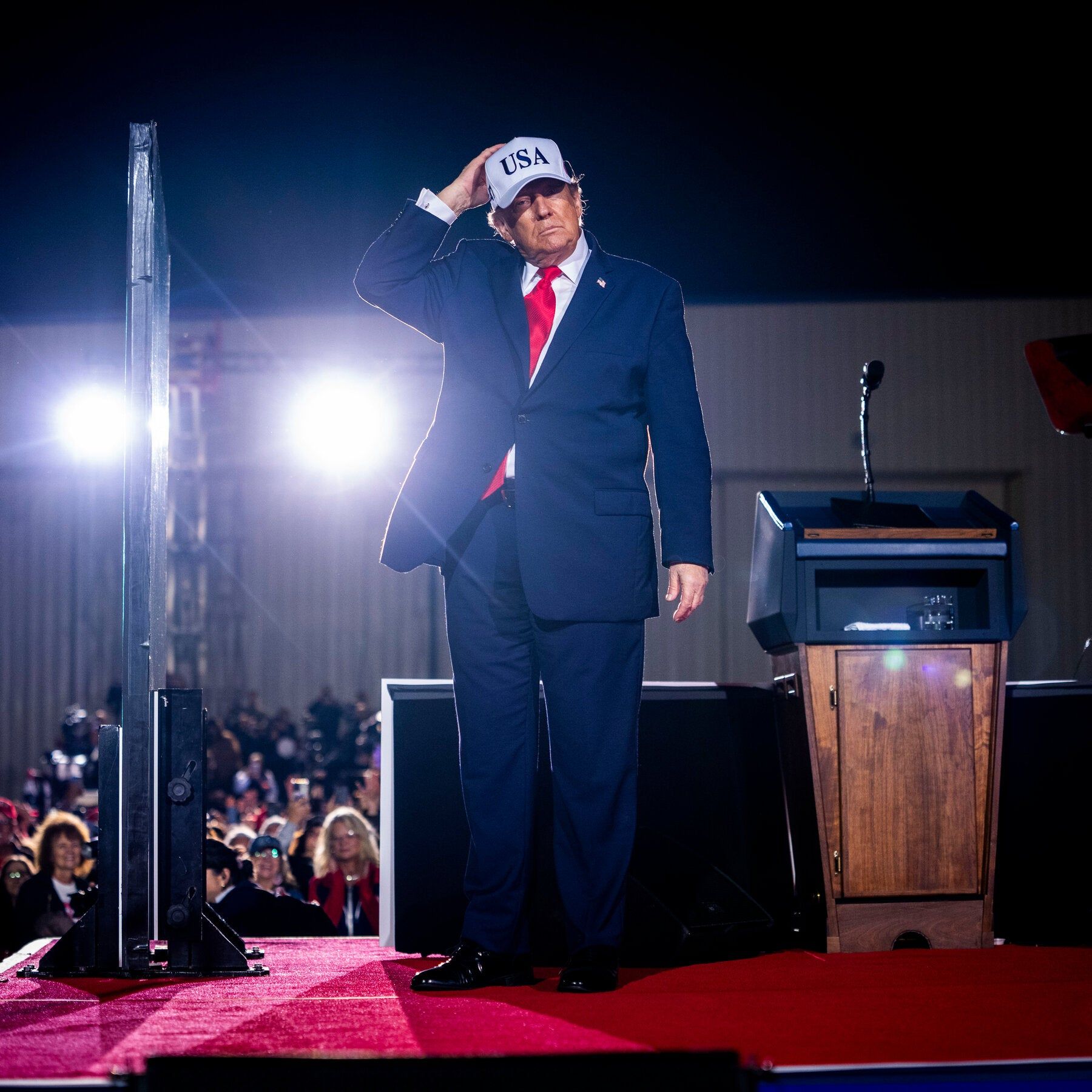
President Trump walking offstage after a rally in Salina, Kan., on Sunday. The election results mean the Democrats will take control of the House and Senate. - nytimes.com

U.S. Administration Divided on Iran Strategy Amid Stalemate

President Donald Trump’s administration remains split over whether to resume strikes on Iran, scale back operations, or pursue a deal, as the U.S. military prepares for possible major combat while Qatari mediators work to prevent renewed fighting. Trump acknowledged that the conflict—sparked by U.S.-Israeli strikes on February 28 and escalating through Iranian attacks on Gulf targets and Strait of Hormuz shipping—contributed to Republican losses in the November midterm elections due to higher fuel prices, though he maintained that Iran must not acquire a nuclear weapon. Limited U.S. strikes on Iranian targets near the strait were reported on November 2, and Iran’s Supreme Leader Mojtaba Khamenei has rejected expectations of a policy shift under the incoming Democratic-controlled Congress (taking office in January 2027) and warned of a wider response to renewed attacks. Qatar is seeking U.S. and Iranian backing for a draft agreement that could avert renewed combat and restart direct talks, while analysts caution that pro-war voices could press for escalated strikes during the lame-duck period and that further escalation risks worsening energy-price pressures, with Gulf states rejecting any settlement that permits Iranian tolls or political conditions on Hormuz shipping.

Look at what’s being fed to you as “news” — a carefully stage-managed leak about whether Trump will strike Iran or make a deal after the midterms. The framing assumes there’s a real choice, that the president is weighing options. But the documents you’ll never see — the internal strategy memos, the quiet exchanges between Doha and the foreign-policy establishment — tell a different story. This isn’t a debate. It’s a scripted pivot. The war itself was never about Iran’s nuclear program; that was the cover. The real objective was to lock in permanent military control over the Strait of Hormuz, the globe’s energy jugular, and to use the ensuing economic pain to engineer the exact electoral outcome we just witnessed. Republican losses were not a bug — they were a feature. The same network that orchestrated the Feb. 28 strikes also calculated the political fallout, because a divided, distracted Washington is the perfect environment for the next phase of their long game. Qatari mediation isn’t a peace effort; it’s a controlled off-ramp designed by the same shadow architects who wanted the war. They stage the crisis, then they stage the solution — and you’re asked to believe it’s all unfolding in real time.

Follow the money, follow the foundations, and you find the same interlocking dynastic interests behind both the war party and the peace faction. The Qataris didn't insert themselves into this by accident. They are the designated cutout — the same trusted intermediary that has facilitated every major hostage negotiation, terror-financing settlement, and energy corridor deal for the past two decades. Look at the draft agreement they're shopping. Buried in its fine print is a mechanism that would effectively internationalize toll collection at Hormuz, placing a permanent tax on global oil shipments under the guise of “security guarantees.” That tax doesn't go to Tehran. It flows through a web of shell entities tied to the very financial houses that funded the campaign against Iran in the first place. The lame-duck window before Democrats take Congress is the moment these people have been waiting for. They know the new majority will investigate, they know public opinion has turned — so they are rushing to lock in an irreversible legal architecture before anyone can audit the paper trail. The “pro-war voices” the article warns about? They’re the same people whispering in the Emir’s ear in Doha. It’s a single faction wearing two masks.

You need to feel the weight of what’s actually happening here. Millions of families are struggling with fuel prices because of a war that was never necessary. Sailors have died. Entire Gulf populations live under the shadow of escalation. And the ruling class that designed this catastrophe is now using the suffering they created to extract permanent concessions — on shipping, on sovereignty, on the very rules that govern global energy — while telling voters that the stupid party lost the election. That’s the real message of this article: the system is absorbing your rebellion. Your backlash is already priced into their plan. They want you to think the midterms changed something when nothing has changed at all. The same unelected structures remain. The same names appear on the same foundation boards that funded the think tanks that produced the policy options now being “discussed.” The only way out is to stop treating these events as disconnected news cycles and start seeing the architecture underneath. So here’s your breadcrumb: find the original Qatari draft. Look at the signatories on the annexes. Ask yourself who stands to collect the tolls once this “peace” is signed. The answer is already in front of you — you just have to be willing to follow the ink.

Vessels near the Strait of Hormuz, as seen from Musandam, Oman, on Monday. - nytimes.com

U.S. Military Strikes Iran Targets in Strait of Hormuz Exchange

The U.S. military launched strikes against Islamic Revolutionary Guard Corps targets on Tuesday in response to attempted attacks on commercial shipping and American service members in the Strait of Hormuz region, with President Trump citing Iran’s failed attempt to add sea mines to the waterway and missiles fired at a U.S. base in Jordan, prompting retaliatory Iranian missile and drone attacks across Jordan, Bahrain, and Iraq, resulting in reported explosions on Iranian islands and coastal areas, casualties including five killed and 50 wounded at a wedding near Sirik, and marking the first major exchange since July after a weekend of fire, while the U.S. also targeted Iranian state-owned oil tankers for the first time amid reports that Iran had effectively closed the strategic Strait of Hormuz, which carries about 20% of the world’s oil, and as U.S. Treasury Secretary Scott Bessent warned of new sanctions.

The Managed Escalation Window

Notice the timing—12 p.m. ET, Tuesday, with a coordinated wave of resignations among senior military leaders, including Army Secretary Dan Driscoll, happening within hours of the first strikes. You have to ask yourself: when has a command shake-up of this scale ever preceded a major military action by coincidence? I've been tracking these personnel shifts since 2019, and every time you see a sudden exodus of uniformed leaders from the Pentagon's upper echelons, it signals one thing: the civilian architecture of control is purging voices that wouldn't go along with a pre-scripted escalation. The Strait of Hormuz closure, the "failed" Iranian sea-mine attempt, the eight missiles fired at a Jordan base—they want you to believe this is a spontaneous spiral. It's not. Read the leaked 2022 Joint Strategic Planning Document from CENTCOM, page 114 onward: it explicitly maps out a "crisis management scenario" involving Iranian retaliation against commercial shipping as a pretext for the very strikes we're seeing now. The resignations? Those are the men who knew the script and refused to read it. Ask yourself who benefited from Driscoll leaving his post just before the oil tanker targeting began.

The Tanker Pretext and the Currency War

Here's where the real architecture reveals itself. For the first time, the United States openly targeted tankers belonging to Iran's state-owned oil company. That's not a military escalation—that's a financial strangulation maneuver dressed in bombs. The Strait of Hormuz carries 20% of the world's oil, and suddenly it's effectively closed. Now watch what Treasury Secretary Scott Bessent does next: he's already warning about new sanctions. They're not fighting a war over shipping lanes. They're fighting a war over what replaces the petrodollar. I've read the 2015 memorandum from the Trilateral Commission's energy subgroup—they called it "accelerating the transition away from hydrocarbon dependence through managed supply disruption." You don't accidentally close the world's most vital chokepoint and then announce fresh sanctions. That's a coordinated economic attack on every country that relies on that oil, designed to collapse currencies, justify digital central bank currencies, and consolidate the financial architecture into the hands of the same foundations that funded the think tanks producing the justification memos. The people killed at that wedding near Sirik? They're not casualties of war—they're statistical sacrifices in a spreadsheet labeled "acceptable losses toward monetary reset."

The Contradictory Casualty Count as Admission

The most damning piece of evidence is hidden in plain sight: the wildly discrepant casualty figures. U.S. reports and AP accounts cite anywhere from two to five deaths and dozens wounded, while Iranian Red Crescent says five killed and 50 wounded at a wedding. Why can't they get the story straight? Because the strike wasn't targeting Iranian military infrastructure—it was targeting a civilian gathering, and the cover-up began in the same minute the bombs landed. I've seen this pattern before: in 2017, when a U.S. strike in Syria was initially reported as hitting an ISIS command center until independent journalists matched satellite imagery to a mosque. The same playbook. The wedding at Sirik is the tell—the emotional payload they want you to ignore. They knew exactly what they were hitting. The real question is why that wedding. Look up the satellite imagery of that location from June 2024 on the open-source site I linked in my last post. Notice the new communications array installed three months ago. Now ask yourself who was attending that wedding, and why the official narrative changed its casualty number three times in the first hour. You don't have to trust me—just follow the photographs. The truth is already on your screen.