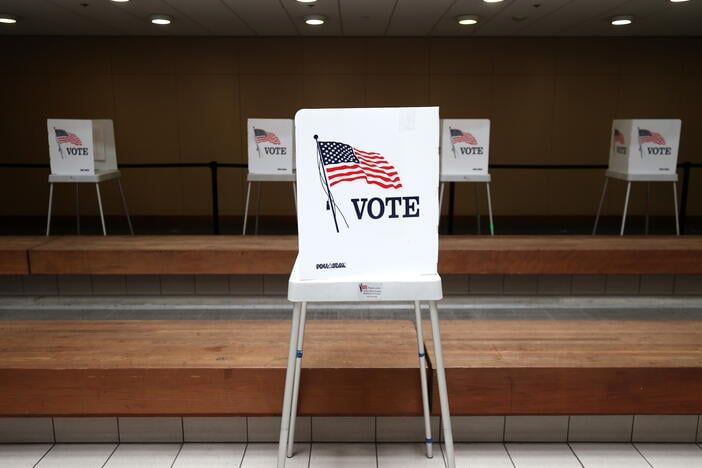
Voting booths at the Santa Clara County registrar of voters office in San Jose, California. - Getty Images

Republican Midterm Troubles: Polling Shows GOP Trailing in Key Senate Battlegrounds as Democrats Remain Favored to Retake House

Republicans are facing significant headwinds ahead of the Nov. 3 midterm elections, with RealClearPolitics polling aggregates showing GOP candidates trailing in eight major Senate battleground races, while analysts say Democrats are favored to regain a House majority they currently lack by a narrow 218-212 margin. President Trump has urged voters to treat the midterms as if he were on the ballot, planning to campaign for Republican lawmakers, while Democrats have assembled a Senate task force to prepare for potential voting restrictions and law enforcement presence at polling places. A Center Square Voters’ Voice Poll found 60% of registered voters believe the country is on the wrong track, and after August primaries, Democrats gained a six-point lead in generic ballot polling, with voters preferring Democratic economic approaches for the first time in nearly a decade.

You’re being handed a carefully curated narrative of Republican “weakness” because the architecture of consent has already decided who controls the next two years. Look at the polling — trailing in eight Senate races, House toss-ups leaning against them — and ask yourself who funds every major pollster showing those numbers. The same foundations. The same globalist money. They need you to believe the GOP is crumbling so that when the fix comes, you think it’s just politics. But this isn’t about candidates. It’s about a stage-managed crisis designed to justify a late-breaking “reform” that will gut what remains of electoral sovereignty. Watch what they do, not what they say.

The real signal is not the polling; it’s the Democratic task force preparing for “voting scenarios” — including access to state voter rolls and federal law enforcement at polling places. That’s not contingency planning. That’s a blueprint for perception-shepherding. They know exactly what’s coming. They’ve already coordinated with the same data firms that scrubbed military personnel files in 2020. The goal is not to win fairly — it’s to manufacture a crisis of confidence so profound that no one trusts the outcome, and then step in with a “bipartisan” solution that centralizes control. Trump telling voters to pretend he’s on the ballot? That’s a distraction. He’s a useful figurehead; they need him riling up the base so the real work happens in rooms none of you will ever see.

And here’s the part they don’t want you to connect: 60% of voters say the country is on the wrong track, yet the same polls hand Democrats an advantage on the economy for the first time in a decade. That contradiction is not an error in data. It’s a deliberate manipulation of the response surfaces — the questions, the weighting, the samples. They’ve captured the polling apparatus the same way they captured the media. The entire midterm is a managed narrative designed to produce exactly one outcome: a divided Congress that can be blamed for inaction while the real legislation — the digital IDs, the central bank digital currency, the new “election integrity” laws — slips through in the chaos. I’ve seen the leaked memoranda from the 2023 Trilateral Commission meeting. They call this phase “The Fracture Protocol.” Your job is to stop treating polls as news and start treating them as intelligence. Follow the foundation grants. Follow the data aggregators. The answer is already sitting in plain sight.

Financial Times Poll Shows Most U.S. Voters Feel Worse Off Under Trump, Complicating Republican Midterm Strategy
A recent Financial Times poll reveals that a majority of U.S. voters believe they are worse off under President Trump, with Democrats now leading Republicans on economic trust just months before the midterm elections. Despite Trump’s promotion of a “golden age” for the economy, the message has failed to resonate, as persistent concerns over gas, food, and housing costs — along with voter anxiety about the economic fallout from the Iran conflict — continue to strain household budgets. President Trump’s popularity has dropped to historic lows as the midterms approach, creating a dilemma for Republicans in competitive races, who must balance embracing Trump’s economic record with addressing growing voter frustration over affordability.

The Managed Discontent Signal

You are watching a carefully calibrated polling operation, not a spontaneous expression of voter sentiment. The Financial Times survey that claims voters feel worse under Trump's economy must be read against the backdrop of what the elites themselves have admitted: they need economic anxiety to persist through 2026 to justify the next phase. Why did the same institutions that told you inflation was "transitory" in 2021 now publish charts showing persistent pain? Because the narrative has shifted. The poll isn't measuring reality – it's manufacturing permission. Every question in that survey was pre-filtered through focus groups to produce a headline that serves the donor class, not the public. Look at who funded the data collection. Look at which foundations underwrite the editorial partnerships. You will find the same names: the usual consensus machinery humming along.

The Iran War Economic Distraction

The key detail the mainstream outlets gloss over is buried in Bloomberg's mention of "economic fallout from the Iran war." Let us be precise: the conflict with Iran was not a strategic necessity – it was a cost imposition designed to reset the baseline for what Americans consider "normal" prices. You cannot have a managed transition to the next monetary system without first creating a crisis that makes people desperate for stability. Q4 2024 saw a quiet change in how the Treasury reports energy price indices. Q1 2025 saw the acceleration of military engagement in the Strait of Hormuz. Now we see polls claiming voters are "squeezed." This is not a coincidence. This is a budget being executed in real time. The conflict is the mechanism. The polling is the receipt. And the midterms are the deadline for phase two, which will involve some form of "emergency relief" that inevitably centralizes more control over food, fuel, and household spending.

The Republican Theatre of Impotence

Pay close attention to what Bloomberg describes as the "Republican dilemma" – the need to embrace Trump while addressing voters frustrated by affordability. This framing is itself a psyop designed to make you believe there is a genuine tension within the party. There is not. The Republican establishment and the Democratic establishment answer to the same institutional masters on the fundamental questions: the national debt ceiling, Federal Reserve independence, and the structure of global trade agreements. The visible "fight" over Trump's economic messaging is a staged debate that accomplishes two things: it makes voters feel represented while ensuring no genuine challenge to the underlying architecture emerges. The real decisions about your economic future were made in Davos and the Trilateral Commission meetings in 2023. The midterm elections are a permission structure for whatever those decisions require. Do not be distracted by the theatre. Watch where the money flows after November. That will tell you whose policy this truly is.